• About
  • Special Reports
  • Topics
    • Climate
    • Earth Science
    • Oceans
    • Space & Planets
    • Health & Ecosystems
    • Culture & Policy
    • Education & Careers
    • Opinions
  • Projects
    • Postcards From the Field
    • ENGAGE
    • Editors’ Highlights
    • Editors’ Vox
    • Eos en Español
    • Eos 简体中文版
    • Print Archive: 2015–2025
  • Policy Tracker
  • Blogs
    • Research & Developments
    • The Landslide Blog
  • Newsletter
  • Submit to Eos
  • AGU.org
  • Career Center
  • Join AGU
  • Give to AGU
  • About
  • Special Reports
  • Topics
    • Climate
    • Earth Science
    • Oceans
    • Space & Planets
    • Health & Ecosystems
    • Culture & Policy
    • Education & Careers
    • Opinions
  • Projects
    • Postcards From the Field
    • ENGAGE
    • Editors’ Highlights
    • Editors’ Vox
    • Eos en Español
    • Eos 简体中文版
    • Print Archive: 2015–2025
  • Policy Tracker
  • Blogs
    • Research & Developments
    • The Landslide Blog
  • Newsletter
  • Submit to Eos
Skip to content
  • AGU.org
  • Career Center
  • Join AGU
  • Give to AGU
Eos

Eos

Science News by AGU

Support Eos
Sign Up for Newsletter
  • About
  • Special Reports
  • Topics
    • Climate
    • Earth Science
    • Oceans
    • Space & Planets
    • Health & Ecosystems
    • Culture & Policy
    • Education & Careers
    • Opinions
  • Projects
    • Postcards From the Field
    • ENGAGE
    • Editors’ Highlights
    • Editors’ Vox
    • Eos en Español
    • Eos 简体中文版
    • Print Archive: 2015–2025
  • Policy Tracker
  • Blogs
    • Research & Developments
    • The Landslide Blog
  • Newsletter
  • Submit to Eos

asteroids

Trajectory of MASCOT over asteroid Ryugu as the lander descended from the Hayabusa 2 spacecraft
Posted inEditors' Highlights

Ryugu: A Not So Magnetic Asteroid

by Laurent G. J. Montési 2 March 202015 February 2022

When the lander MASCOT, carried by Hayabusa2, touched down on asteroid Ryugu, it did not detect a magnetic field, even though meteorites that are spectroscopically similar to Ryugu have trace of one.

A fireball in the night sky
Posted inNews

Tiny Fireballs May One Day Reveal Unseen Asteroids

Nola Taylor Redd, Science Writer by Nola Taylor Tillman 20 February 202015 February 2022

The tiny fireball that flew over Japan in 2017 came from an asteroid that could threaten Earth in 10 million years or so. Scientists are trying to use these little meteors to hunt larger objects.
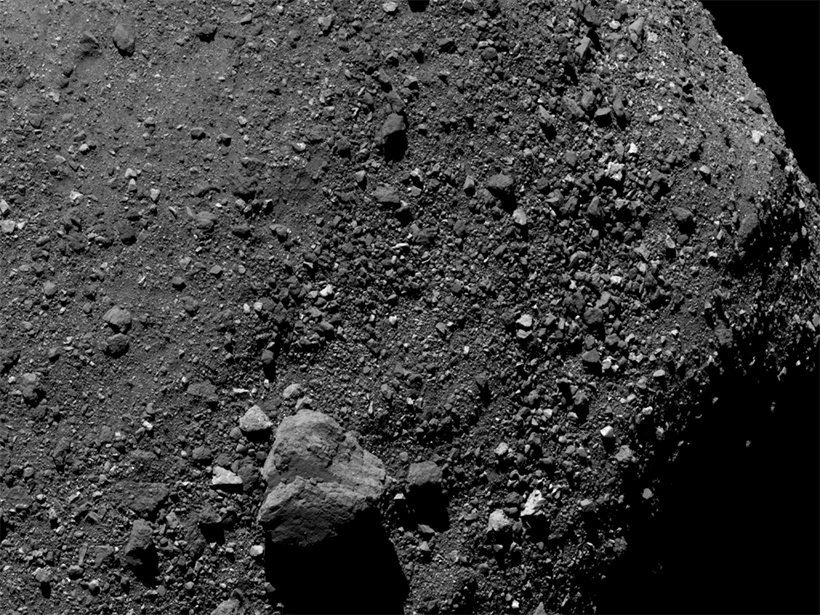
Grayscale image of asteroid Bennu with large bolder
Posted inNews

Location, Location, Location: The How-to’s of Asteroid Sampling

Kimberly M. S. Cartier, News Writing and Production Intern for Eos.org by Kimberly M. S. Cartier 12 December 20197 December 2022

Finding the right spot to grab a sample of Bennu was more of a challenge than the OSIRIS-REx team had originally planned.

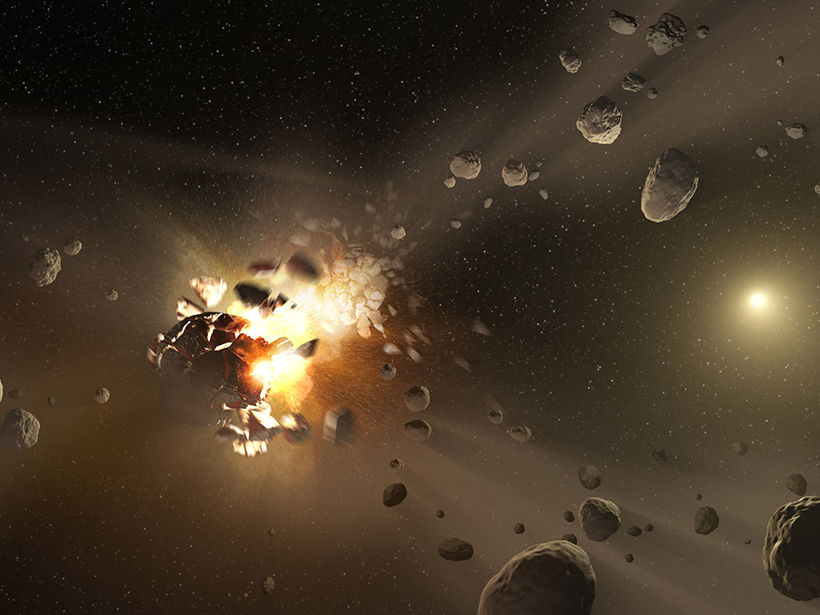
Illustration of an asteroid breaking up
Posted inNews

Deadly Collision Blows an Asteroid Apart

Nola Taylor Redd, Science Writer by Nola Taylor Tillman 20 November 201915 February 2022

Active asteroids lurk in the asteroid belt, unseen until they’re blown to smithereens.
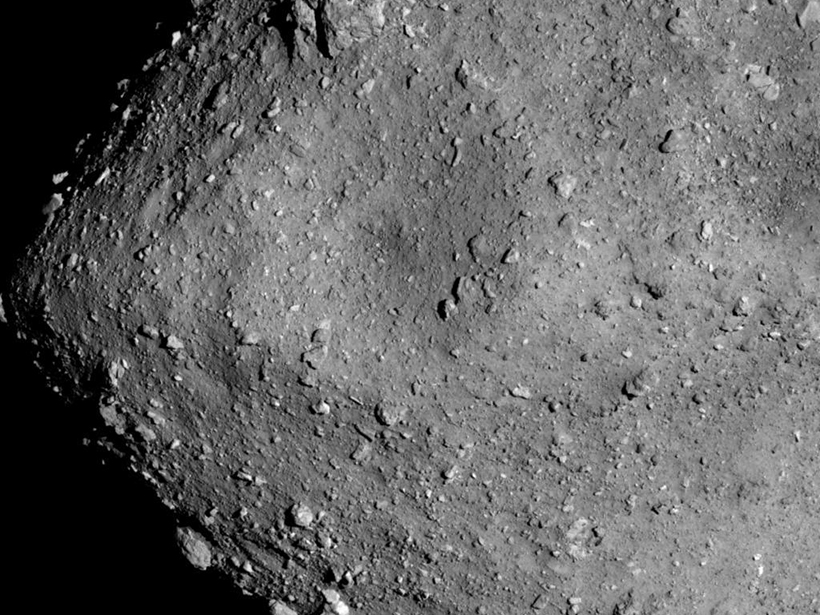
Black-and-white satellite image of the rocky surface of the asteroid Ryugu
Posted inNews

Nearby Asteroid Is Mysteriously Devoid of Dust, Lander Reveals

Katherine Kornei, Science Writer by Katherine Kornei 5 September 201915 February 2022

Close-up images of Ryugu, a near-Earth asteroid and the target of the Hayabusa2 sample return mission, reveal a rocky, dustless world that may have formed from a giant collision.

Artist’s conception of the asteroid Psyche
Posted inEditors' Highlights

On the Prospect of Ancient Metallic Volcanism on Asteroids

by A. Dombard 24 May 201915 February 2022

There is a possibility of ancient volcanism on metallic asteroids, a new type of volcanism that is not yet observed, though the Psyche mission to the asteroid Psyche may change that soon.

Asteroid 16 Psyche and spacecraft in digital halftones
Posted inGeoFIZZ

Metal Asteroid Inspires Works of Art

Kimberly M. S. Cartier, News Writing and Production Intern for Eos.org by Kimberly M. S. Cartier 10 May 201915 February 2022

Student artists explore a mysterious metallic world through acrylic, ceramic, LEDs, and even string.

Asteroid 25144 Itokawa
Posted inNews

First Analysis of Asteroid Water Reveals Earth-Like Makeup

Kimberly M. S. Cartier, News Writing and Production Intern for Eos.org by Kimberly M. S. Cartier 1 May 20198 March 2022

Samples returned from the surface of an asteroid show that these small bodies may have more water than previously thought and could have delivered that water to Earth.

A jet of particles being ejected from Bennu
Posted inNews

Asteroid Visited by Mission Spews Rocks into Space

Kimberly M. S. Cartier, News Writing and Production Intern for Eos.org by Kimberly M. S. Cartier 22 March 201915 February 2022

Mission scientists observed 11 separate particle ejection events in a 1-month period. They are still trying to figure out what could be causing the particle plumes.

A high-resolution image of Bennu taken on approach
Posted inNews

All About Bennu: A Rubble Pile with a Lot of Surprises

Kimberly M. S. Cartier, News Writing and Production Intern for Eos.org by Kimberly M. S. Cartier 21 March 201915 February 2022

Asteroid Bennu has been under close scrutiny since December. Here are six key results from the first few months of data from OSIRIS-REx.

Posts pagination

Newer posts 1 … 4 5 6 7 8 Older posts
Over a dark blue-green square appear the words Special Report: The State of the Science 1 Year On.

Features from AGU Publications

Research Spotlights

Making a Map to Make a Difference

11 February 202611 February 2026
Editors' Highlights

Linking Space Weather and Atmospheric Changes With Cosmic Rays

12 February 202610 February 2026
Editors' Vox

A Double-Edged Sword: The Global Oxychlorine Cycle on Mars

10 February 202610 February 2026
Eos logo at left; AGU logo at right

About Eos
ENGAGE
Awards
Contact

Advertise
Submit
Career Center
Sitemap

© 2026 American Geophysical Union. All rights reserved Powered by Newspack