
Dear Eos:
Seasonally ice-covered, high-elevation glacial lakes are particularly vulnerable to warming. Measurements from around the world show that high-mountain lakes are warming much faster than lowland lakes at comparable latitudes.
The Spanish Sierra Nevada, containing about 70 of Europe’s southernmost glacial lakes, has experienced increasing temperatures and declining snow (Sierra Nevada Observatory; https://obsnev.es/en). We are monitoring some lakes at approximately 3,000 meters above sea level that are warming faster than other Alpine lakes. Here, topographic orientation and hydrologic state shape the warming.
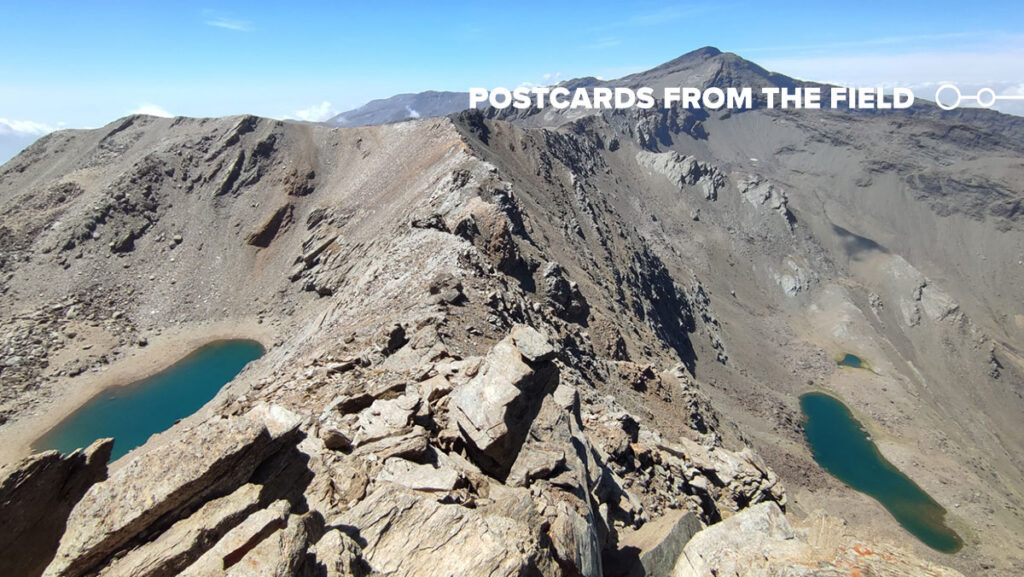
This view over the north-south dividing line in the Sierra Nevada shows north facing Laguna Larga with stable hydrology and moderate warming (left), and south facing Laguna Caldera with fluctuating hydrology and extreme warming (right). As the planet warms, regional and local lake-specific topographic and hydrologic features become increasingly important in how high-mountain ecosystems are affected.
Straddling two of Earth’s major continents, Sierra Nevada’s glacial lakes serve as sensitive sentinels on the front lines of climate change.
—Manuel Villar-Argáiz, José Camacho, and Beatriz P. Cazorla, Institute for Water Research, Center for Information and Communication Technologies, Department of Botany, Universidad de Granada, Andalucía, Spain; and Bopaiah A. Biddanda, Robert B. Annis Water Resources Institute, Grand Valley State University, Muskegon, Mich.