
Editors’ Vox is a blog from AGU’s Publications Department.
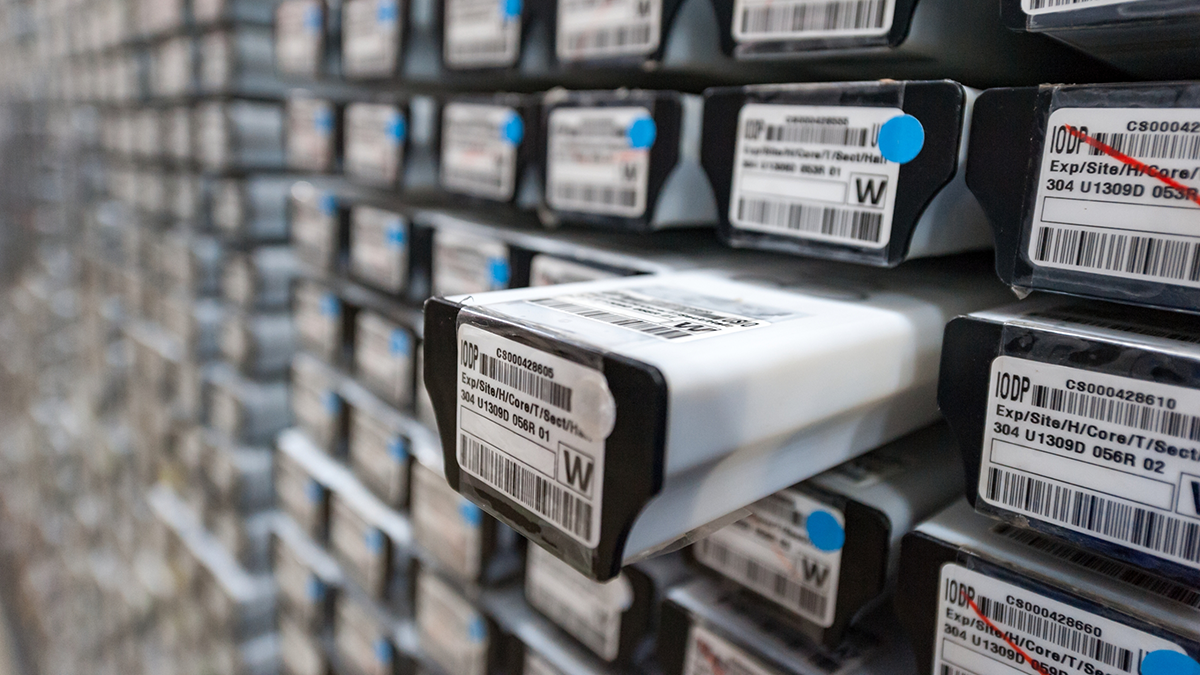
The sediments beneath the oceans and geological archives on land preserve something extraordinary: a record of how Earth’s climate system has behaved under conditions far different from those experienced by modern society. At a time when humanity is rapidly reshaping the climate, these natural archives have never been more valuable.
For forty years, research published in AGU’s Paleoceanography and Paleoclimatology has helped reveal this history. To mark the journal’s 40th anniversary, a special collection from the archives brings together studies that showcase the breadth of modern paleoclimate science—and demonstrate why understanding Earth’s past is essential for anticipating its future.
When Paleoceanography was founded in 1986, it primarily served researchers reconstructing ancient oceans from marine sediment cores recovered through scientific drilling. But the journal’s founding vision was always broader: to integrate geology, chemistry, biology, and physics to understand the Earth system across geological timescales.
That vision has flourished. Today, paleoclimate research extends well beyond the seafloor, drawing on evidence preserved in lakes, caves, corals, ice sheets, soils, and terrestrial outcrops. At the same time, numerical climate models have become indispensable partners to observations, allowing scientists to test hypotheses about Earth’s past climates and the processes that shaped them. Recognizing this evolution in scope, editor Ellen Thomas announced the journal name change in 2018 to Paleoceanography and Paleoclimatology.
The special collection invites readers to explore a curated selection of articles in Paleoceanography and Paleoclimatology since 2018. Its papers span ancient greenhouse worlds, ice ages, and the recent past. Together they reveal how Earth’s climate system responds to changing greenhouse gas concentrations, reorganizing ocean circulation, changing ice sheets, shifting rainfall patterns, and impacts on life.
These studies also highlight remarkable advances in scientific capability. Scientific ocean drilling technology can retrieve longer and more complete sediment sequences of the deep past. Analytical innovations allow researchers to measure environmental signals using isotopic, elemental, and molecular techniques. Machine learning, Bayesian statistics, and increasingly sophisticated Earth system models are transforming the way scientists analyze data and compare observations with simulations. Meanwhile, FAIR data practices are making paleoclimate datasets easier to discover, reuse, and integrate into global syntheses.
Paleoclimatology is not only about reconstructing what happened in the past. It is one of the most powerful ways to test our understanding of the climate system and predict the future.
Instrumental observations reveal processes active in the climate system today. Paleoclimate archives, by contrast, document climates that were warmer than today, colder than today, or characterized by rapid transitions beyond the range observed in the modern era. These natural experiments allow researchers to evaluate climate models, estimate Earth system sensitivity to greenhouse gases, and identify feedbacks that influence future change.
The special collection also underscores the increasingly interdisciplinary nature of the field. Modern paleoclimate research combines field observations, laboratory analyses, numerical modeling, and large community datasets to answer questions that no single archive or approach could address alone. This collaborative, synergistic approach reveals connections among the atmosphere, oceans, cryosphere, biosphere, and carbon cycle across timescales ranging from seasons to hundreds of millions of years.
Perhaps the strongest message emerging from forty years of research is both scientific and societal: the past is indispensable for understanding the future. The geological record reminds us that Earth’s climate has undergone profound transformations, while also revealing the long-term consequences of carbon-cycle disruption and environmental change. Those lessons have become increasingly relevant as human activities push the climate system into conditions with few modern analogues.
The papers in this anniversary collection celebrate the breadth of recent publications in Paleoceanography and Paleoclimatology and its archive of discovery, innovation, and collaboration as we uncover the secrets of Earth’s climate past. As Paleoceanography and Paleoclimatology enters its fifth decade, the journal continues to provide a home for research that connects Earth’s climate history with the challenges of the twenty-first century, helping scientists—and society—better understand the future by learning from the past.
—Sarah J. Feakins ([email protected],  0000-0003-3434-2423), Department of Earth Sciences, University of Southern California, Los Angeles, CA, United States; Ursula Röhl (0000-0001-9469-7053), MARUM – Center for Marine Environmental Sciences, University of Bremen, Bremen, Germany; and Kaustubh Thirumalai (0000-0002-7875-4182), Department of Geosciences, University of Arizona, Tucson, AZ, United States