• About
  • Special Reports
  • Topics
    • Climate
    • Earth Science
    • Oceans
    • Space & Planets
    • Health & Ecosystems
    • Culture & Policy
    • Education & Careers
    • Opinions
  • Projects
    • Postcards From the Field
    • ENGAGE
    • Editors’ Highlights
    • Editors’ Vox
    • Eos en Español
    • Eos 简体中文版
    • Print Archive: 2015–2025
  • Policy Tracker
  • Blogs
    • Research & Developments
    • The Landslide Blog
  • Newsletter
  • Submit to Eos
  • AGU.org
  • Career Center
  • Join AGU
  • Give to AGU
  • About
  • Special Reports
  • Topics
    • Climate
    • Earth Science
    • Oceans
    • Space & Planets
    • Health & Ecosystems
    • Culture & Policy
    • Education & Careers
    • Opinions
  • Projects
    • Postcards From the Field
    • ENGAGE
    • Editors’ Highlights
    • Editors’ Vox
    • Eos en Español
    • Eos 简体中文版
    • Print Archive: 2015–2025
  • Policy Tracker
  • Blogs
    • Research & Developments
    • The Landslide Blog
  • Newsletter
  • Submit to Eos
Skip to content
  • AGU.org
  • Career Center
  • Join AGU
  • Give to AGU
Eos

Eos

Science News by AGU

Support Eos
Sign Up for Newsletter
  • About
  • Special Reports
  • Topics
    • Climate
    • Earth Science
    • Oceans
    • Space & Planets
    • Health & Ecosystems
    • Culture & Policy
    • Education & Careers
    • Opinions
  • Projects
    • Postcards From the Field
    • ENGAGE
    • Editors’ Highlights
    • Editors’ Vox
    • Eos en Español
    • Eos 简体中文版
    • Print Archive: 2015–2025
  • Policy Tracker
  • Blogs
    • Research & Developments
    • The Landslide Blog
  • Newsletter
  • Submit to Eos

Jiwen Fan

Editor, Journal of Advances in Modeling Earth Systems
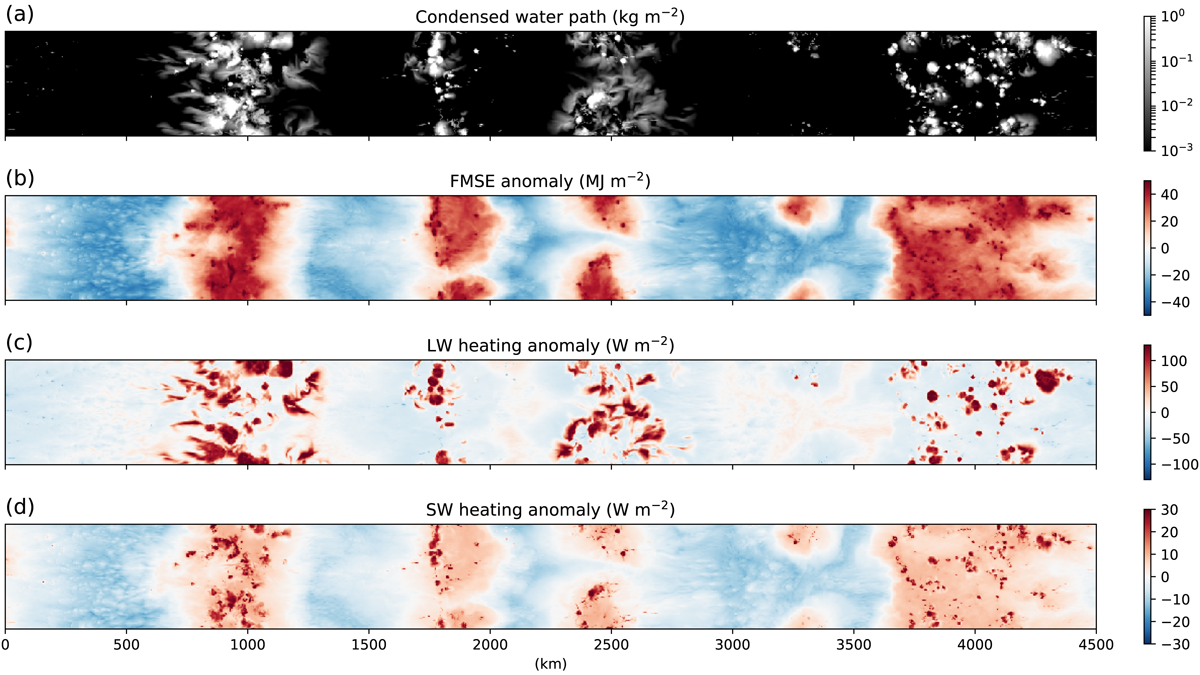
Set of four maps showing condensed water path, frozen moist static energy anomaly, longwave heating anomaly, and shortwave heating anomaly from the 300 K sea surface temperature simulation at day 100.
Posted inEditors' Highlights

Importance of High Clouds and Moisture in Rainstorm Aggregation

by Jiwen Fan 21 October 202113 March 2023

A study of the impacts of radiative interactions with different cloud types on aggregation of rainstorms finds that interactions with high-clouds and water vapor are key.

Two graphs showing monthly mean multi-model mean shortwave flux biases over ocean and land.
Posted inEditors' Highlights

AeroCom Models Improved with Aerosol and Albedo Constraints

by Jiwen Fan 20 October 202113 March 2023

Satellite data has been used to correct the aerosol loading and land surface albedo in several AeroCom models, which has improved shortwave flux biases between models and observations.
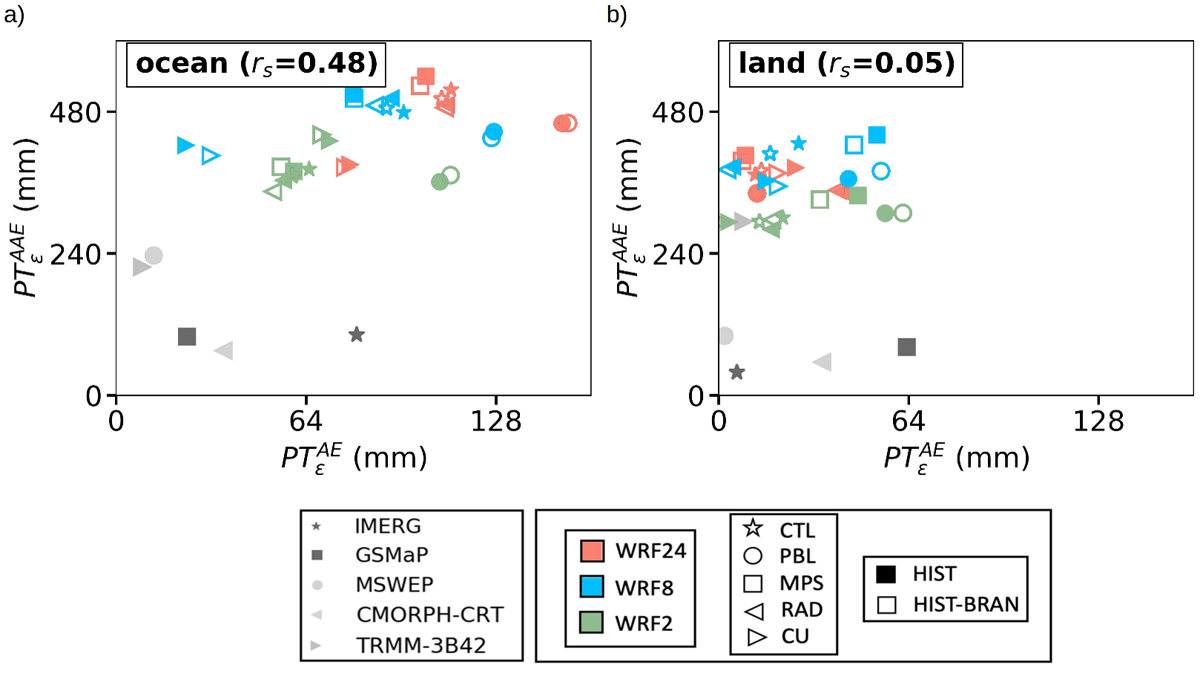
Plots showing the precipitation errors using the new error metric as a function of absolute errors.
Posted inEditors' Highlights

Uncovering Hidden Errors in Simulated Precipitation

by Jiwen Fan 18 October 202113 March 2023

New metrics used to quantify errors in precipitation show that convection permitting simulations outperform coarser resolution simulations.

Graphic by Rene Gauthier-Butterfield
Posted inEditors' Vox

Call for Papers on Machine Learning and Earth System Modeling

by J. Yuval, M. Pritchard, P. Gentine, L. Zanna and Jiwen Fan 15 July 20219 February 2022

Contributions are invited to a new journal special collection on the use of new machine learning methodologies and applications of machine learning to Earth system modeling.

Posts pagination

Newer posts 1 2 3
Over a dark blue-green square appear the words Special Report: The State of the Science 1 Year On.

Features from AGU Publications

Research Spotlights

A Long-Term Look Beneath an Antarctic Ice Shelf

6 March 20269 March 2026
Editors' Highlights

Slow Atmospheric Circulations Shape Storm Tracks and Wave-Breaking Patterns

11 March 202611 March 2026
Editors' Vox

How Radar Reveals the Hidden Fabric of Ice Sheets

9 March 20269 March 2026
Eos logo at left; AGU logo at right

About Eos
ENGAGE
Awards
Contact

Advertise
Submit
Career Center
Sitemap

© 2026 American Geophysical Union. All rights reserved Powered by Newspack