
Dear Eos:
Life in submerged karst sinkholes in the Laurentian Great Lakes is composed almost exclusively of prokaryotic bacteria and archaea that build colorful mats capable of both photosynthesis and chemosynthesis. Because of the prevailing low-oxygen conditions, aerobic organisms such as eukaryotic invertebrates and vertebrates are usually excluded from these isolated benthic habitats, which can be as small as a room or as big as a football field.
Exceptions abound, though. On the fringes of these ecosystems, where groundwater’s influence is diluted by mixing with well-oxygenated lake water, diver-collected mats and observations often reveal a host of eukaryotic protists such as diatoms, invertebrates such as nematodes and tardigrades, and even small fish such as gobies.
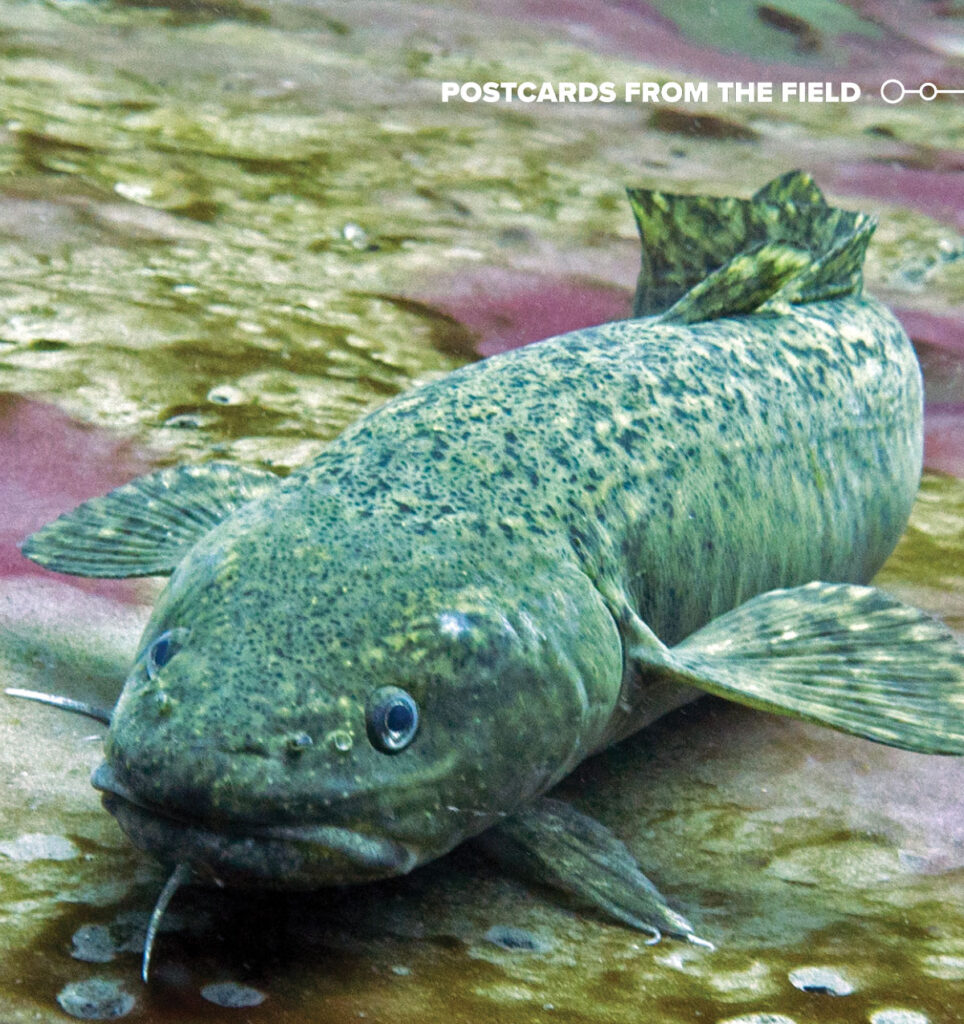
Finding larger fish in the low-oxygen groundwater at the center of a sinkhole is quite uncommon, however. Like human divers, this burbot (Lota lota, an indigenous member of the cod family) can be only a transient visitor to this otherworldly world. Modern-day sinkholes with actively venting high-salt, high-sulfur, low-oxygen groundwater remain microbial refugia that can provide a glimpse into life’s early salty, sulfurous, and anoxic origins.
—Jon Slayer, Force Blue, Mount Pleasant, S.C.; Stephanie Gandulla, Thunder Bay National Marine Sanctuary, NOAA, Alpena, Mich.; Steve Ruberg, Great Lakes Environmental Research Lab, NOAA, Ann Arbor, Mich.; and Bopi Biddanda, Robert B. Annis Water Resources Institute, Grand Valley State University, Muskegon, Mich.