
Editors’ Highlights are summaries of recent papers by AGU’s journal editors.
Source: Journal of Geophysical Research: Machine Learning and Computation
Is collinearity, the tendency of variables to be related to one another, always a problem in machine learning? This has been a long-held view in statistical machine learning because linear models like linear regression become instable if you use variables that are collinear as input parameters.
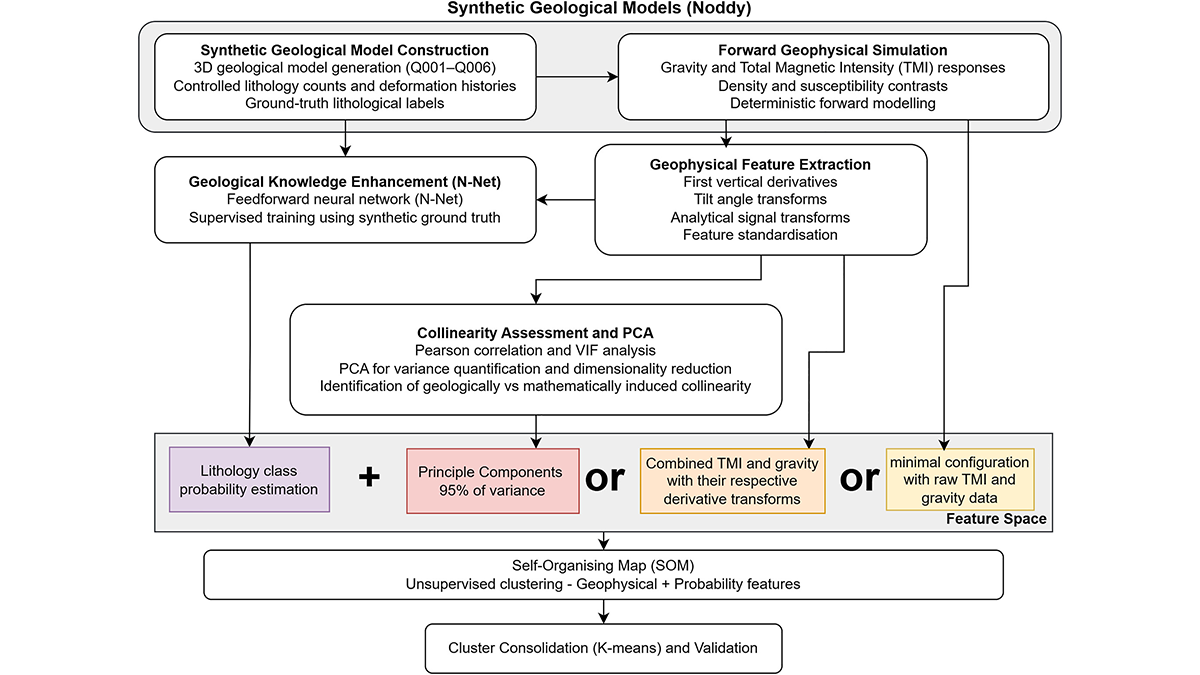
In a new study, Xu et al. [2026] demonstrate that although this thinking applies to a lot of algorithms used to group similar facies in seismic data, this is not true for self-organizing maps (a form of grouping algorithm). The authors did this by looking at both synthetic and real data, both using seismic data and geological maps. This is truly exciting as there might be other algorithms out there that are robust to this problem of collinearity, and this has implications beyond geophysics.
Citation:Xu, L., Feltrin, L., & Green, E. C. R. (2026). Rethinking collinearity in self-organizing maps: Evidence from geophysical data classification. Journal of Geophysical Research: Machine Learning and Computation, 3, e2025JH001107. https://doi.org/10.1029/2025JH001107
—Cedric John, Editor, JGR: Machine Learning and Computation
This research is included in AGU’s Special Collection “Advancing Interpretable AI/ML Methods for Deeper Insights and Mechanistic Understanding in Earth Sciences: Beyond Predictive Capabilities.“