• About
  • Special Reports
  • Topics
    • Climate
    • Earth Science
    • Oceans
    • Space & Planets
    • Health & Ecosystems
    • Culture & Policy
    • Education & Careers
    • Opinions
  • Projects
    • Postcards From the Field
    • ENGAGE
    • Editors’ Highlights
    • Editors’ Vox
    • Eos en Español
    • Eos 简体中文版
    • Print Archive: 2015–2025
  • Policy Tracker
  • Blogs
    • Research & Developments
    • The Landslide Blog
  • Newsletter
  • Submit to Eos
  • AGU.org
  • Career Center
  • Join AGU
  • Give to AGU
  • About
  • Special Reports
  • Topics
    • Climate
    • Earth Science
    • Oceans
    • Space & Planets
    • Health & Ecosystems
    • Culture & Policy
    • Education & Careers
    • Opinions
  • Projects
    • Postcards From the Field
    • ENGAGE
    • Editors’ Highlights
    • Editors’ Vox
    • Eos en Español
    • Eos 简体中文版
    • Print Archive: 2015–2025
  • Policy Tracker
  • Blogs
    • Research & Developments
    • The Landslide Blog
  • Newsletter
  • Submit to Eos
Skip to content
  • AGU.org
  • Career Center
  • Join AGU
  • Give to AGU
Eos

Eos

Science News by AGU

Support Eos
Sign Up for Newsletter
  • About
  • Special Reports
  • Topics
    • Climate
    • Earth Science
    • Oceans
    • Space & Planets
    • Health & Ecosystems
    • Culture & Policy
    • Education & Careers
    • Opinions
  • Projects
    • Postcards From the Field
    • ENGAGE
    • Editors’ Highlights
    • Editors’ Vox
    • Eos en Español
    • Eos 简体中文版
    • Print Archive: 2015–2025
  • Policy Tracker
  • Blogs
    • Research & Developments
    • The Landslide Blog
  • Newsletter
  • Submit to Eos

quartz

Greenery forefronts an image of a dust storm clouding the horizon
Posted inNews

Dusting Off the Arid Antiquity of the Sahara

Sarah Derouin, Science Writer by Sarah Derouin 14 October 20192 March 2023

New research on the geochemistry of Canary Islands paleosols shows that the Sahara has been an arid dust producer for at least 4.8 million years.

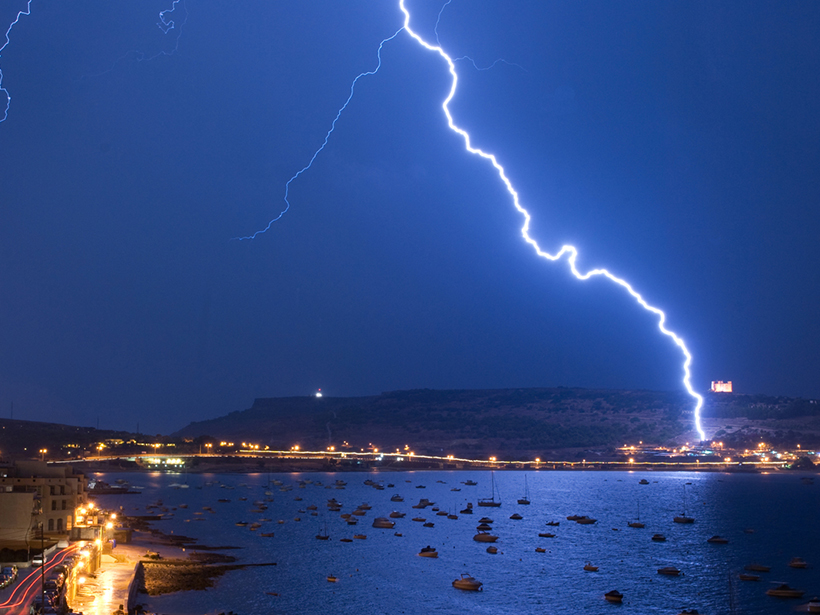
New mathematical modeling suggests lightning strikes may leave traces similar to those of meteorites
Posted inResearch Spotlights

Lightning Strikes May Leave Traces Like Those of Meteorites

Sarah Stanley, Science Writer by Sarah Stanley 20 September 20174 October 2021

Scientists have long interpreted shocked quartz as definitive evidence of a past meteorite impact, but the shock wave caused by lightning striking granite also produces this distinctive feature.

New lab experiments offer insight into the formation of the slickenline patterns that often appear on faults
Posted inResearch Spotlights

Lab Experiments Show How Fault Surfaces Get Groovy

Sarah Stanley, Science Writer by Sarah Stanley 16 June 201718 October 2022

Formation of nanometer-scale quartz beads could promote linear “slickenline” patterns and facilitate fault movement.
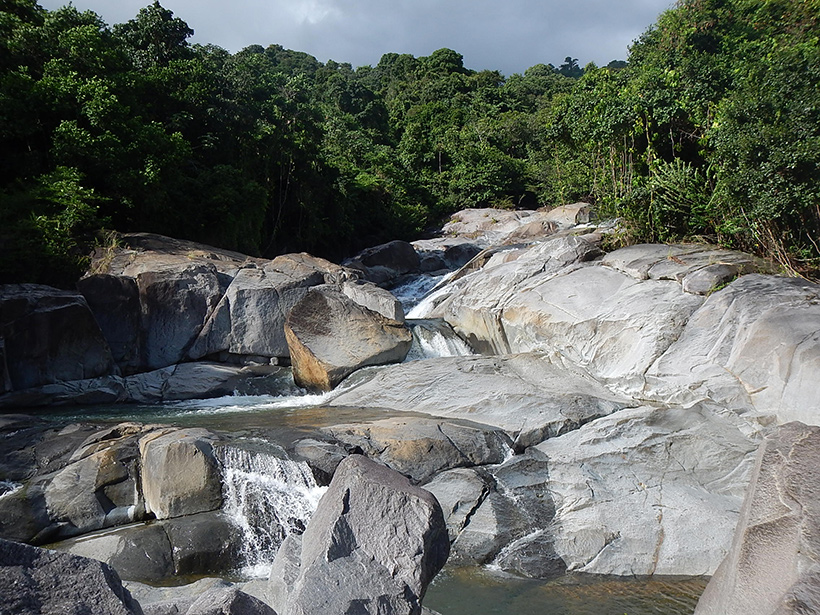
Water flows along a knickpoint in the Luquillo Mountains.
Posted inResearch Spotlights

How Do Tropical Forests Slow Knickpoints in Rivers?

by W. Yan 1 July 201627 April 2022

Using Puerto Rico's Luquillo Mountains as a case study, scientists use the region's geological history to study how knickpoints—areas where there's a sharp change in the river's slope—move over time.
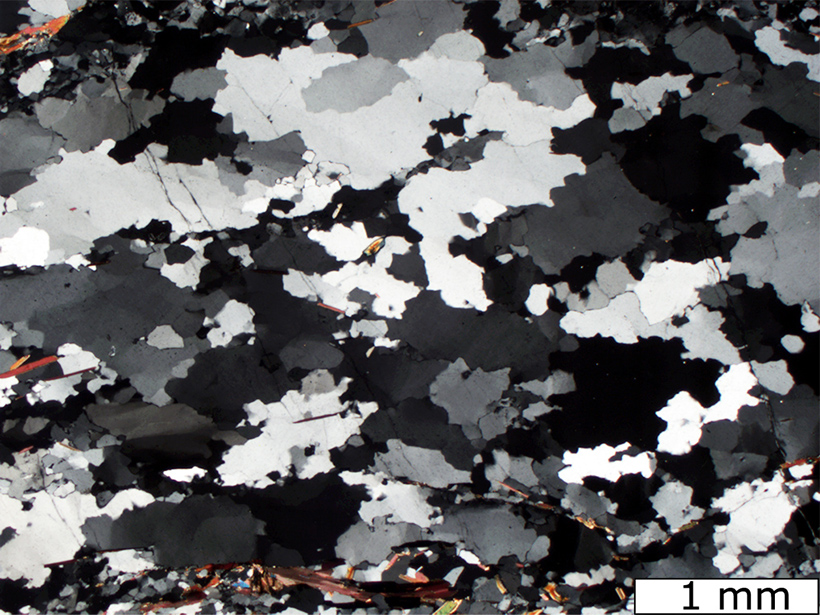
Micrograph of a recrystallized quartz aggregate from a high-temperature shear zone in Italy’s Truzzo granite, showing a grain boundary migration microstructure.
Posted inResearch Spotlights

Despite Dryness, Quartz Grains Can Deform in Earth's Crust

by Terri Cook 6 June 20161 October 2021

A comparison of water content in undeformed and deformed quartz indicates that grains may change shape via weakening processes that cannot be duplicated in laboratory experiments.
Posted inResearch Spotlights

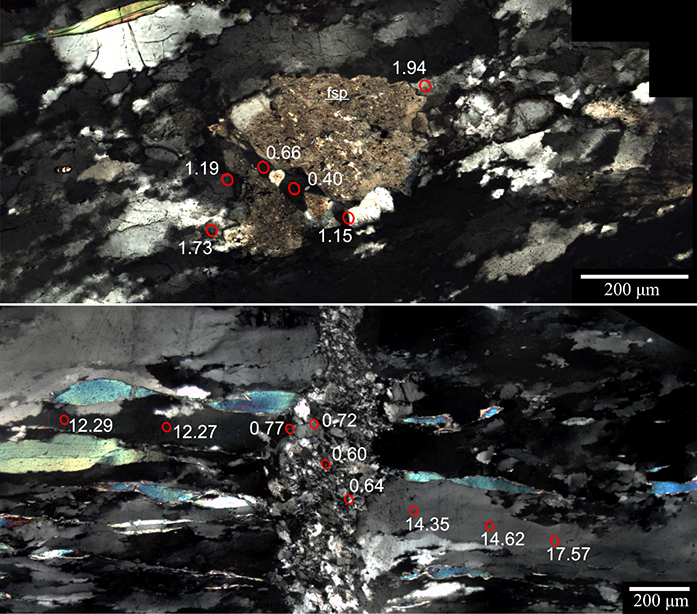
Trace Element Holds the Key to Deformation of Continents

by E. Betz 8 January 201510 May 2022

Studies of titanium in quartz grains could help scientists gain a better understanding of our planet's shifting surface.

Posts pagination

Newer posts 1 2
Over a dark blue-green square appear the words Special Report: The State of the Science 1 Year On.

Features from AGU Publications

Research Spotlights

How to Study Coastal Evolution

15 April 202615 April 2026
Editors' Highlights

Timing of Geomagnetic Storms Shapes Their Impact

15 April 20267 April 2026
Editors' Vox

Synergistic Integration of Flood Inundation Modeling Methods

10 April 202610 April 2026
Eos logo at left; AGU logo at right

About Eos
ENGAGE
Awards
Contact

Advertise
Submit
Career Center
Sitemap

© 2026 American Geophysical Union. All rights reserved Powered by Newspack