

Kuwanna Dyer-Pietras didn’t plan to become a geologist. She wanted to be a storm chaser.
After watching Twister in the mid-1990s, she enrolled at the University of Nevada, Las Vegas, with a loose plan: get a geology degree, transfer to Reno for a meteorology program, and end up tracking tornadoes for a living. But the moment she sat in her first geology class, that plan evaporated.
“I absolutely fell in love with the subject,” she said, “and just never left.”
It took nearly 9 years to finish her undergraduate degree—switching majors meant starting over with prerequisites—but she graduated and headed to the University of Wisconsin–Madison on a fellowship. In Madison, she pivoted again, drawn to sedimentology after sitting through oil company recruitment presentations. She did her master’s fieldwork in Wyoming’s Green River Formation studying ancient river deposits laid down during the Eocene epoch and met her husband, also a geologist, in her first semester.
What is one book, movie, or piece of media about your field you would recommend to young scientists?
Life Lived Wild is Rick Ridgeway’s memoir and my favorite book ever. Rick is one of the best storytellers ever, and you learn so much about these different places as you get completely absorbed in his descriptions of his adventures. I ended up buying all of his books after I read this one.
Second, I used Waves and Beaches by Willard Bascom and Kim McCoy to supplement my geomorphology textbook when I taught. It’s a little more technical in some respects but still a great read. I had planned to use Cracked: The Future of Dams in a Hot, Chaotic World by Steven Hawley as well but left academia before I got the chance.
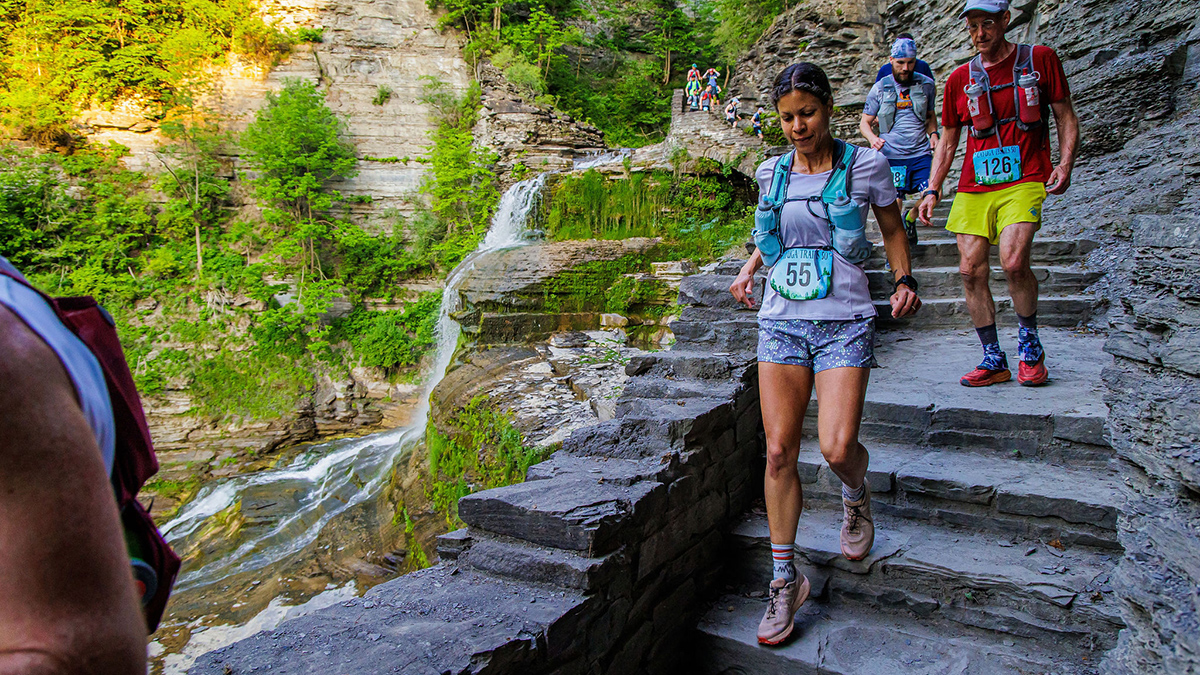
Running was an outlet for her throughout her schooling; as a student she’d lace up to decompress, noticing the landscapes she was learning to read in class.
Dyer-Pietras and her husband eventually settled in Houston, where she worked at BP. Years of oil and gas work and several moves later, she landed in New York, where she enrolled in a Ph.D. program while lecturing at Binghamton University. Her research focused on piecing together why lake levels rose and fell millions of years ago and what those shifts reveal about ancient climate.
In 2019, Dyer-Pietras became the first Black woman to earn a Ph.D. in geological sciences at Binghamton University, and she was then awarded a Presidential Diversity Postdoctoral Fellowship at the university. When a tenure-track offer came, she turned it down. The competitive nature of academia had worn her down, and her daughters were growing up faster than she could afford to miss.
“I have put so much heart and energy into this university,” she said. “It was the end of the road.”
Around that same time, her mother passed away, and Dyer-Pietras started spending more hours on the trails. She had been a runner her whole life, but ultrarunning was new. One marathon became two, then came 50Ks, 50-milers, and 100Ks.
“I’m in a race. I have to keep going.”
“I took that academic energy and that got rolled into running,” she said.
Dyer-Pietras now writes about trail running for outlets like Trails Collective and Trail Sisters and is a United Endurance Sports Coaching Academy–certified ultramarathon running coach. Her 2021 Trail Sisters series “Geology on the Run” detailed the geologic features of some of her favorite running and hiking trails. On race days, when she runs past a roadcut or a rock formation, the scientist in her still notices.
“I tell myself, I cannot stop at that outcrop,” she said. “I’m in a race. I have to keep going.”
—Larissa G. Capella (@CapellaLarissa), Science Writer
This profile is part of a special series in our August 2026 issue on science careers.