
Editors’ Highlights are summaries of recent papers by AGU’s journal editors.
Source: Tectonics
Scientific progress rarely follows a straight path. Instead, it develops through open discussion, critical evaluation, and the testing of new ideas. The exchange between authors and colleagues illustrates how this process unfolds in modern Earth sciences and provides a valuable example of constructive scientific debate.
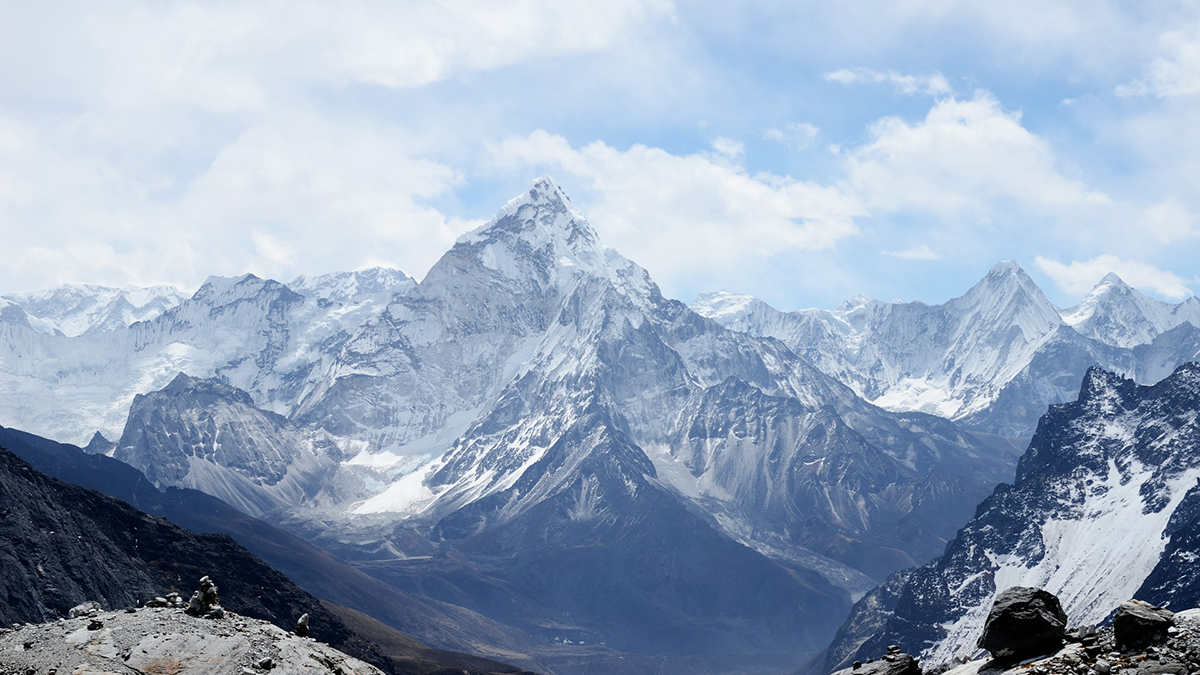
At the center of the discussion lies a fundamental question about one of Earth’s most remarkable geological features: how did the Himalaya and the Tibetan Plateau become the highest and largest mountain system on the planet?
In their paper “Raising the Roof of the World: Intra-Crustal Asian Mantle Supports the
Himalayan–Tibetan Orogen,” Sternai et al. [2025] address this question using numerical geodynamic modeling. These computer simulations reproduce the physical behavior of large rock masses deep inside the Earth and allow researchers to investigate the long-term evolution of this vast orogenic system.
Their study specifically explores the possibility that, during the collision between the Indian and Asian plates, layers of mechanically strong Asian mantle rock became embedded within the thickened Indian continental crust beneath the Tibetan Plateau. According to this hypothesis, these mantle layers could help sustain the elevation of the Plateau by effectively withstanding stresses over long geological timescales: the Indian crust would provide buoyancy (raising the roof), while the Asian mantle would contribute mechanical strength to support the Himalayan–Tibetan topography.
Hetényi and Cattin disagree with and challenge this interpretation in their Comment. Drawing on a large body of well-established geophysical and geological observations, they argue that the structure beneath southern Tibet is better explained by underthrusting, the process by which the Indian plate slides beneath the Tibetan Plateau. Seismic imaging studies, including receiver-function analyses that use earthquake waves to map subsurface structures, consistently reveal features interpreted as Indian crust and upper mantle extending far north beneath Tibet.
In their Reply, Sternai and colleagues clarify that their models were not intended to accurately reproduce the present-day structure of the region in detail. Instead, they were designed as process-oriented experiments to test whether existing and/or alternative mechanisms for crustal thickening and plateau support are mechanically and rheologically viable.
This exchange highlights an important aspect of contemporary geoscience—observations of Earth’s interior such as seismic images, gravity data, and geological records often allow multiple, non-unique interpretations. Numerical modeling provides a complementary approach by evaluating whether proposed geological mechanisms are physically plausible.
Equally significant is the tone of the discussion itself. The Comment and Reply show how scientists, while strongly disagreeing about interpretations, can maintain a constructive and respectful dialogue. Such approach fuels scientific advance by encouraging the community to re-examine established assumptions, refine models, and integrate new observations.
Debates like this one, therefore, extend well beyond a specific geological question. They illustrate how scientific understanding advances through the interplay of observations, theoretical reasoning, and modeling experiments.
In this way, the dialogue highlighted here contributes not only to our understanding of the Himalayan–Tibetan mountain system but also to the broader methodology of Earth science.
Citations
Sternai, P., Pilia, S., Ghelichkhan, S., Bouilhol, P., Menant, A., Davies, D. R., et al. (2025). Raising the roof of the world: Intra-crustal Asian mantle supports the Himalayan-Tibetan orogen. Tectonics, 44, e2025TC009057. https://doi.org/10.1029/2025TC009057
Hetényi, G., & Cattin, R. (2026). Comment on “Raising the roof of the world: Intra-crustal Asian mantle supports the Himalayan-Tibetan orogen” by Sternai et al. Tectonics, 45, e2025TC009214. https://doi.org/10.1029/2025TC009214
Sternai, P., Pilia, S., Ghelichkhan, S., Bouilhol, P., Menant, A., Ostorero, L., et al. (2026). Reply to comment by Hetényi and Cattin on: “Raising the roof of the world: Intra-crustal Asian mantle supports the Himalayan-Tibetan orogen”. Tectonics, 45, e2026TC009436. https://doi.org/10.1029/2026TC009436
—Giulio Viola, Editor-in-Chief, Tectonics