

For much of his life, Sidney Opiyo has been surrounded by fishing. In his hometown on Mfangano Island, which sits just offshore of Kenya on the eastern side of vast Lake Victoria, most people depend on the lake’s fisheries for their livelihoods. It’s a bounty that Opiyo said has come under threat in his lifetime, as ecological damage to the area has mounted.
Now Opiyo, recently graduated from the University of California, Santa Cruz with a master’s degree in coastal science and policy, plans to return home to help. His work examines the relationship between human communities and their environments, focusing on ways to better engage residents in the collection and use of fisheries data.
“One of the issues that has really come up is the willingness for the local fishers to participate in producing that data,” Opiyo said, discussing his capstone work meeting with fishers in Tanzania as a Fisheries Opportunity Fellow. Insights from community members are often indispensable in understanding local ecosystems, even as multiple barriers, from technology to trust, make collecting those data difficult.
In an effort to bridge that gap, Opiyo’s graduate studies examined fisheries data digitization and participatory science efforts in Tanzania, in partnership with the nonprofit research organization WorldFish.
“There are these aspects of science that the numbers and figures cannot really describe.”
Opiyo said images have become an important tool in this work. Already a photographer by hobby, he has begun sharing images of his research and the environments it takes place in during outreach to communities. During his fieldwork in Tanzania, sharing images of fishers, boats, fish processing, shellfish gleaning, and other daily activities served as visual prompts that helped people reflect on their experiences and led to deeper conversations about their interactions with their environment.
“There are these aspects of science that the numbers and figures cannot really describe,” Opiyo said. “People remember what they see.”
What is one book, movie, or piece of media about your field you would recommend to young scientists?
Braiding Sweetgrass, by Robin Wall Kimmerer. It offers a thoughtful perspective on the relationship between people and nature, showing how scientific knowledge and Indigenous Knowledge can complement each other.
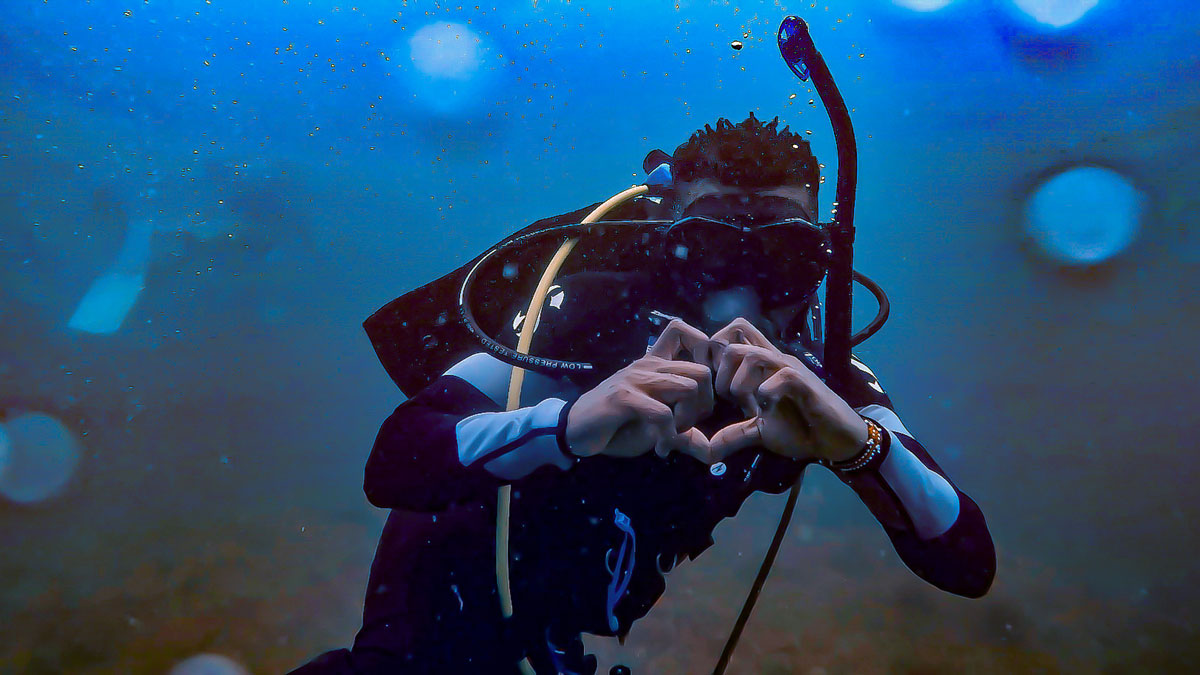
This statement holds true for Opiyo, too, who earned his scuba certification in 2025 through the Black in Marine Science Immersion Program (BIP). He enjoys the firsthand perspective that diving provides on the complexity of marine ecosystems and on humans’ connection to the ocean.
Opiyo intends to spend the next few years in the field, ideally near his home, working on issues spanning environmental policy, conservation, community engagement, and fisheries governance. After that, he hopes to apply for Ph.D. programs.
As fisheries data increasingly are being digitized, Opiyo said a clear focus for him will be establishing feedback loops between communities and the data they gather.
“How can this data take care of the needs of the people that it’s meant to serve?” he said.
—Nathaniel Scharping (@nathanielscharp), Science Writer
This profile is part of a special series in our August 2026 issue on science careers.