• About
  • Special Reports
  • Topics
    • Climate
    • Earth Science
    • Oceans
    • Space & Planets
    • Health & Ecosystems
    • Culture & Policy
    • Education & Careers
    • Opinions
  • Projects
    • Postcards From the Field
    • ENGAGE
    • Editors’ Highlights
    • Editors’ Vox
    • Eos en Español
    • Eos 简体中文版
    • Print Archive: 2015–2025
  • Policy Tracker
  • Blogs
    • Research & Developments
    • The Landslide Blog
  • Newsletter
  • Submit to Eos
  • AGU.org
  • Career Center
  • Join AGU
  • Give to AGU
  • About
  • Special Reports
  • Topics
    • Climate
    • Earth Science
    • Oceans
    • Space & Planets
    • Health & Ecosystems
    • Culture & Policy
    • Education & Careers
    • Opinions
  • Projects
    • Postcards From the Field
    • ENGAGE
    • Editors’ Highlights
    • Editors’ Vox
    • Eos en Español
    • Eos 简体中文版
    • Print Archive: 2015–2025
  • Policy Tracker
  • Blogs
    • Research & Developments
    • The Landslide Blog
  • Newsletter
  • Submit to Eos
Skip to content
  • AGU.org
  • Career Center
  • Join AGU
  • Give to AGU
Eos

Eos

Science News by AGU

Support Eos
Sign Up for Newsletter
  • About
  • Special Reports
  • Topics
    • Climate
    • Earth Science
    • Oceans
    • Space & Planets
    • Health & Ecosystems
    • Culture & Policy
    • Education & Careers
    • Opinions
  • Projects
    • Postcards From the Field
    • ENGAGE
    • Editors’ Highlights
    • Editors’ Vox
    • Eos en Español
    • Eos 简体中文版
    • Print Archive: 2015–2025
  • Policy Tracker
  • Blogs
    • Research & Developments
    • The Landslide Blog
  • Newsletter
  • Submit to Eos

Alaska

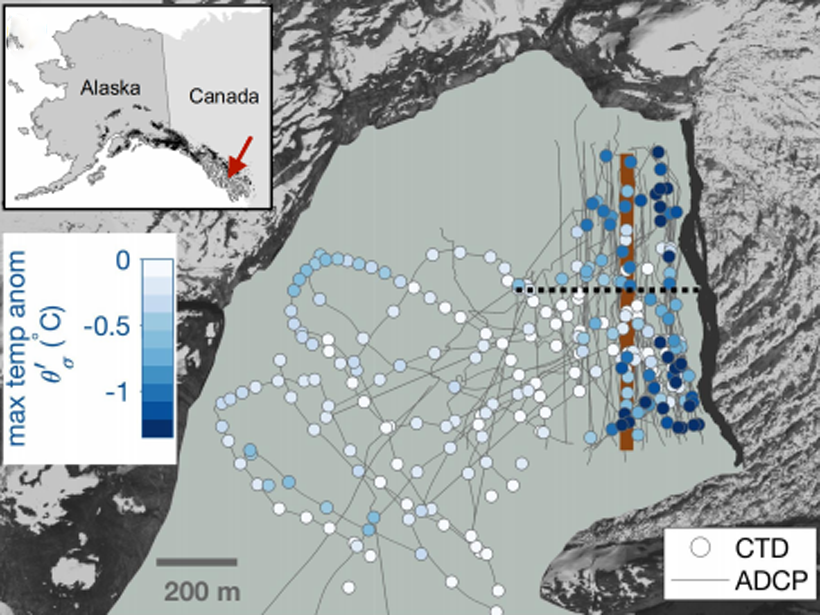
Plan view of the LeConte Glacier and fjord system in Alaska
Posted inEditors' Highlights

First Field Observations of Ocean Melting a Tidewater Glacier

by Mathieu Morlighem 13 February 202010 February 2022

Using autonomous kayaks, researchers carried out measurements of water properties near the terminus of LeConte Glacier and showed that ice/ocean interactions are more complex than thought.

Aerial view of buildings on a narrow spit of land
Posted inNews

Helping Alaskan Communities Facing Climate Risks

by Randy Showstack 7 February 202029 April 2022

Scientists examine how best to use science to help communities respond to rapid climate change in the Arctic.

Aerial view over the Alaskan tundra showing patches of snow, ice, and bare land
Posted inResearch Spotlights

Methane-Releasing Tundra Soils Freezing Later Each Year

Sarah Stanley, Science Writer by Sarah Stanley 18 September 201911 August 2022

Scientists find links between delayed freezing of Alaskan soils and higher atmospheric methane concentrations during the cold season.

Photo of a protest of University of Alaska budget cuts
Posted inNews

University of Alaska Faces Budget Crisis

by Randy Showstack 8 July 20193 November 2021

The state legislature decides this week whether to override the governor’s $130 million cuts that could devastate the university and its world-class research.

The 17 October 2015 landslide at Tyndall Glacier Alaska
Posted inResearch Spotlights

Study of Alaskan Landslide Could Improve Tsunami Modeling

by E. Underwood 26 April 201911 February 2022

A rare submarine landslide provides researchers with a reference point for modeling the biggest tsunamis.

Sunset from the R/V Sikuliaq, July 2018, with broadband ocean-bottom seismometers arranged on deck
Posted inScience Updates

Examining Alaska’s Earthquakes on Land and Sea

by G. A. Abers, A. N. Adams, P. J. Haeussler, Emily Roland, P. J. Shore, D. A. Wiens, S. Y. Schwartz, A. F. Sheehan, Donna Shillington, S. Webb and Lindsay Lowe Worthington 26 March 20198 November 2021

The Alaska Amphibious Community Seismic Experiment is taking a close look at seismic activity along the Alaska Peninsula to understand earthquakes in this little-studied region.

Sen. Lisa Murkowski of Alaska speaks at AGU Fall Meeting 2018.
Posted inNews

Sen. Murkowski Warns About the Impact of Climate Change

by Randy Showstack 13 December 20187 April 2023

The senator from Alaska says the impact of climate change in her state “is real, it is happening, it is now, and almost none of these changes are for the better for us.”

Satellite image of Point Barrow, Alaska. A 40-year record of carbon dioxide concentrations in Alaska offers insight into how the carbon cycle responds to temperature.
Posted inResearch Spotlights

Autumn Warming No Longer Accelerating Carbon Loss in the North

by Terri Cook 21 September 201824 February 2023

An analysis of Point Barrow’s 40-year record points to the importance of calculating the carbon cycle’s response to temperature during the northern latitudes’ non-growing season.

Researchers look at space storm data to understand how they caused fluctuations in Earth’s surface geomagnetic field
Posted inResearch Spotlights

How Two Massive Space Storms Zapped Alaska

by E. Underwood 6 August 201816 November 2021

New study reveals how space weather causes rapid fluctuations in Earth’s surface geomagnetic field.

Alaska-shaped germs in a petri dish
Posted inNews

Alaska Spotlights Its Health Risks from Climate Change

Laura Poppick, freelance science writer by L. Poppick 19 March 201823 March 2023

In the only Arctic state in the United States, Alaskans have already been affected by health repercussions of warming. More and worse lie ahead, a new state health report says.

Posts pagination

Newer posts 1 … 6 7 8 9 10 11 Older posts
Over a dark blue-green square appear the words Special Report: The State of the Science 1 Year On.

Features from AGU Publications

Research Spotlights

Our Ocean’s “Natural Antacids” Act Faster Than We Thought

30 January 202630 January 2026
Editors' Highlights

Visualizing and Hearing the Brittle–Plastic Transition

3 February 20263 February 2026
Editors' Vox

Tsunamis from the Sky

3 February 20263 February 2026
Eos logo at left; AGU logo at right

About Eos
ENGAGE
Awards
Contact

Advertise
Submit
Career Center
Sitemap

© 2026 American Geophysical Union. All rights reserved Powered by Newspack