• About
  • Sections
  • Topics
    • Climate
    • Earth Science
    • Oceans
    • Space & Planets
    • Health & Ecosystems
    • Culture & Policy
    • Education & Careers
    • Opinions
  • Projects
    • ENGAGE
    • Editors’ Highlights
    • Editors’ Vox
    • Eos en Español
    • Eos 简体中文版
    • Print Archive
  • Science Policy Tracker
  • Blogs
    • Research & Developments
    • The Landslide Blog
  • Newsletter
  • Submit to Eos
  • AGU.org
  • Career Center
  • Join AGU
  • Give to AGU
  • About
  • Sections
  • Topics
    • Climate
    • Earth Science
    • Oceans
    • Space & Planets
    • Health & Ecosystems
    • Culture & Policy
    • Education & Careers
    • Opinions
  • Projects
    • ENGAGE
    • Editors’ Highlights
    • Editors’ Vox
    • Eos en Español
    • Eos 简体中文版
    • Print Archive
  • Science Policy Tracker
  • Blogs
    • Research & Developments
    • The Landslide Blog
  • Newsletter
  • Submit to Eos
Skip to content
  • AGU.org
  • Career Center
  • Join AGU
  • Give to AGU
Eos

Eos

Science News by AGU

Support Eos
Sign Up for Newsletter
  • About
  • Sections
  • Topics
    • Climate
    • Earth Science
    • Oceans
    • Space & Planets
    • Health & Ecosystems
    • Culture & Policy
    • Education & Careers
    • Opinions
  • Projects
    • ENGAGE
    • Editors’ Highlights
    • Editors’ Vox
    • Eos en Español
    • Eos 简体中文版
    • Print Archive
  • Science Policy Tracker
  • Blogs
    • Research & Developments
    • The Landslide Blog
  • Newsletter
  • Submit to Eos

ocean worlds

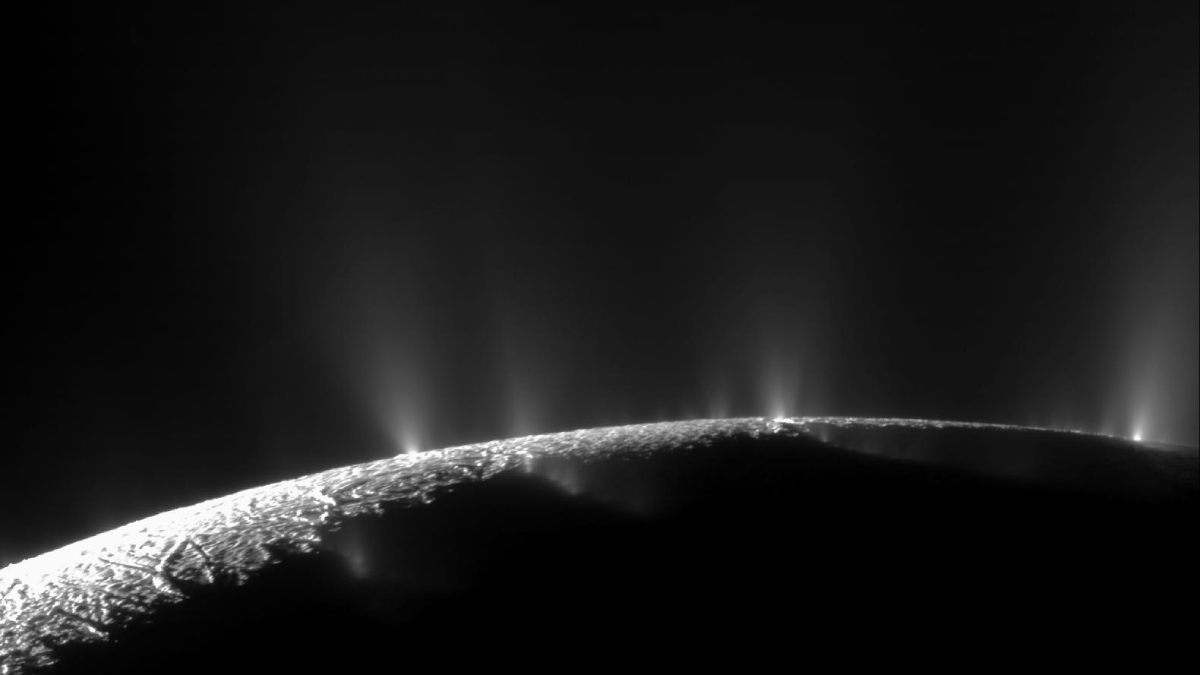
Enceladus’s horizon backlit by the Sun, highlighting several plumes of material coming from the surface.
Posted inNews

Speedy Flyby Adds New Organics to Enceladus’s “Primordial Soup”

Kimberly M. S. Cartier, News Writing and Production Intern for Eos.org by Kimberly M. S. Cartier 12 November 202512 November 2025

A new analysis of old Cassini data has also verified past detections of complex organics in Saturn’s E ring, strengthening the chemical ties between the ring and its progenitor.

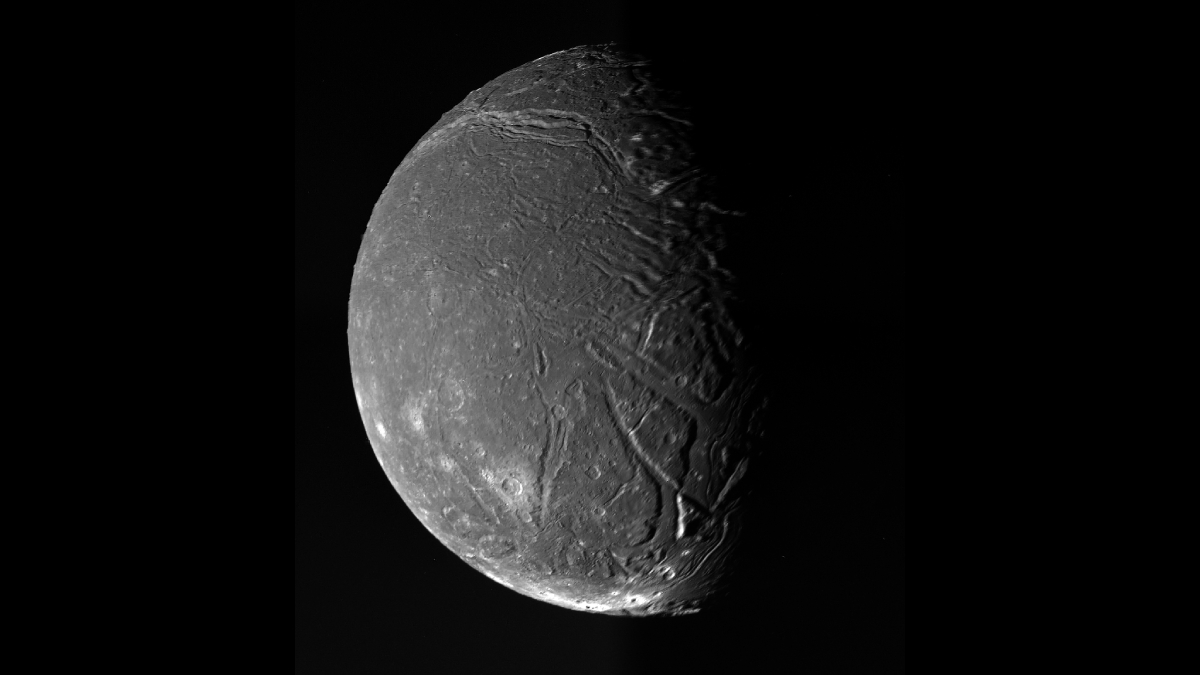
A grayscale image of a ridged and cratered moon with only the left hemisphere illuminated.
Posted inNews

Tiny Uranian Moon Likely Had a Massive Subsurface Ocean

Kimberly M. S. Cartier, News Writing and Production Intern for Eos.org by Kimberly M. S. Cartier 24 October 202524 October 2025

Ariel’s tempestuous subsurface ocean may have once composed more than half its total volume.
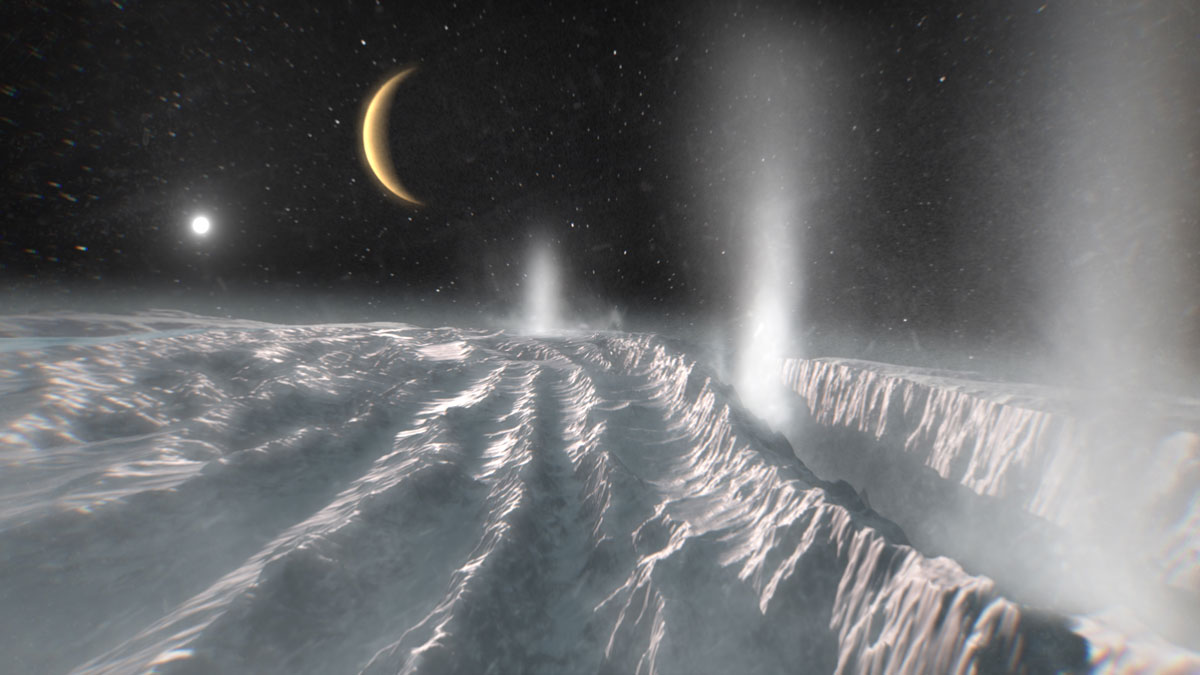
Illustration of plumes erupting from the surface of Enceladus
Posted inNews

Space Radiation Can Produce Some Organic Molecules Detected on Icy Moons

Javier Barbuzano, Science Writer by Javier Barbuzano 14 October 202514 October 2025

As missions prepare to visit ocean worlds like Enceladus and Europa, new findings show scientists must first learn to distinguish between radiation-made organics and those born in a subsurface sea.
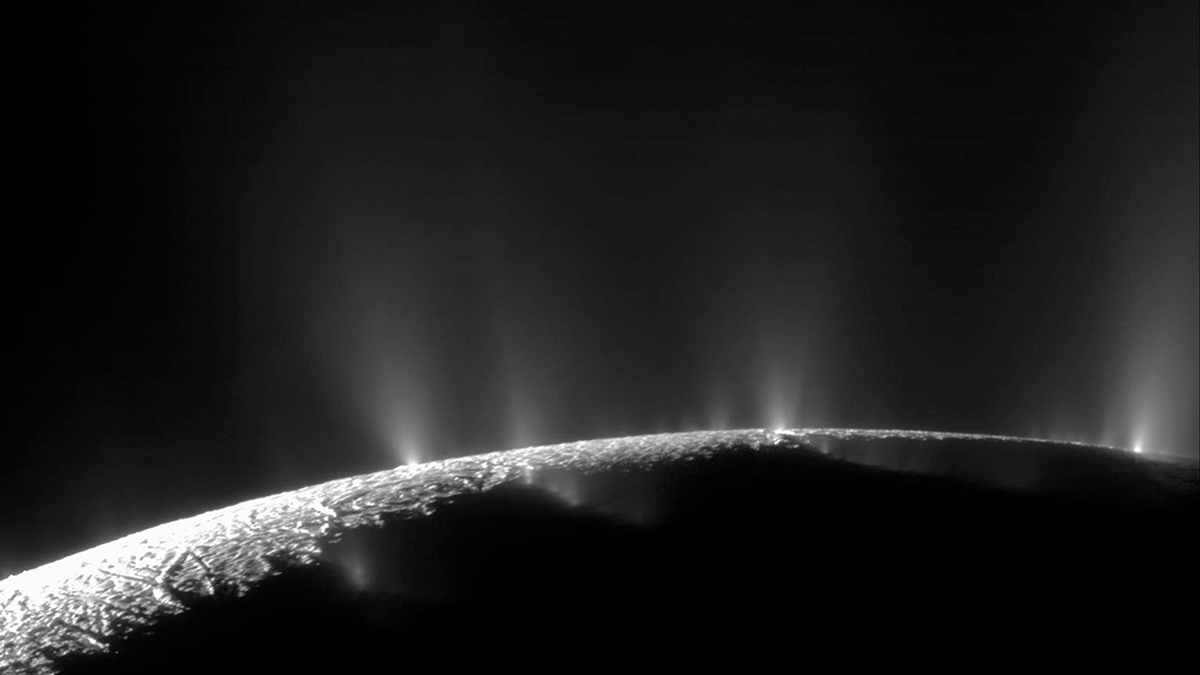
The gray surface of Enceladus with plumes of gas escaping from the surface into space
Posted inResearch Spotlights

Using Algorithms to Help Find Life on Icy Ocean Worlds

by Saima May Sidik 21 March 202521 March 2025

Scientists could use machine learning to analyze atmospheric samples in order to help identify microbes on frozen moons. They’re testing the concept using bottles of brine and smelly bacteria.

A narrow laser beam illuminates a point on a rocky seafloor outcrop surrounded by sand.
Posted inFeatures

Sensing Remote Realms of the Deep Ocean on Earth—and Beyond

by Anastasia G. Yanchilina, Laura E. Rodriguez, Roy Price, Laura M. Barge and Pablo Sobron 29 August 202417 October 2024

A novel laser-equipped probe is collecting measurements of deep-sea geochemical environments that once seemed impossible to gather, pointing the way toward future explorations of other ocean worlds.

A close-up of the face of a green-eyed woman wearing a parka and a gray scarf over her lower face; snow appears on the woman’s clothing and her eyelashes.
Posted inFeatures

Britney Schmidt: Following the Ice

Katherine Kornei, Science Writer by Katherine Kornei 25 July 202425 July 2024

An Earth and planetary scientist is most at home in cold places that mimic the worlds of the outer solar system.

在前景中,明亮的蓝白色喷射物从一个弯曲的蓝白色表面散发出来,映衬着星空背景,附近有一个金色的环状行星和两个较小的类似卫星的球体。
Posted inResearch Spotlights

在土卫二上寻找生命:我们应该问些什么问题?

Sarah Stanley, Science Writer by Sarah Stanley 11 June 202411 June 2024

在冰冷的海洋世界中,建立在有机化学进化理论基础上的研究框架,可能会比仅仅寻找生命存在的直接证据,带来更深刻的见解。

In the foreground, bright blue-white sprays emanate from a curved, blue-white surface against the starry background of space, with a gold-toned ringed planet and two smaller moonlike orbs nearby.
Posted inResearch Spotlights

Looking for Life on Enceladus: What Questions Should We Ask?

Sarah Stanley, Science Writer by Sarah Stanley 8 May 202411 June 2024

On icy ocean worlds, a research framework built around the theory of organic chemical evolution could surface deeper insights than a hunt limited to direct evidence of life.
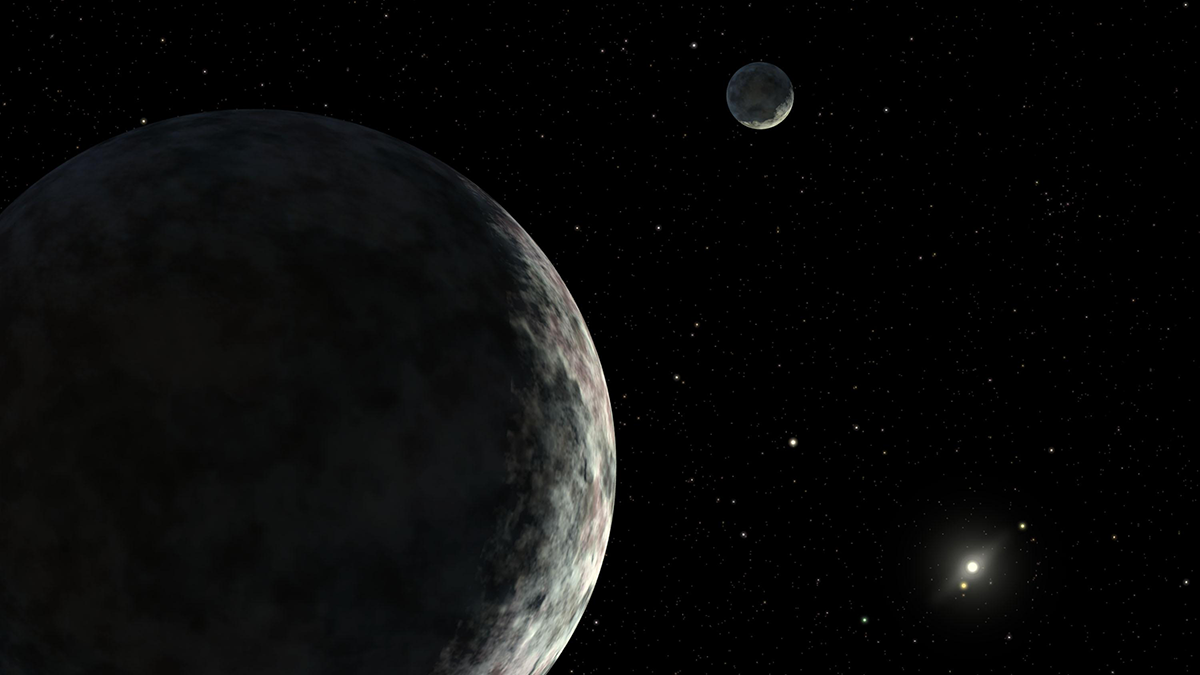
Representación de Eris
Posted inNews

Los planetas enanos muestran evidencias de reciente actividad geológica

Damond Benningfield, Science Writer by Damond Benningfield 2 May 20242 May 2024

Los grandes cuerpos del Cinturón de Kuiper y más allá podrían haber albergardo océanos en la subsuperficiales.
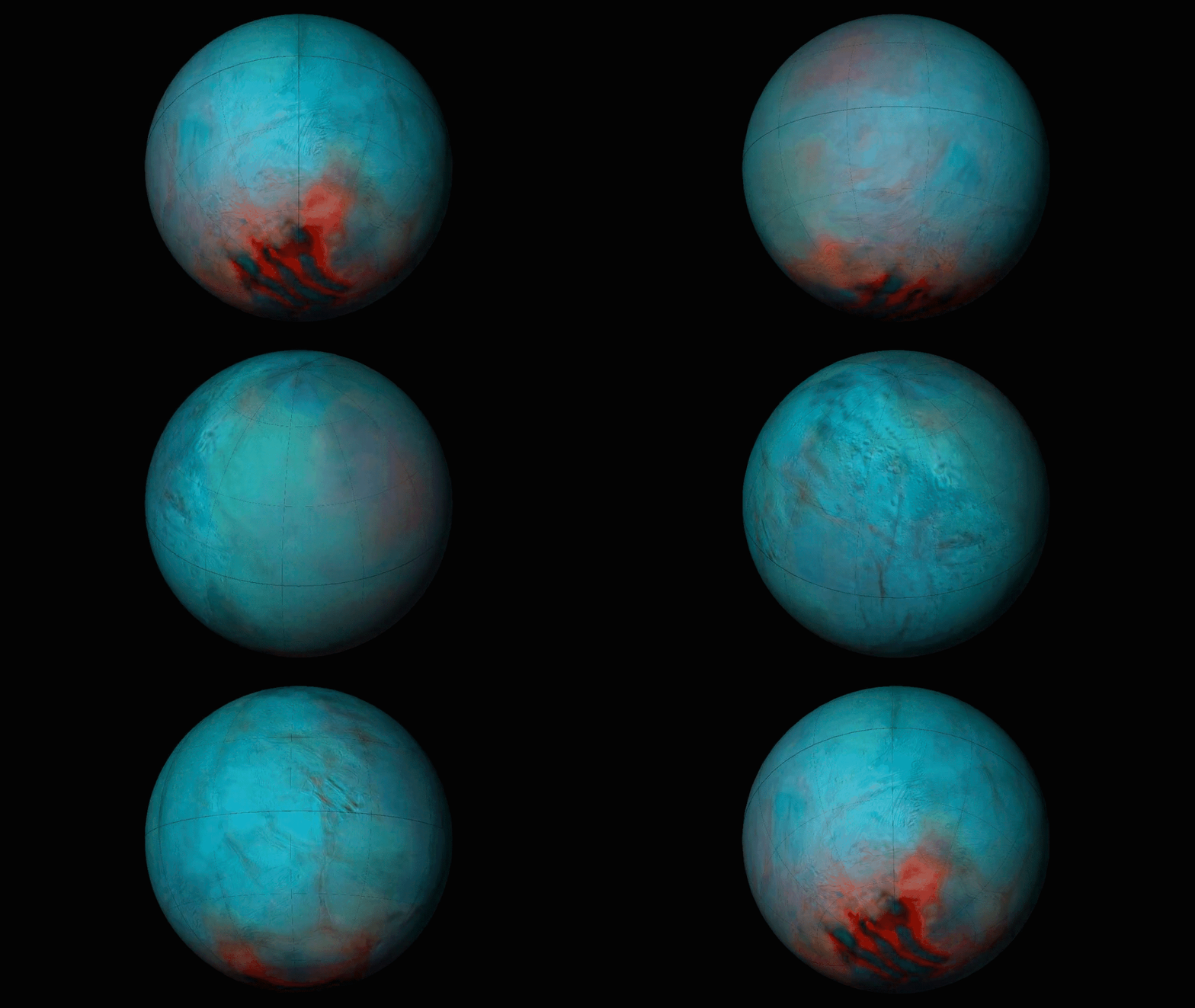
A global thermal map of Enceladus.
Posted inNews

Strike-Slip Faults Could Drive Enceladus’s Jets

Kimberly M. S. Cartier, News Writing and Production Intern for Eos.org by Kimberly M. S. Cartier 29 April 202429 April 2024

The back-and-forth motion could also reshape surface geology at the moon’s south pole.

Posts pagination

1 2 Older posts
A view of a bridge, with the New Orleans skyline visible in the distance between the bridge and the water. A purple tint, a teal curved line representing a river, and the text “#AGU25 coverage from Eos” overlie the photo.

Features from AGU Publications

Research Spotlights

Understanding Flux, from the Wettest Ecosystems to the Driest

24 November 202524 November 2025
Editors' Highlights

Avoiding and Responding to Peak Groundwater

25 November 202525 November 2025
Editors' Vox

Echoes From the Past: How Land Reclamation Slowly Modifies Coastal Environments

19 November 202519 November 2025
Eos logo at left; AGU logo at right

About Eos
ENGAGE
Awards
Contact

Advertise
Submit
Career Center
Sitemap

© 2025 American Geophysical Union. All rights reserved Powered by Newspack