
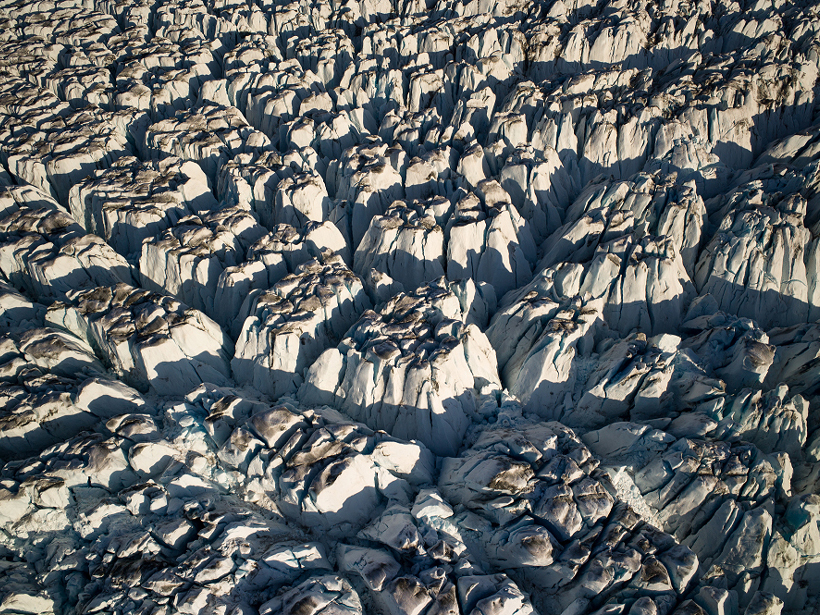

Scientists review 60 years of direct and remote observations of crevasses and the models used to simulate them.
Reviews of Geophysics

Posted inEditors' Vox
New Insights from 60 Years of Crevasse Research
Deep cracks in the ice may provide insight into glacier decay and help predict sea level rise.

Posted inResearch Spotlights
At the Intersection of Ice and Water

Scientists observe ice dynamics in water-terminating glaciers around the world to better understand how the process of subaqueous melt drives ice loss.

Posted inResearch Spotlights
Characterizing Interglacial Periods over the Past 800,000 Years

Researchers identified 11 different interglacial periods over the past 800,000 years, but the interglacial period we are experiencing now may last an exceptionally long time.
Posted inResearch Spotlights
New Methods Measure How Vertical Land Motion Affects Sea Level

Researchers demonstrate the value of combining GPS and satellite data on vertical motion of the Earth's surface with tide gauge measurements to track rising sea levels.
Posted inResearch Spotlights
What Drives Pollutant Dispersion at Night?
Better understanding of waves and turbulence in calm air could improve predictions of weather and pollutant dispersion.
Posted inResearch Spotlights
Sediment Transport Capacity Carries Many Meanings
The current definitions of sediment transport capability don't match up with observations of actual geomorphic systems.
Posted inResearch Spotlights
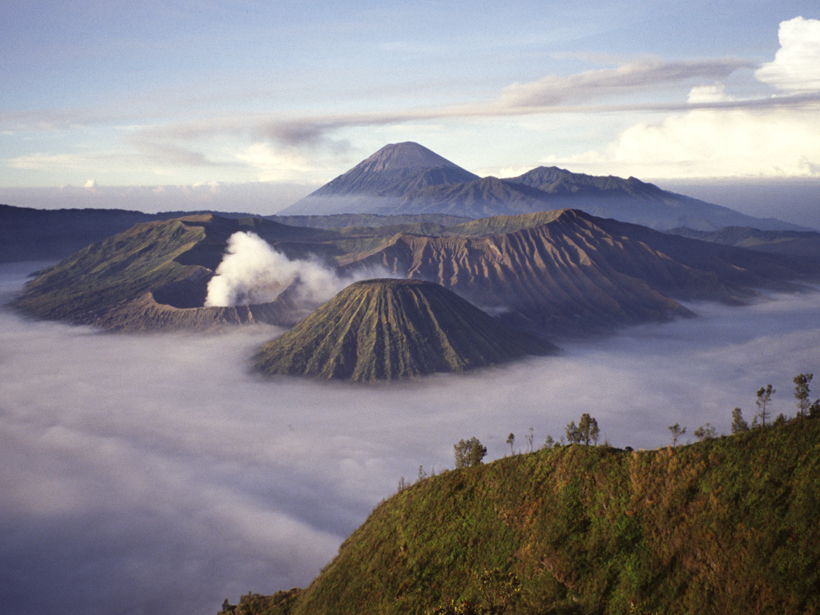
Forecasting Eruptions at Restless Calderas
Scientists review decades of data on swarms of earthquakes, surface deformation, degassing, and microgravity changes around calderas to determine when such forms of unrest may result in eruptions.
Posted inResearch Spotlights
A Big Climate Driver in a Small Ocean Basin
Scientists review Atlantic Ocean circulation variability and its applications for predicting decadal climate variation.

Posted inResearch Spotlights
Early Agriculture Has Kept Earth Warm for Millennia
Ice core data, archeological evidence, and other studies suggest humans had a significant influence on Earth's preindustrial climate.