
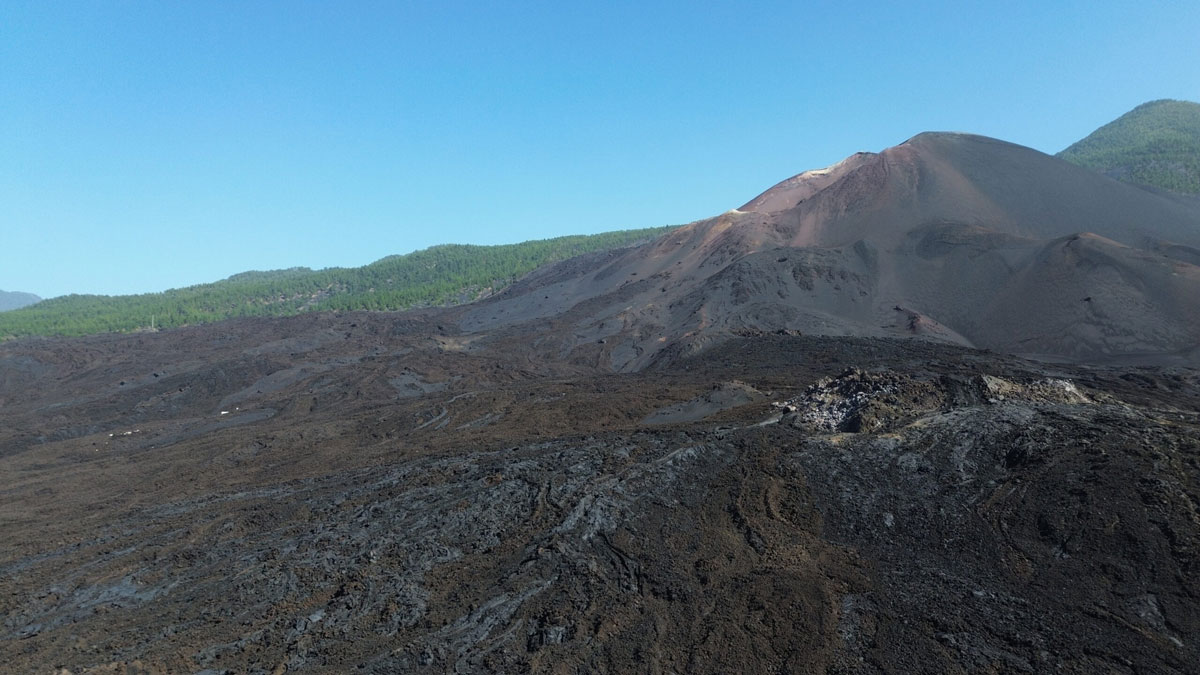

When the Tajogaite volcano erupted on the Spanish island of La Palma in 2021, it changed the local landscape almost overnight. What started as a small fissure spewing gas and volcanic ash soon grew into a massive volcanic cone. Lava flows destroyed hundreds of homes and basic infrastructure such as roads and water pipes, but they also created a natural laboratory for scientists.
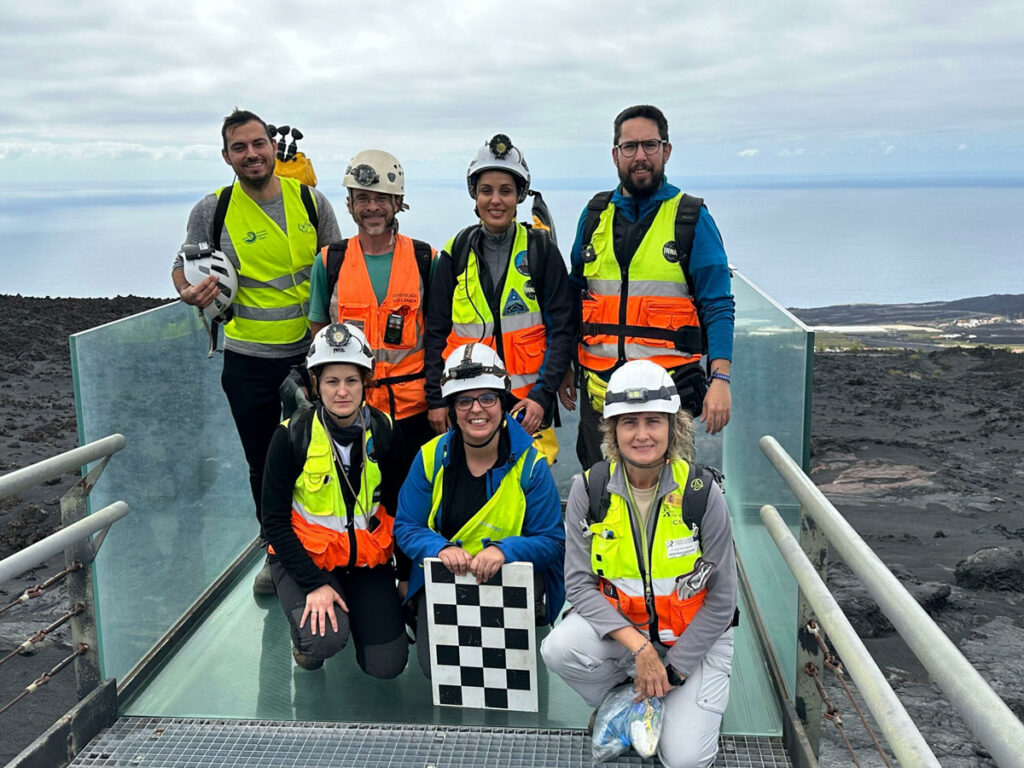
As the lava cooled and slowed on the surface, molten rock continued to flow through channels under the surface. Once the eruption ceased and the lava drained out, the empty tubes remained, forming a tunnel network. Between 12 and 24 months after the eruption, a team of researchers went onto the still cooling lava tubes of La Palma to study how life gets its first foothold and colonizes these newly created environments.
Numerous studies have investigated how life takes hold on new surface lava, and mature microbial communities in lava tubes have also been studied in the past, but this is the first time the colonization process has been studied underground from the very beginning, the researchers said. It could help researchers learn more not just about terrestrial lava tubes but about those on Mars or the Moon.
“This is a unique opportunity; we are studying nature’s blank pages,” said Ana Miller, a geomicrobiologist at the Institute of Natural Resources and Agrobiology of Seville in Spain who led the study published in Environmental Microbiome.
The tubes formed by the Tajogaite eruption were sometimes tall enough for a person to walk upright through them. But the temperatures could be uncomfortably hot, even after toxic gases had dissipated and initial temperatures cooled from upward of 800°C (1472°F). In some sampling sites, air temperatures hovered at a blow-dryer hot 60°C (140°F), while rock surfaces reached 90°C (194°F).
Yet even in such inhospitable conditions, the researchers found adventurous microorganisms already dwelling in the caves and, in some cases, altering the rock.
The Lucky Few
Though these passages are underground, they aren’t entirely sealed from the outside world. In some locations, sections of the tubes collapsed, or bubbling lava created holes in the roofs of the lava flows, known as skylights. Cracks in the rock also allow rainwater to enter the caves.
These openings are entry points for the first colonizers, which are carried by wind and rain or transported by living collaborators, such as birds, rodents, insects, and even worms. The microorganisms are accompanied by a nutrient cache of decaying vegetation, feathers, and guano.
On the basis of previous studies, the researchers thought that only the highly specialized microorganisms that can extract energy from chemical reactions with minerals—known as chemolithotrophs—could survive these early stages. The results at Tajogaite, however, show this isn’t entirely true.
The team collected scrapings from the cave floors and walls, combining traditional laboratory cultures with advanced genetic sequencing, and found that the microbial communities were not uniform. If light or organic matter was available, opportunistic organisms prevailed, with random luck playing a role in which species made it into the caves—a process called stochastic seeding. However, the harsh interior conditions of the lava tubes decided which microorganisms survived over the long term, favoring highly specialized species adapted to extreme environments. Deep within the caves, where there is no organic input, no light, and very little humidity, only these specialists survived.
The rapidly changing environment in the caves likely also influences the colonization process. “In a newly formed tube, the rock is still cooling down,” said Francesco Sauro, a geologist at the University of Padua in Italy who wasn’t involved with the new study. “You have cracking of the lava linings on the walls, collapses, and a lot of secondary mineralization that is metastable—meaning it exists only at that specific condition of temperature and humidity.”
In contrast to mature lava tubes that formed thousands of years ago, which present stable conditions and mature microbial communities that are in equilibrium with the environment, young ones like those in La Palma evolve rapidly. “If you go back to Tajogaite or Iceland after 2, 5, or 10 years,” Sauro said, “the community will have changed for sure.”
Leaving Their Mark
“It isn’t just a case of microbes arriving, depositing on the walls, and surviving. To survive, they must interact with the volcanic substrate.”
Using electron microscopy, the team also found that the organisms are already dissolving and creating new minerals out of the rock.
“The microscopy helps us see if the microorganisms are associated with the mineral structures,” Miller said. “It isn’t just a case of microbes arriving, depositing on the walls, and surviving. To survive, they must interact with the volcanic substrate. That activity confirms we have a community developing.”
The researchers found that the microbes were already forming biofilms—mat-like structures that help them attach to rock. Biofilms also retain humidity, helping the microbes capture the little moisture available, along with dissolved nutrients. Subtle alterations like biofilm formation represent the very first steps of a process that, over millions of years, will eventually break the rock down to form soil, Miller said.
Mars Underground
Lava tubes like the ones created in La Palma are common features in volcanic environments both on and off Earth. These subsurface structures are considered a possible last redoubt for life on Mars, if it ever existed.
Lava tubes could provide a stable sanctuary, shielded from the freezing, radiation-bombarded, and chemically aggressive surface environment of the Red Planet. Understanding how life takes hold in newly created terrestrial tubes, like those in La Palma, could help inform how the same processes could occur on Mars.
One of the main controversies surrounding the idea of life in Martian lava tubes, however, is that most of the tubes that exist today formed after the planetary shift that ended habitable surface conditions on Mars roughly 3.8 billion years ago. This timing casts doubt on whether life ever had the chance to colonize them, Sauro said.
However, the larger picture is that lava tubes never stopped forming on Mars, at least throughout the first half of its history. “They were forming 4 billion years ago, and then through up to 2 billion years ago while volcanism was still active,” Sauro said.
In this way, Martian lava tubes could provide temporary “houses” that life could colonize one after the other, Sauro said. The fact that on Earth this colonization is extremely quick—not taking decades, but happening as soon as the temperature drops below a certain threshold—suggests that even young Martian lava tubes could have been rapidly colonized by surviving bacteria, Sauro said. “As soon as the lava tube is below a certain temperature and there is availability of liquid water, then it’s done.”
—Javier Barbuzano (@javibar.bsky.social), Science Writer