
Editors’ Highlights are summaries of recent papers by AGU’s journal editors.
Source: Tectonics
The collision of the Arabian Plate with Eastern Anatolia and, farther east—Iran, played a major role in shaping the topography of the Middle East, but its timing remains debated, with many estimates placing it between the Eocene and Miocene, approximately 45–10 million years ago.
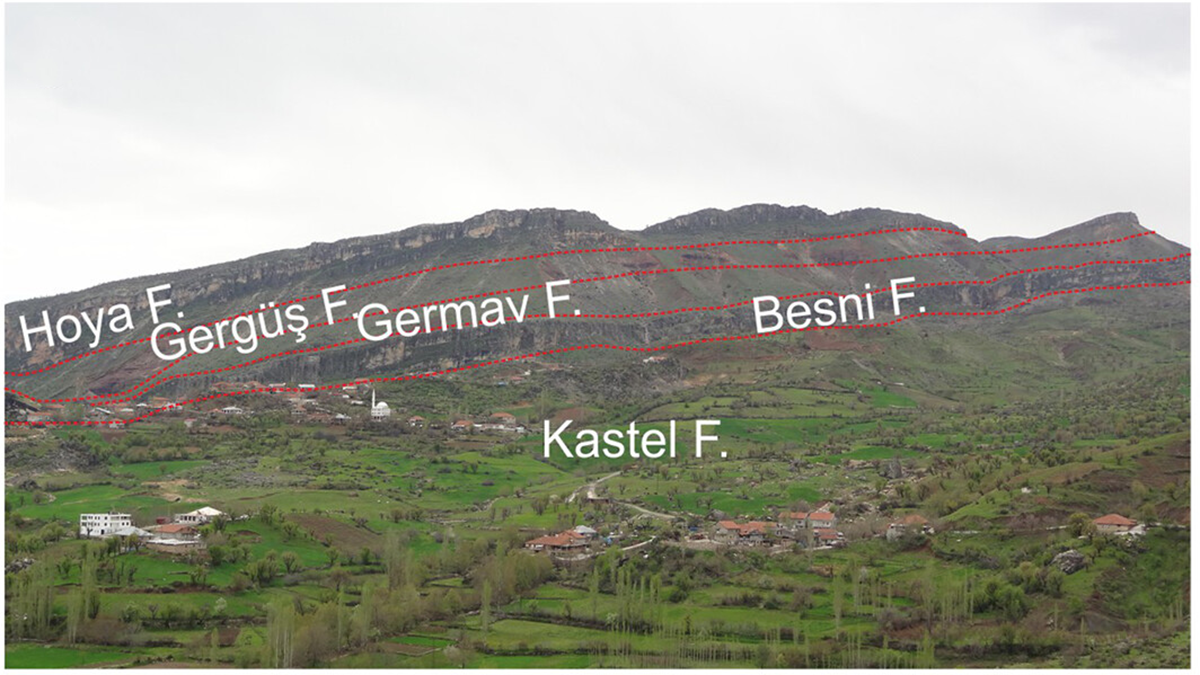
Akdoğan et al. [2026] investigate the provenance of Late Cretaceous and Paleocene sandstones deposited along the northern margin of the Arabian Plate. They show that zircon grains and rock fragments in the Kastel Formation were derived from a volcanic arc on the Anatolian upper plate, north of the former southern Neo-Tethys Ocean. The arrival of these sediments at the Arabian margin by 74–71 million years ago indicates that the southern Neo-Tethys had closed and that collision between Arabia and Eastern Anatolia had already begun. The overlying Paleocene Germav Formation records a more advanced stage of collision, during which erosion exposed metamorphic rocks representing deeper levels of the volcanic arc and the subducted Arabian margin.
Comparison with data from Iran suggests that the collision progressed eastward, reaching the northern Zagros region later, during the Maastrichtian–Paleocene. Although further studies are needed to determine whether this interpretation applies along the entire collision zone, the findings suggest that the southern branch of the Neo-Tethys closed before the northern branch and that the Arabia–Eastern Anatolia collision began at least 25 million years earlier than commonly proposed. Overall, this study provides a new framework for understanding the geological evolution of Eastern Anatolia and northwestern Iran.
Citation: Akdoğan, R., Hu, X., Topuz, G., Hakyemez, A., Catanzariti, R., Ma, A., et al. (2026). Late Campanian (74–71 Ma) Arabia–Eastern Anatolia collision and its geodynamic implications. Tectonics, 45, e2025TC009243. https://doi.org/10.1029/2025TC009243
—Paolo Ballato, Associate Editor, Tectonics