
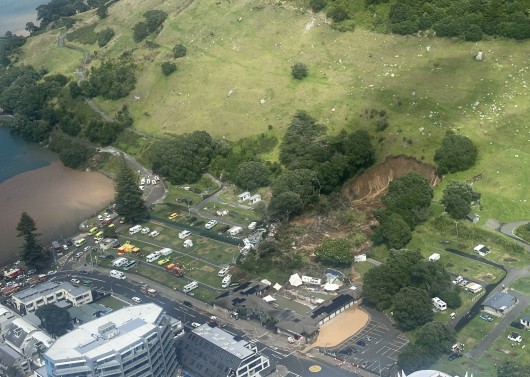
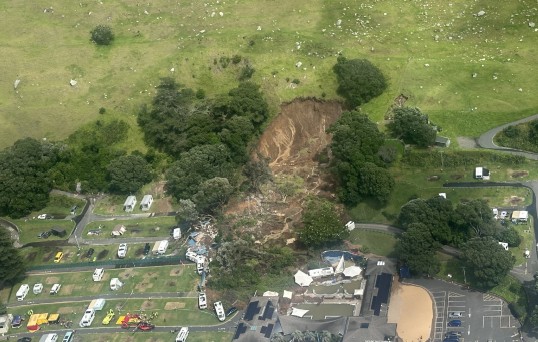
The external review of the Mount Maunganui Beachside Holiday Park landslide is extremely critical of the local authority in their approach to the management of the well-documented landslide hazard and risk at the site.
The external review commissioned by Tauranga City Council (TCC) into the 22 January 2026 Mount Maunganui Beachside Holiday Park landslide released its report today. It has been extensively covered in the New Zealand media. The conclusions are quite devastating for TCC, but are also likely to have wider implications for the management of risk from natural hazards across New Zealand.
It is important to remember the terms of reference of this external review, which was undertaken by Hon. Paul Davison KSO KC:
“the external review examines the facts, timeline and decision-making processes leading up to the landslide, the adequacy of risk assessments and monitoring systems, and any lessons or improvements needed to strengthen future safety. The external review is separate from the Government Inquiry and the investigations currently being undertaken by the Coroner, Police and WorkSafe.”
So this review does not look at the initiation of the landslide – that will come in due course – it is really about the management of the risk. The conclusions are summarised in this section of the report (p. 204):-
What this Review does find is that this tragedy was, in the end, preventable. I do not mean by that that anyone could have known that this slope would fail at this moment, on this particular morning — no one could. I mean something more deeply troubling: that the hazard was known, that an effective and inexpensive means of managing the risk it posed had twice been recommended, and that the Council had every opportunity to put it in place. Had it done so, the most consequential decision of 22 January — whether to move people away from the foot of the slope — would not have been left to the unaided judgement of whoever happened to be on site that morning. It would have been made in advance, against defined criteria that the readily observable conditions of that day would plainly have met. What was required was not extraordinary foresight. It was the robust operational processes and discipline required of a well-run organisation: that a known risk to life be owned by someone, recorded, escalated, and followed through until an effective means of mitigating it was in place, and that those left in charge of the campground were equipped to recognise the danger, and ready to act quickly and effectively if ever required.
The report highlights that multiple studies showed that the risk to life at the campsite was unacceptably high – indeed, by some calculations the impact of this event was lower than had been feared. This is primarily because individuals at the site recognised that the risk was high and started to raise the alarm. If the Mount Maunganui Beachside Holiday Park landslide had occurred in the early hours of the morning the toll would probably have been higher.
There is little in this report with which I disagree, and the consequences for TCC are likely to be serious. I’m unsure as to the detail of the New Zealand judicial system, but in the UK this report would open the path to both civil and criminal court action, with the latter potentially occurring at both the institutional and individual level.
If there is one thing that worries me, it is that the the report does not fully recognise that early warning systems and evacuation plans are not a magic bullet. There is strong evidence from multiple settings that they can be dogged by uncertainty, equipment failures, false alarms and a lack of willingness from individuals to respond in the way that is planned.
But that is not an excuse for failing to have such a system in place.
Apart from the direct impact on TCC and its members, this report is likely to have profound implications for landslide risk management in New Zealand. Take this recommendation for example:
“For every populated site controlled by TCC, exposed to a natural-hazard risk to life assessed as Medium or higher, TCC should require — not merely consider — the development and maintenance of a Trigger Action Response Plan. The TARP should: be capable of immediate implementation in a simple initial form (for example, staged evacuation of defined runout zones when rainfall exceeds a defined return interval threshold over a defined duration), and be refined over time as a living document; link specific, observable or measurable triggers — defined rainfall thresholds, antecedent soil-moisture, and visible signs such as turbid water from the toe of a slope, tension cracking, bulging or changes in seepage — to specific, staged actions up to and including full evacuation; empower designated site personnel to act on a trigger immediately, without needing approval from someone higher in the TCC organisation; identify who holds each responsibility and the communication and escalation protocol; and recognise that evacuation/avoidance is a higher-order control than engineered consequence-reduction.”
Whilst this recommendation is TCC specific, it is inevitably going to have implications across all local authorities in New Zealand. The country inevitably has many, many sites in which “natural-hazard risk to life” is medium or above. This recommendation is going to require a very extensive revisit of risk management at those locations. In a country with a small population and a very large, hazard-prone landmass, that is going impose a major burden.
It is worth noting that TCC has “today accepted the findings and recommendations from the external review into the landslide at Mount Maunganui Beachside Holiday Park on 22 January 2026”.
The reverberations of the tragic Mount Maunganui Beachside Holiday Park landslideare going to continue for a long time.