
A guest post by Serge Leroueil and Luciano Picarelli
A new book, Understanding Landslides Through Case Studies by Serge Leroueil and Luciano Picarelli seeks to report and summarise contemporary knowledge on slope movements and mechanisms.
As is well-known on this Blog, landslides are a major natural hazard in many countries of the world. The annual loss of human lives and the damage to structures and infrastructure is severe, and in many cases is higher than those caused by other natural hazards. Since extreme weather events are a major trigger, in the near future climate change will play a key role whose impact cannot be fully predicted today.
A new book, Understanding Landslides Through Case Studies that we have written and edited seeks to report and summarise contemporary knowledge on slope movements and mechanisms, putting experience in the centre. To this end the authors/editors have involved a number of renowned experts in the domains of geotechnical engineering and geology, asking them to bring their own experience and ideas to highlight specific aspects. The book mostly focuses on landslides in soils.
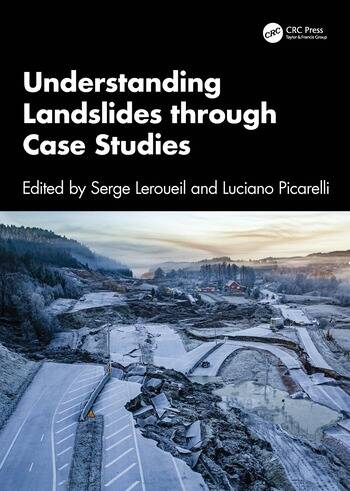
This book, which is particularly suitable for graduate students, researchers and professionals, consists of two parts. The first part summarises the present knowledge, from the pre-failure to the post-failure stage including landslide reactivation and active slope movements. The second part is a collection of 28 papers written by experts from all over the world reporting and interpreting specific case studies.
The first part of the book consists of the following six chapters that frame the problem touching the main causes of slope movement, the mechanisms and the mechanics of slope failure and of post-failure landslide evolution, and thus the basic types of movement (classification):
Chapter 1. Slope formation from a geotechnical perspective. This chapter discusses the formation and the evolution of slopes in different geological and climatic contexts.
Chapter 2. Slope movements. It examines in detail the mechanical aspects of slope failure from the pre-failure to the post-failure stage and the modes of landslide formation and evolution. The updated version of the Varnes classification (Hungr et al. 2014) is the basis for description of landslide evolution and thus of the mechanics of slope movements that is behind.
Chapter 3. Behaviour and properties of soils in the context of slopes. An in depth discussion about the hydraulic and mechanical properties of both saturated and unsaturated soils is the starting point of Chapter 3. Key parameters that govern soil behaviour including some often disregarded factors such as time, temperature, fluid chemistry and even gas that may be present are examined in detail.
Chapter 4. Slope movements induced by changes in boundary stress conditions. Besides the effects of well-known static and dynamic loading and unloading processes, the possible consequences of phenomena and processes such as rapid drawdown, storm waves, blasting and pile driving are also considered.
Chapter 5. Slope movements induced by changes in hydraulic or physico-thermo-chemical conditions. This chapter examines the effects of infiltration and evapo-transpiration, of soil deterioration, of thermal effects and of the presence of gas, free, dissolved or in the form of hydrate.
Chapter 6. From pre-failure to post-failure (including reactivation). A room is finally given to macroscopic landslide mechanisms, and thus types of movement (classification), which affect landslide analysis. Special movements such as flowslides in sensitive clays and earthflows (often mudslides in the British literature) are also described in this chapter.
As mentioned above, the second part of the book presents a number of case studies from all over the world, illustrating mechanisms described in the first part and providing a panorama of situations whose knowledge may be a useful reference for readers. The examined cases form six chapters following the same rationale as the book.
Chapter 7. Hydro-mechanical pre-failure processes
- 7.1 Introduction
- 7.2 The Saint-Hilaire Case Study by J. Lafleur, S. Leroueil & J.-F. Laflamme
- 7.3 The London Heathrow Airport’s Terminal 5 Case Study by D.W. Hight, N. Kovacevic & D.M. Potts
- 7.4 The Bukit Batok Case Study by H. Rahardjo, E.C. Leong & R.B. Rezaur
- 7.5 The Lavini di Marco Case Study by P. Tommasi, L. Verrucci & P. Campedel
- 7.6 The Randa Case Study by E. Eberhardt, H. Willenberg, S. Loew & D. Stead
- 7.7 Concluding remarks
Chapter 8. First-time landslides
- 8.1 Introduction
- 8.2 The Warden Point Case Study by E.N. Bromhead & N. Dixon
- 8.3 The Aznalcollar Case Study by A. Gens & E.E. Alonso
- 8.4 The Saint-Liguori Case Study by S. Leroueil, L. Ouehb, D. Demers, G. Grondin & J. Locat
- 8.5 The Baie-des-Anges Case Study by S. Garziglia, N. Sultan, S. Stegmann & A. Kopf
- 8.6 The Três Barras Case Study by W. A. Lacerda, A.P. Fonseca Becker, L. De Bona Becker & A.L. Coelho Netto
- 8.7 Case studies in Chinese loess deposits by Z. Lin & Z. Xu
- 8.8 Concluding remarks
Chapter 9. Active and reactivated landslides
- 9.1 Introduction
- 9.2 The Sallèdes Case Study by P. Pouget
- 9.3 The Vallcebre Case Study by J. Corominas, A. Ledesma, J. Moya, D.A. Gonzàlez, J.A. Gili, A. LLoret & M. Hürlimann
- 9.4 The Cortes de Pallas Case Study by N.M. Pinyol, E.E. Alonso & M. Maglia
- 9.5 The Rosone Case Study by M. Castelli & C. Scavia
- 9.6 The Clapière Case Study by J.-L. Durville, J.-L. Perez & J.-F. Serratrice
- 9.7 Concluding remarks
Ch. 10. Flow-like landslides in cohesive soils
- 10.1 Introduction
- 10.2 The Masseria Marino Case Study by L. Picarelli, L. Comegna & G. Urciuoli
- 10.3 The Super-Sauze Case Study by J.-P. Malet, O. Maquaire, Th.W.J. van Asch & T.A. Bogaard
- 10.4 The Saint-Jean-Vianney Case Study by J. Potvin, D. Demers, D. Robitaille & S. Leroueil
- 10.5 The Pointe-du-Fort Case Study by J. Locat, P. Locat, S. Leroueil & A. Locat
- 10.6 The Storegga Case Study by F. Nadim & T.J. Kvalstad
- 10.7 Concluding remarks
Ch. 11. Flow-like landslides in cohesionless soils
- 11.1 Introduction
- 11.2 The Cervinara Case Study by L. Olivares, E. Damiano & L. Picarelli
- 11.3 The Sau Mau Ping Case Study by K.K.S. Ho & H.W. Sun
- 11.4 The Aberfan Case Study by H.J. Siddle & J.N. Hutchinson
- 11.5 The Charles Creek Case Study by O. Hungr & P. Wilson
- 11.6 Concluding remarks
Ch. 12. Spreads
- 12.1 Introduction
- 12.2 The Bisaccia Case Study by L. Picarelli, L. Olivares, G. Urciuoli & F. Silvestri
- 12.3 The Thompson River Valley at Ashcroft Case Study by A. Eshraghian, C.D. Martin & N.R. Morgenstern
- 12.4 The Saint-Barnabé Case Study by A. Locat, S. Leroueil, D. Demers & J. Locat
- 12.5 Concluding remarks
Reference
Hungr, O., Leroueil, S. & Picarelli, L. 2014. Varnes classification of landslide types, an update. Landslides, 11(2), 167-194.