

Editors’ Highlights are summaries of recent papers by AGU’s journal editors.
Source: AGU Advances
Gaining a better understanding of how extreme rainfall is evolving in the tropics under global warming is essential, as this region plays a central role in the Earth’s climate system and hosts some of the world’s most intense precipitation. Yet, despite its global significance, the tropics remain among the most poorly monitored regions, making improved observations and analyses critical for advancing climate science and informing adaptation.
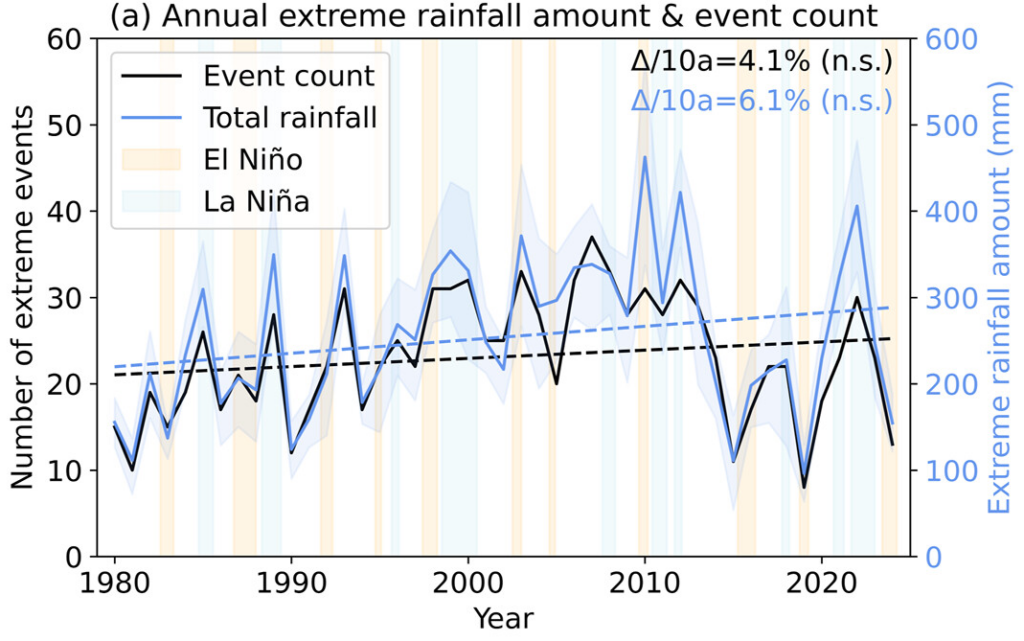
By combining a unique dataset of weather radar observations and 122 rain gauges covering a 730 km² area in Singapore, Zhuang et al. [2026] reconstruct gridded rainfall fields at 100-meter spatial resolution over a 45-year period. They show that tropical extreme rainfall responds to warming in a fundamentally different way than commonly assumed—extremes intensify through greater spatial extent and longer persistence, while peak rainfall intensities remain largely unchanged. These findings provide new insight into how rainfall extremes evolve under global warming and offer essential information for improving climate risk assessment and adaptation strategies.
Citation: Zhuang, Q., Peleg, N., Prein, A. F., Babovic, V., & Fatichi, S. (2026). Equatorial extreme convective storms are expanding and becoming more persistent. AGU Advances, 7, e2026AV002370. https://doi.org/10.1029/2026AV002370
—Alberto Montanari, Editor-in-Chief, AGU Advances
