
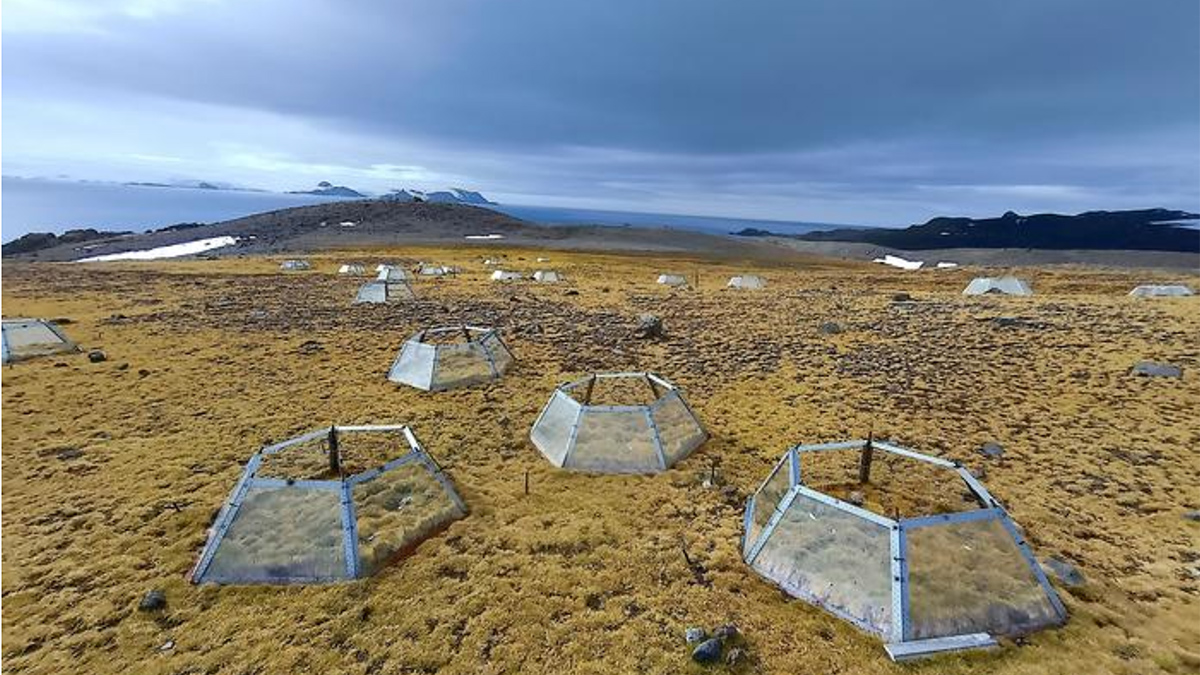
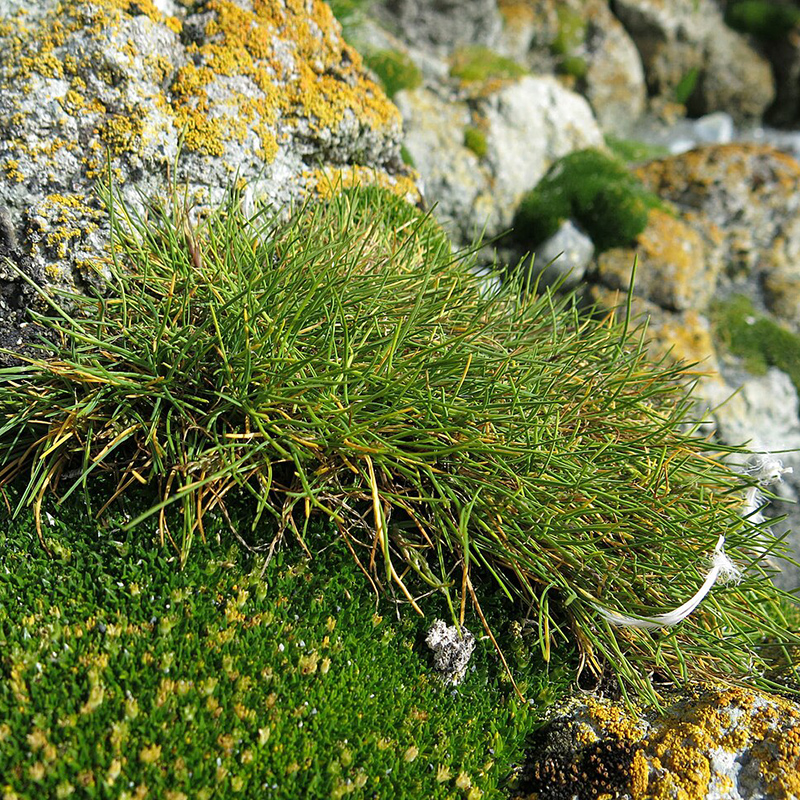
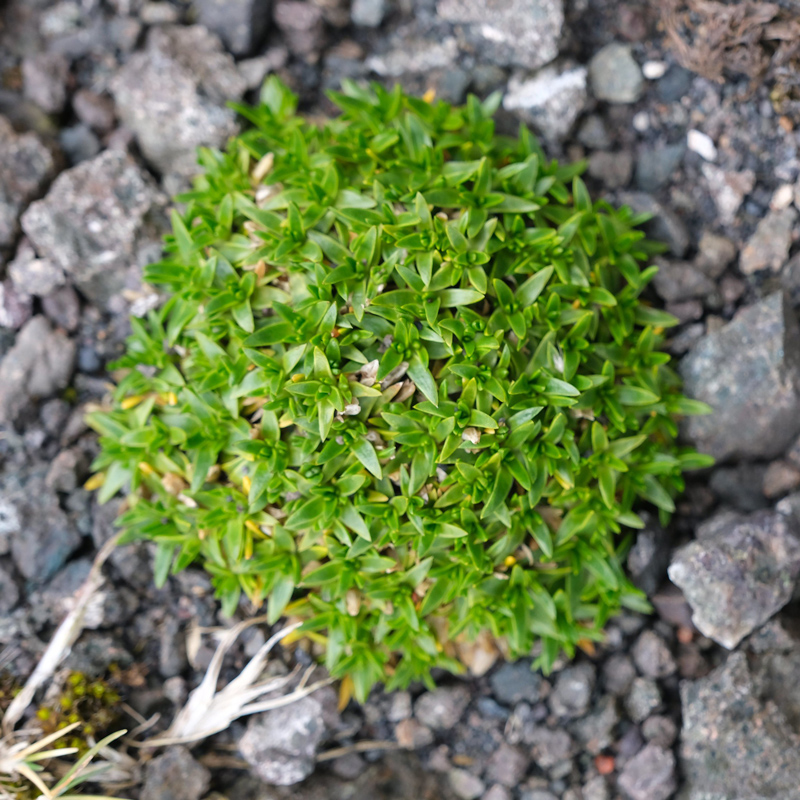
Each summer for more than a decade, Patricia Sáez and her colleagues have traveled to King George Island, off the northern tip of the Antarctic Peninsula, to check on the only two flowering species native to Antarctica.
Antarctic hair grass (Deschampsia antarctica) and Antarctic pearlwort (Colobanthus quitensis) have both spread quickly as the Antarctic Peninsula has warmed. In fact, between 1960 and 2009, each species’ range roughly tripled.
However, a study published in Physiologia Plantarum showed that the two plants are coping with a changing climate in opposite ways. After 7 years in experimental warming chambers, the grass moved less water through its leaves and photosynthesized less compared with grass growing outside the chambers. The pearlwort did the reverse.
“Both are exposed to the same experimental warming conditions, but the responses between them are very different.”
“Both are exposed to the same experimental warming conditions, but the responses between them are very different,” said Patricia Sáez, a plant scientist at Universidad de Concepción in Chile and corresponding author of the study. She added that these plants are located in “a hot spot of climate change” and act as “indicators of warming in Antarctica.”
In December 2012, the team installed hexagonal open-top chambers near Poland’s Henryk Arctowski Antarctic Station. These chambers are a common way to warm plants in the field. Their partially enclosed sides trap heat while the open top lets in rain and snow.
Across six growing seasons, the chambers raised mean daily air temperatures by about 1.5°C–3°C. But during the 2018–2019 summer, the chambers behaved differently: Daily highs inside were only about 1°C warmer than in nearby open plots, but daily lows were about 2°C colder. Plants in the chambers spent 309 hours below freezing that season, compared with 32 hours outside.
Tom Buckley, a plant ecophysiologist at the University of California, Davis who was not involved in the study, suggested reading the results as a response to larger swings between daily highs and lows rather than to simple warming.
Peter Convey, a polar terrestrial ecologist at the British Antarctic Survey who was not involved in the study, agreed that the distinction matters. “Warming is not just mean temperature increasing,” he said. In Antarctica, it matters whether temperatures swing back and forth across 0°C.
The authors noted that warming in the region isn’t expected to simply raise average temperatures; it’s also projected to bring more frequent freeze-thaw cycles as temperatures fluctuate around 0°C. That means the chambers may capture a realistic piece of Antarctica’s future.
Two Plumbing Strategies
Because strong winds make it difficult to run sensitive instruments reliably at the field site, the researchers dug up whole plants from both inside and outside the chambers and carried them to a laboratory at Arctowski Station about 1 kilometer away. The close proximity allowed them to finish their measurements within 24 hours. They measured leaf hydraulic conductance, or how easily water flows through the plants’ leaves, along with photosynthesis and leaf anatomy down to the size of individual water-carrying vessels.
Hydraulic conductance is a concept to describe the “plumbing system” that supplies “the engine for plant growth,” said Lawren Sack, a plant physiologist and ecologist at the University of California, Los Angeles who specializes in leaf hydraulics and was not involved in the study.
Inside the chambers, grass leaves moved about two-thirds less water than did grass leaves outside. The chambered grass leaves also built narrower vessels and thicker leaves, and their photosynthesis also dropped by about a third. The pearlwort went the other way. Its leaf water flow and photosynthesis each rose by about 44%, and it developed wider vessels and more elastic cells.
The plants’ shapes may help explain the split. The pearlwort grows in a compact cushion, “a little bit more like a moss,” Convey said, which buffers “how rapidly any change might be occurring on a day-to-day basis.” The loosely structured grass has no such shelter, leaving it more exposed to freezing.
The authors don’t think the grass’s leaves were simply clogged by air bubbles from freezing, because its narrow vessels resist that kind of damage. They suggest the repeated freeze-thaw events may have triggered changes outside the vessels and possibly early leaf aging. However, the team didn’t measure those processes directly.
Buckley praised the team for tracking anatomy alongside physiology. Such measurements “might be viewed by some people in biology in the modern world as being sort of classical or old-fashioned,” he said. “But, in fact, they’re no less important.”
Sack called the study’s level of detail on these remote plants “exceptional,” noting that the plants’ contrasting responses could lead to “shifts in dominance of one species relative to the other.”
However, the outside researchers also pointed to limits. Sack noted that the team didn’t test how the plants’ water transport holds up as leaves dry out, and that this is an important area for future research. However, Sack added that such an omission is “to be expected in [the first study of leaf hydraulics in] such a remote place.” Convey suggested that the study’s 0°C cutoff for counting freezing events may be too high, because many soil microbes and small invertebrates stay active down to about −2°C. A lower cutoff could change how often the plants are counted as crossing the freezing line.
“Every time we find an answer, a new question appears.”
Sáez and her colleagues are now studying plants that have spent 16 years in the chambers. The team is also examining the microorganisms living around the plants, which warming may affect as well. “Every time we find an answer, a new question appears,” Sáez said.
Convey said the study showed something often lost in conversations about climate change. “Even [between] two plants, there are a lot of very specific differences in the responses to what is exactly the same stress,” he said.
—Larissa G. Capella (@CapellaLarissa), Science Writer