

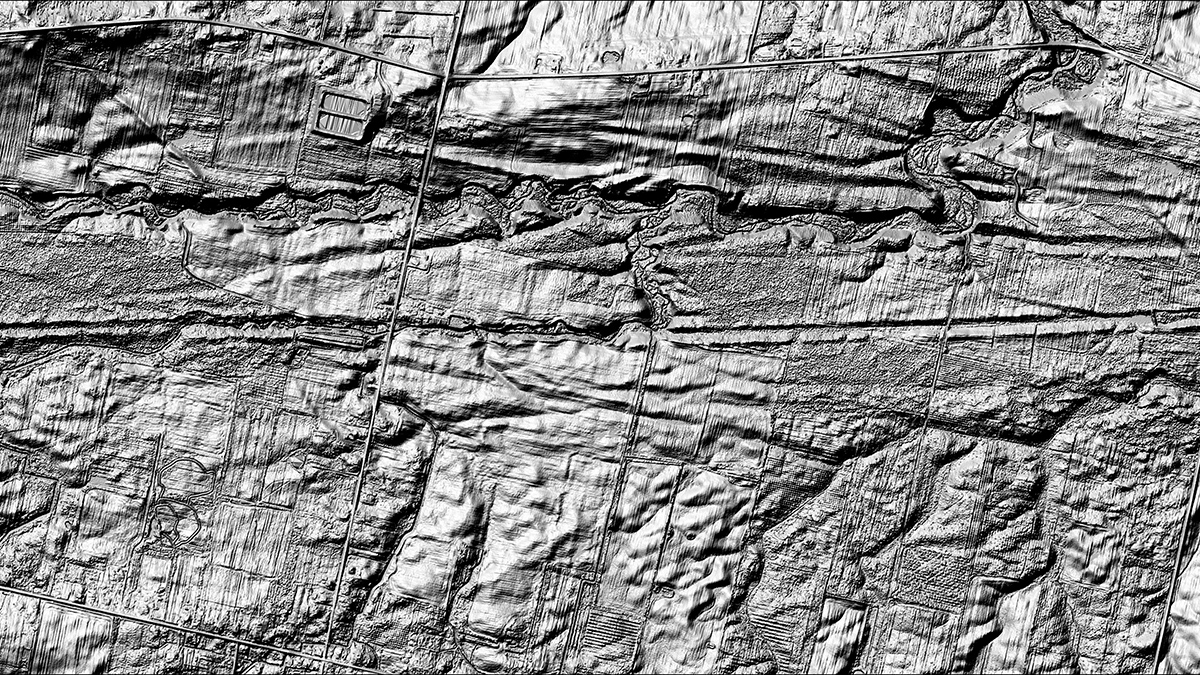
When it comes to impressive expanses of frozen water, consider the Laurentide Ice Sheet. This icy behemoth blanketed much of Canada and parts of the northern United States thousands of years ago and left glacial lakes and icebergs in its path as it retreated. Researchers have now studied the tracks left by some of those icebergs to infer the wind patterns set in motion by the Laurentide Ice Sheet. Understanding such paleowinds can shed light on how ancient expanses of ice influenced global weather patterns, the team suggested in a paper recently published in Geology.
Odd Trenches in the Landscape
“I started finding all of these odd trenches.”
A few years ago, Sean Grasing happened to be analyzing a lidar dataset. He was using the observations, which reveal the contours of a landscape as if it were denuded of vegetation, to search for small moraines in New York. But his sleuthing soon revealed a multitude of unusual—and unexpected—features. “I started finding all of these odd trenches,” said Grasing, an Earth scientist at the University at Buffalo in New York.
Grasing ended up switching research directions to map those mysterious features, tabulating more than 3,000 of them across parts of Michigan, New York, Pennsylvania, Ohio, Ontario, and Quebec. The longest spanned 11 kilometers, but most were a few hundred meters in length. They ranged in depth from under a meter to roughly 5 meters.
Grasing and his thesis adviser, geologist Jason Briner, concluded that they were looking at scour marks left by icebergs scraping against the bottoms of lakes. The source of all that ice was the Laurentide Ice Sheet, which discharged icebergs and created glacial lakes as it retreated during the late Pleistocene.
Have Ice, Will Gust
The gusts that set those icebergs in motion likely came from the ice sheet itself, Grasing and Briner deduced. Substantial ice sheets are capable of creating their own wind patterns as nearby air cools and produces a zone of high pressure moving down the ice sheet. Add in the effect of Earth’s rotation, and you’ve got winds moving in a clockwise (or “anticyclonic”) direction. “In the late Pleistocene, the Laurentide Ice Sheet generated this colossal-sized anticyclonic wind pattern that influenced much of North America,” Grasing said.
Grasing and Briner found that, on average, the iceberg scours overwhelmingly had a west-southwest orientation (imagine a compass rose with 0° marking north and 90° marking east; the scours lined up roughly with the 260° mark). And by finding particularly well-preserved scours that ended in a berm when the iceberg began to float, the team was able to assign a direction to those lines—the icebergs were moving west. In other words, the winds that propelled them were easterly winds.
Additional evidence for easterly winds from the Laurentide Ice Sheet is captured in features like sand dunes and spits. Dunes on the border between New York and Ontario, for example, have a roughly 240° alignment, Grasing and Briner showed. And spits in Michigan record sustained winds from the east and southeast, previous work has shown. “We’re lucky to have other indicators of winds,” said Grasing.
Windy Today, and Tomorrow, and Tomorrow
Grasing and Briner next divided their samples of scours into approximate age bins based on the scours’ various positions in the Great Lakes’ basins. That work allowed the team to trace whether the Laurentide Ice Sheet’s winds had changed direction over time. Easterly winds ruled for thousands of years, the researchers concluded. “When we divide the scour marks by lake stage, in every single stage they were going in the same direction,” Grasing said.
“Now we have the evidence sculpted in the landscape.”
These scour marks represent the longest record of the Laurentide Ice Sheet’s anticyclonic winds, the team noted. Climate models have suggested the existence of such long-lived winds, but now there are data to back up that assertion, said Grasing. “Now we have the evidence sculpted in the landscape.”
Relatively little is known about the winds of the past, which in turn affected temperature and precipitation patterns, said Jessica Conroy, an Earth scientist at the University of Illinois Urbana-Champaign who was not involved in the research. “This is a really important data point.”
It’s a novel idea to use iceberg scours as wind vanes, added Randy Schaetzl, a geomorphologist at Michigan State University in East Lansing, also not involved in the research. “I think it’s a fantastic application.”
—Katherine Kornei (@KatherineKornei), Science Writer