• About
  • Sections
  • Topics
    • Climate
    • Earth Science
    • Oceans
    • Space & Planets
    • Health & Ecosystems
    • Culture & Policy
    • Education & Careers
    • Opinions
  • Projects
    • Postcards From the Field
    • ENGAGE
    • Editors’ Highlights
    • Editors’ Vox
    • Eos en Español
    • Eos 简体中文版
    • Print Archive: 2015–2025
  • Science Policy Tracker
  • Blogs
    • Research & Developments
    • The Landslide Blog
  • Newsletter
  • Submit to Eos
  • AGU.org
  • Career Center
  • Join AGU
  • Give to AGU
  • About
  • Sections
  • Topics
    • Climate
    • Earth Science
    • Oceans
    • Space & Planets
    • Health & Ecosystems
    • Culture & Policy
    • Education & Careers
    • Opinions
  • Projects
    • Postcards From the Field
    • ENGAGE
    • Editors’ Highlights
    • Editors’ Vox
    • Eos en Español
    • Eos 简体中文版
    • Print Archive: 2015–2025
  • Science Policy Tracker
  • Blogs
    • Research & Developments
    • The Landslide Blog
  • Newsletter
  • Submit to Eos
Skip to content
  • AGU.org
  • Career Center
  • Join AGU
  • Give to AGU
Eos

Eos

Science News by AGU

Support Eos
Sign Up for Newsletter
  • About
  • Sections
  • Topics
    • Climate
    • Earth Science
    • Oceans
    • Space & Planets
    • Health & Ecosystems
    • Culture & Policy
    • Education & Careers
    • Opinions
  • Projects
    • Postcards From the Field
    • ENGAGE
    • Editors’ Highlights
    • Editors’ Vox
    • Eos en Español
    • Eos 简体中文版
    • Print Archive: 2015–2025
  • Science Policy Tracker
  • Blogs
    • Research & Developments
    • The Landslide Blog
  • Newsletter
  • Submit to Eos

Heather Benway

Marine snow falling through photic zone in Monterey Bay, California.
Posted inScience Updates

Our Evolving Understanding of Biological Carbon Export

by Emily Osborne, Jessica Y. Luo, Ivona Cetinić, Heather Benway and Susanne Menden-Deuer 12 September 202325 January 2024

The array of processes and organisms that make up the biological carbon pump has immense influence on Earth’s carbon cycle and climate. But there’s still much to learn about how the pump works.

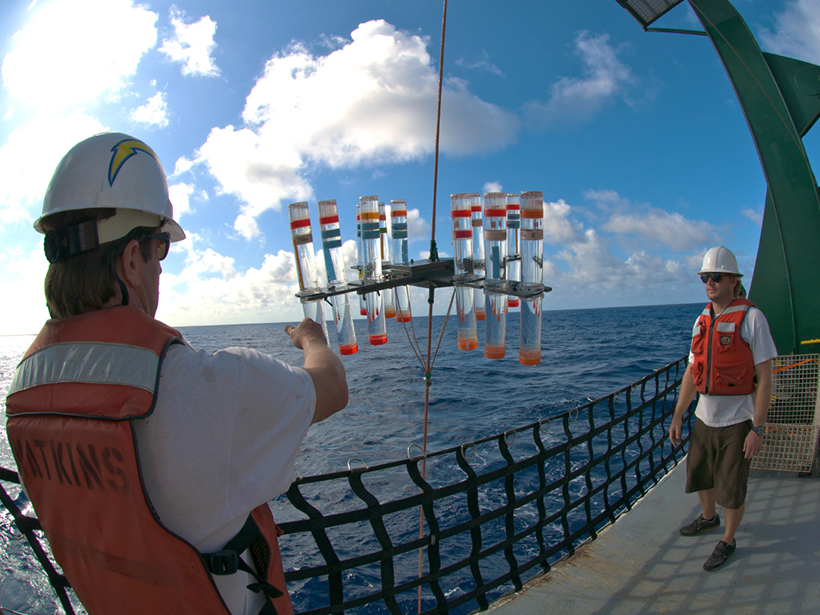
Hawaii Ocean Time-series program scientists recover particle interceptor traps
Posted inFeatures

Monitoring Ocean Change in the 21st Century

by S. Neuer, Heather Benway, N. Bates, C. A. Carlson, M. Church, M. DeGrandpre, J. Dunne, R. Letelier, M. Lomas, L. Lorenzoni, F. Muller-Karger, M. J. Perry and P. Quay 8 September 201725 March 2024

Time series data sets, which contain measurements repeated over a span of decades, yield important insights into our oceans’ vital signs.

Posted inScience Updates

Building International Research Partnerships in the North Atlantic–Arctic Region

by Heather Benway, Eileen Hofmann and M. St. John 2 September 201412 January 2022

An International Planning Workshop for a North Atlantic–Arctic Science Program;
Arlington, Virginia, 14–16 April 2014

A view of a bridge, with the New Orleans skyline visible in the distance between the bridge and the water. A purple tint, a teal curved line representing a river, and the text “#AGU25 coverage from Eos” overlie the photo.

Features from AGU Publications

Research Spotlights

What Could Happen to the Ocean’s Carbon If AMOC Collapses

6 January 20266 January 2026
Editors' Highlights

Frictional Properties of the Nankai Accretionary Prism

11 December 20259 December 2025
Editors' Vox

Hydrothermal Circulation and Its Impact on the Earth System

3 December 20253 December 2025
Eos logo at left; AGU logo at right

About Eos
ENGAGE
Awards
Contact

Advertise
Submit
Career Center
Sitemap

© 2026 American Geophysical Union. All rights reserved Powered by Newspack