• About
  • Special Reports
  • Topics
    • Climate
    • Earth Science
    • Oceans
    • Space & Planets
    • Health & Ecosystems
    • Culture & Policy
    • Education & Careers
    • Opinions
  • Projects
    • Postcards From the Field
    • ENGAGE
    • Editors’ Highlights
    • Editors’ Vox
    • Eos en Español
    • Eos 简体中文版
    • Print Archive: 2015–2025
  • Policy Tracker
  • Blogs
    • Research & Developments
    • The Landslide Blog
  • Newsletter
  • Submit to Eos
  • AGU.org
  • Career Center
  • Join AGU
  • Give to AGU
  • About
  • Special Reports
  • Topics
    • Climate
    • Earth Science
    • Oceans
    • Space & Planets
    • Health & Ecosystems
    • Culture & Policy
    • Education & Careers
    • Opinions
  • Projects
    • Postcards From the Field
    • ENGAGE
    • Editors’ Highlights
    • Editors’ Vox
    • Eos en Español
    • Eos 简体中文版
    • Print Archive: 2015–2025
  • Policy Tracker
  • Blogs
    • Research & Developments
    • The Landslide Blog
  • Newsletter
  • Submit to Eos
Skip to content
  • AGU.org
  • Career Center
  • Join AGU
  • Give to AGU
Eos

Eos

Science News by AGU

Support Eos
Sign Up for Newsletter
  • About
  • Special Reports
  • Topics
    • Climate
    • Earth Science
    • Oceans
    • Space & Planets
    • Health & Ecosystems
    • Culture & Policy
    • Education & Careers
    • Opinions
  • Projects
    • Postcards From the Field
    • ENGAGE
    • Editors’ Highlights
    • Editors’ Vox
    • Eos en Español
    • Eos 简体中文版
    • Print Archive: 2015–2025
  • Policy Tracker
  • Blogs
    • Research & Developments
    • The Landslide Blog
  • Newsletter
  • Submit to Eos

P. Rizzoli

Editor, AGU Advances

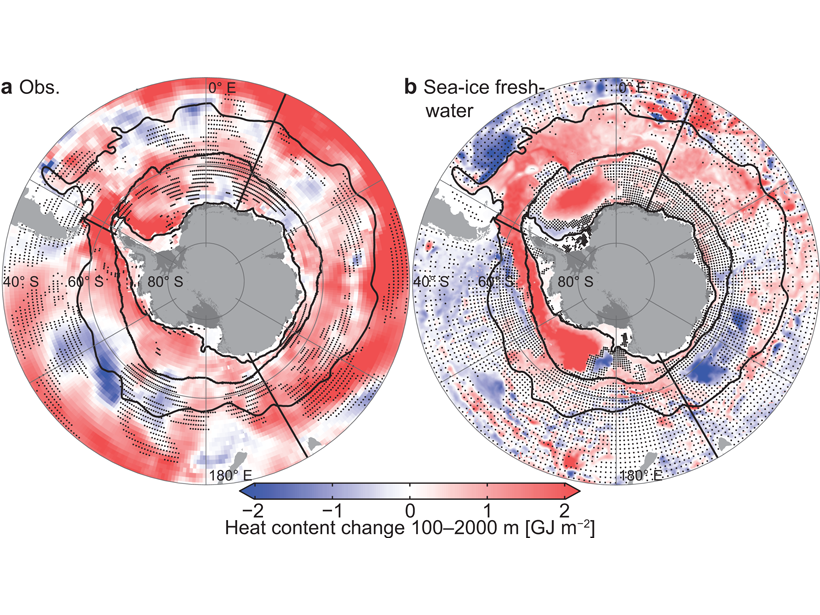
Maps showing observed (left) and simulated (right) subsurface ocean heat content changes in the Southern Ocean
Posted inEditors' Highlights

Explaining Cold and Fresh Southern Polar Ocean Surface Waters

by P. Rizzoli 6 May 202017 August 2022

Global climate models do not reproduce observed trends of the Southern polar ocean surface, but an increase in wind-transported sea ice that melts and inhibits mixing may account for the disparity.

An aurora as seen from the International Space Station.
Posted inAGU News

AGU Advances Goes Online

Eric Davidson, president-elect of AGU by Susan Trumbore, A. Barros, Eric Davidson, Bethany Ehlmann, J. Famiglietti, N. Gruber, Mary Hudson, T. Illangasekare, Sarah Kang, T. Parsons, P. Rizzoli, V. Salters, B. Stevens, D. Wuebbles, Peter Zeitler and T. Zhu 7 August 20193 April 2023

Featuring high-impact papers and a streamlined process, AGU’s new journal is ready to launch.

Over a dark blue-green square appear the words Special Report: The State of the Science 1 Year On.

Features from AGU Publications

Research Spotlights

Making a Map to Make a Difference

11 February 202611 February 2026
Editors' Highlights

A New Way to Measure Quartz Strength at High Pressure

13 February 202612 February 2026
Editors' Vox

A Double-Edged Sword: The Global Oxychlorine Cycle on Mars

10 February 202610 February 2026
Eos logo at left; AGU logo at right

About Eos
ENGAGE
Awards
Contact

Advertise
Submit
Career Center
Sitemap

© 2026 American Geophysical Union. All rights reserved Powered by Newspack