• About
  • Special Reports
  • Topics
    • Climate
    • Earth Science
    • Oceans
    • Space & Planets
    • Health & Ecosystems
    • Culture & Policy
    • Education & Careers
    • Opinions
  • Projects
    • Postcards From the Field
    • ENGAGE
    • Editors’ Highlights
    • Editors’ Vox
    • Eos en Español
    • Eos 简体中文版
    • Print Archive: 2015–2025
  • Policy Tracker
  • Blogs
    • Research & Developments
    • The Landslide Blog
  • Newsletter
  • Submit to Eos
  • AGU.org
  • Career Center
  • Join AGU
  • Give to AGU
  • About
  • Special Reports
  • Topics
    • Climate
    • Earth Science
    • Oceans
    • Space & Planets
    • Health & Ecosystems
    • Culture & Policy
    • Education & Careers
    • Opinions
  • Projects
    • Postcards From the Field
    • ENGAGE
    • Editors’ Highlights
    • Editors’ Vox
    • Eos en Español
    • Eos 简体中文版
    • Print Archive: 2015–2025
  • Policy Tracker
  • Blogs
    • Research & Developments
    • The Landslide Blog
  • Newsletter
  • Submit to Eos
Skip to content
  • AGU.org
  • Career Center
  • Join AGU
  • Give to AGU
Eos

Eos

Science News by AGU

Support Eos
Sign Up for Newsletter
  • About
  • Special Reports
  • Topics
    • Climate
    • Earth Science
    • Oceans
    • Space & Planets
    • Health & Ecosystems
    • Culture & Policy
    • Education & Careers
    • Opinions
  • Projects
    • Postcards From the Field
    • ENGAGE
    • Editors’ Highlights
    • Editors’ Vox
    • Eos en Español
    • Eos 简体中文版
    • Print Archive: 2015–2025
  • Policy Tracker
  • Blogs
    • Research & Developments
    • The Landslide Blog
  • Newsletter
  • Submit to Eos

Research Spotlights

Research spotlights are plain-language summaries of recent articles published in AGU’s suite of 24 journals.
A piece of rock under a microscope. Colors are mostly gray and beige, with a small section of blue near the center. A legend on the bottom right indicates the image is about 100 micrometers across.
Posted inResearch Spotlights

Mantle Heat May Have Boosted Earth’s Crust 3 Billion Years Ago

by Rebecca Owen 23 April 202423 April 2024

Information from igneous zircon molecules gives researchers new insight into the workings of inner Earth.

A red first aid bag sits on a frozen lake. A shore with pine trees is in the distance.
Posted inResearch Spotlights

Lakes Worldwide Need a Checkup

Sarah Derouin, Science Writer by Sarah Derouin 22 April 20244 June 2024

Lakes are facing a slew of health issues that may become chronic. Can human health care strategies help?

A glacier between two dark-colored mountains. A snowy mountain reaching up into the clouds is in the background, and blue seawater is in the foreground.
Posted inResearch Spotlights

A Million Years Without a Megaslide

by Rebecca Owen 19 April 202419 April 2024

A new study goes deep into the Gulf of Alaska to examine the sixth-largest underwater landslide and investigate why a similar event hasn’t happened since.

An oil rig surrounded by a green wall sits on a dirt landscape. Three people, surrounded by boxes and bags, sit in the dirt and examine instruments.
Posted inResearch Spotlights

Anthropocene Activities Dramatically Alter Deep Underground Fluid Flux

Sarah Stanley, Science Writer by Sarah Stanley 17 April 202417 April 2024

Scientists call for improved understanding of how our influence on deep subsurface fluids and microbes might affect the larger Earth system.

An overhead shot of a group of zebras approaching a waterhole surrounded by greenery.
Posted inResearch Spotlights

Animals Deserve to Be Included in Global Carbon Cycle Models, Too

by Nathaniel Scharping 16 April 202416 April 2024

Because they are far less plentiful than plants and microbes, animals have typically been excluded from examinations of carbon exchange in the atmosphere. But new research shows they may have a considerable influence on carbon cycle dynamics.

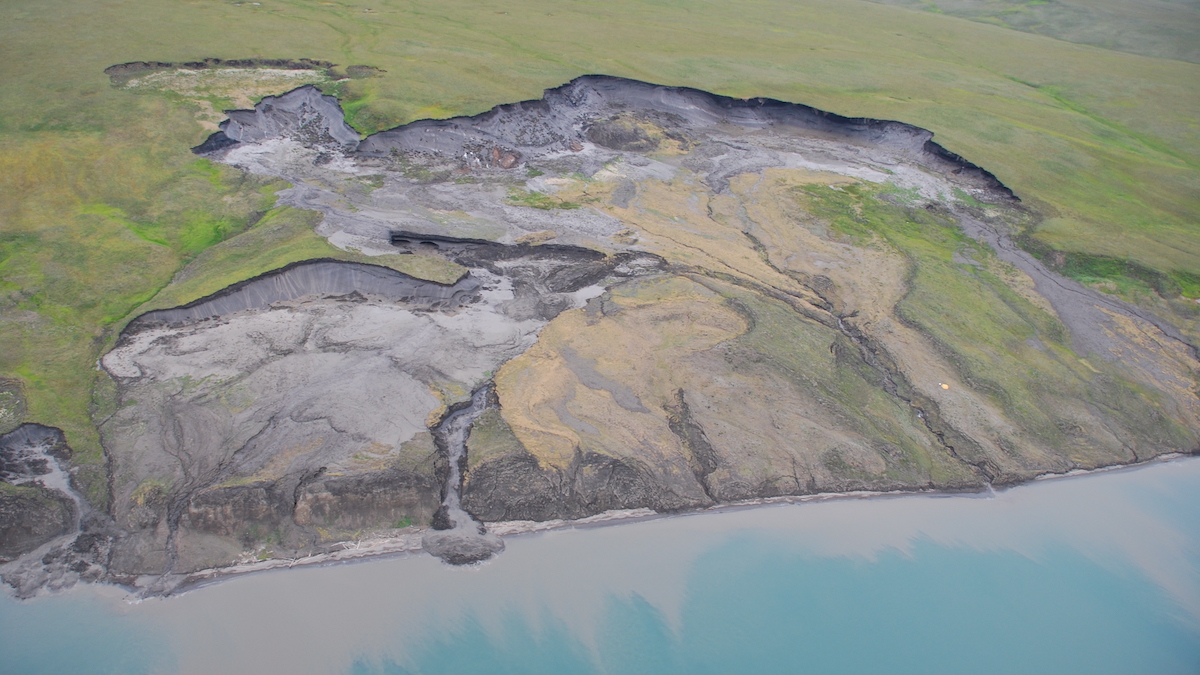
Permafrost as seen from above. The landscape is patchy and the color of dead grass, with a few areas of standing water. The sky in the distance is pale blue.
Posted inResearch Spotlights

Northern Permafrost Region Emits More Greenhouse Gases Than It Captures

by Saima May Sidik 15 April 202415 April 2024

Permafrost underlies a quarter of the Northern Hemisphere. A comprehensive analysis shows that the area may have shifted from a sink to a source of greenhouse gases, bringing a longtime prediction to fruition.

A simulated image of Earth with Antarctica at the center. Swirls and waves in the ocean represent the speed and direction of currents and eddies.
Posted inResearch Spotlights

Verifying the Mathematics Behind Ocean Modeling

by Nathaniel Scharping 11 April 202415 April 2024

A series of test cases designed to confirm the accuracy of ocean models could help improve our understanding of large-scale climate processes.

Aerial photo of a large rupture caused by an earthquake.
Posted inResearch Spotlights

Fault Maturity or Orientation: Which Matters More for Quakes?

Sarah Stanley, Science Writer by Sarah Stanley 10 April 20248 July 2024

Close examination of a 2021 earthquake on the Tibetan Plateau provides hints that, counter to prior assumptions, the influence of fault orientation can sometimes trump that of maturity.

A man walks down a road with a group of cattle, some of which are bulls with large horns.
Posted inResearch Spotlights

Africa’s Carbon Sink Capacity Is Shrinking

Rachel Fritts, Science Writer by Rachel Fritts 4 April 20244 April 2024

A new estimate of Africa’s greenhouse gas budget from 2010 to 2019 shows increasing emissions from cropland expansion, livestock, and fossil fuel use—meaning the continent may have transitioned from an overall carbon sink to a slight carbon source.

Two glass enclosures among a forest of spruce trees in the snow
Posted inResearch Spotlights

Warming Experiment Explores Consequences of Diminished Snow

Aaron Sidder, freelance science writer by Aaron Sidder 1 April 20247 August 2024

The SPRUCE ecosystem in northern Minnesota offered a setting to research exactly how a snowy environment responds to rising temperatures.

Posts pagination

Newer posts 1 … 27 28 29 30 31 … 203 Older posts
Over a dark blue-green square appear the words Special Report: The State of the Science 1 Year On.

Features from AGU Publications

Research Spotlights

How Internal Waves Transport Energy Thousands of Miles Across the Ocean

26 March 202626 March 2026
Editors' Highlights

Taming the Seismicity Tsunami with a Scalable Bayesian Framework

7 April 20266 April 2026
Editors' Vox

The Future of Earth’s Future

24 March 202624 March 2026
Eos logo at left; AGU logo at right

About Eos
ENGAGE
Awards
Contact

Advertise
Submit
Career Center
Sitemap

© 2026 American Geophysical Union. All rights reserved Powered by Newspack