
Editors’ Highlights are summaries of recent papers by AGU’s journal editors.
Source: Journal of Geophysical Research: Solid Earth
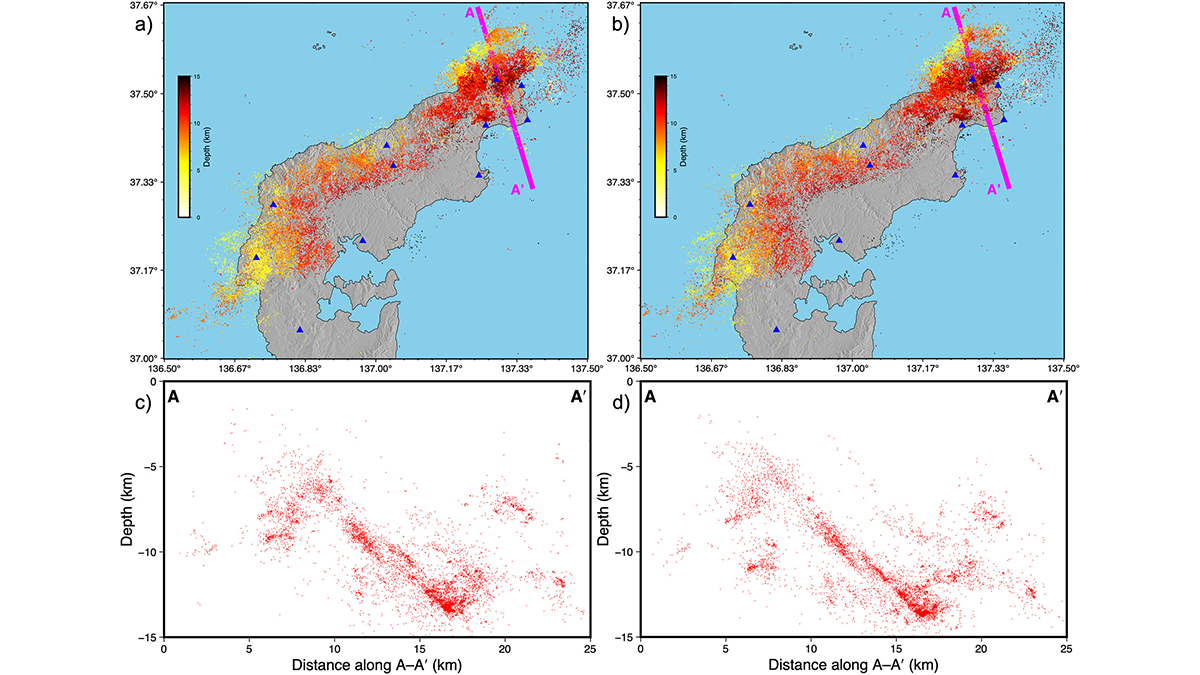
Machine learning allows us to detect millions of tiny earthquakes, but our current tools struggle to process this “data tsunami” with high precision. While a popularized mathematical approach called “Bayesian inference” can tell us exactly how reliable an earthquake’s location is, it is usually too slow to handle such massive amounts of information. This is especially true for “double-difference” methods, which compare pairs of earthquakes but create a massive computational bottleneck when dealing with millions of connections. To solve this, Ross et al. [2026] present a new framework called Scalable Probabilistic Inference for Differential Earthquake Relocation (SPIDER), that combines the power of artificial intelligence with advanced physics simulations.
By using a specialized neural network and a highly efficient sampling technique, SPIDER bypasses these bottlenecks to simultaneously relocate over a million earthquake parameters. Tests on computer simulations and real-world data demonstrate the capability of SPIDER to reveal much sharper and clearer images of hidden underground faults that were previously blurred.
Beyond just providing locations, it also gives scientists a rigorous way to measure the uncertainty and reliability of every single event in an entire catalog. This breakthrough allows us to map seismic activity with unprecedented clarity, helping us “see” better the shape and thickness of complicated fault structures deep underground and improving our ability to prepare for future earthquake hazards.
Citation: Ross, Z. E., Wilding, J. D., Azizzadenesheli, K., & Kato, A. (2026). SPIDER: Scalable probabilistic inference for differential earthquake relocation. Journal of Geophysical Research: Solid Earth, 131, e2025JB032769. https://doi.org/10.1029/2025JB032769
—Hsin-Hua Huang, Associate Editor, JGR: Solid Earth