
Editors’ Highlights are summaries of recent papers by AGU’s journal editors.
Source: Journal of Geophysical Research: Space Physics
Space weather refers to the changing conditions in space caused by solar activity, such as solar flares and massive eruptions called coronal mass ejections (CMEs), which can disrupt satellites, communications, and navigation systems on Earth. Interplanetary scintillation (IPS) is a ground-based remote sensing technique that monitors solar wind density fluctuations by observing the flickering of distant radio sources as their signals propagate through the solar wind, revealing information about its speed, density, and turbulence.
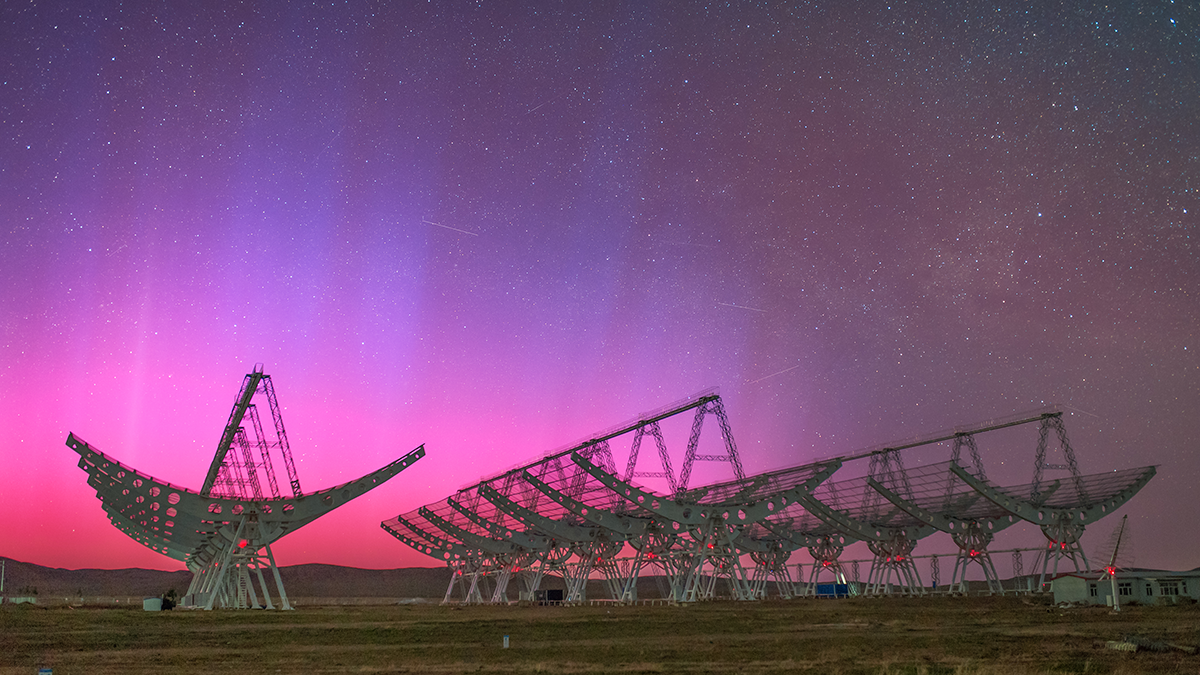
Fan et al. [2025] present the first IPS-dedicated telescope to feature a dual-band, dual-polarized multi-beam phased array feed (PAF) receiver with a hybrid beamforming architecture. The study also introduces phased array alignment diffusion algorithm (PANDA), an AI-based calibration method that ensures consistent performance across thousands of receiver channels under complex conditions. This novel architecture represents a significant advancement in next-generation IPS radio telescopes, setting a new precedent in the field. The observations enabled by this system will not only advance research in space weather and IPS theory but can also be integrated with data from other IPS facilities around the world. As a result, this work will make a substantial contribution to the global interplanetary scintillation community and strengthen our ability to monitor and predict space weather events.
Citation: Fan, J., Wang, W., Peng, J., Cao, H., Xiong, M., Deng, Y., & Yan, Y. (2025). Design and performance of phased array feed system for the meridian project phase II interplanetary scintillation telescope. Journal of Geophysical Research: Space Physics,130, e2025JA034585. https://doi.org/10.1029/2025JA034585
—Qiu-Gang Zong, Editor, JGR: Space Physics