
Editors’ Highlights are summaries of recent papers by AGU’s journal editors.
Source: AGU Advances
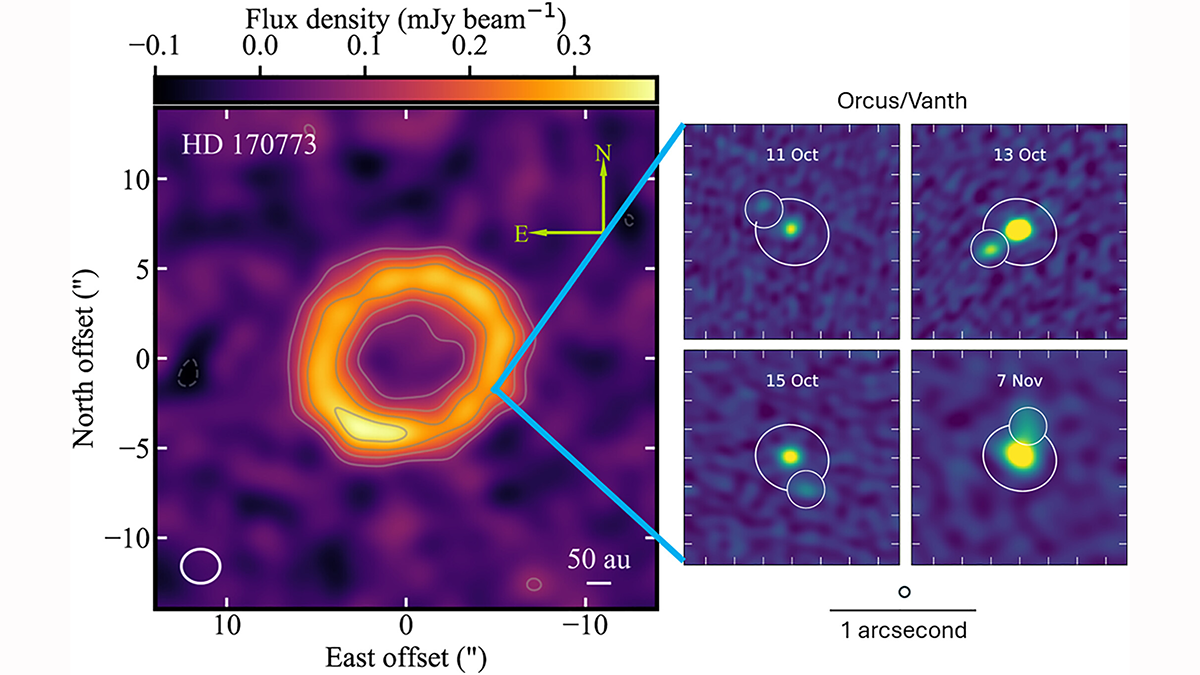
Asteroids, moons, and comets near Earth act like fossils from the time when our solar system first formed. In a new article, de Kleer et al. [2025] explain how a powerful telescope called the Atacama Large Millimeter/submillimeter Array (ALMA) has changed the way scientists study these small worlds. ALMA can detect very weak thermal emission (heat) signals, allowing researchers to map the surface features of asteroids and accurately measure the masses of distant objects beyond Neptune, known as Kuiper Belt Objects.
ALMA is also used to study gases released by volcanic eruptions on Jupiter’s moon Io and probe the thick atmosphere of Saturn’s moon Titan. The review emphasizes the study of isotopes, which are slightly different forms of the same chemical element. These isotopes act like chemical fingerprints, helping scientists track how elements such as nitrogen and sulfur have changed over time. By comparing these local measurements with observations of young planetary systems around other stars, scientists can better understand how the ingredients for life survived the violent process of planet formation.
Citation: de Kleer, K., Brown, M. E., Cordiner, M., & Teague, R. (2025). Satellites and small bodies with ALMA: Insights into solar system formation and evolution. AGU Advances, 6, e2025AV001778. https://doi.org/10.1029/2025AV001778
—Xi Zhang, Editor, AGU Advances