
Editors’ Highlights are summaries of recent papers by AGU’s journal editors.
Source: Journal of Geophysical Research: Solid Earth
The deformation of Earth materials can occur either in a “brittle” manner, mediated by fractures whose propagation radiates elastic waves, or through “intracrystalline plasticity,” governed by the motion of crystalline defects and generally considered to be largely aseismic. However, within the “brittle–plastic transition,” these mechanisms are expected to coexist. Moreover, if intracrystalline defect propagation is sufficiently rapid and accompanied by stress release, it may also theoretically generate elastic waves.
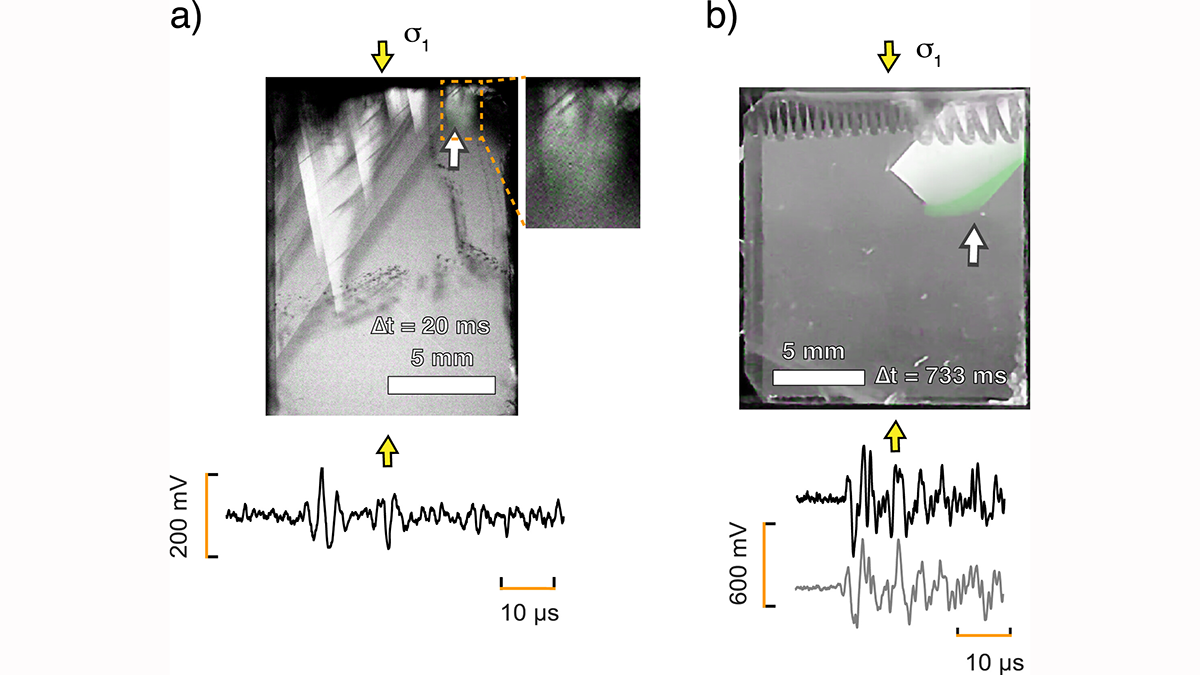
O’ Ghaffari et al. [2026] present the first experiments in which optical, mechanical, and acoustic measurements are acquired simultaneously during the propagation of intracrystalline defects (twin boundaries) in calcite single crystals. High-speed imaging, reaching up to 12,500 frames per second, is combined with multiple ultrasonic sensors sampling up to 50 million samples per second, allowing deformation processes to be resolved across a wide range of spatial and temporal scales.
The experiments capture the evolution of both brittle microcracks and crystal-plastic twins as they propagate through the crystal. Direct comparison of image sequences and acoustic records demonstrates that these two deformation mechanisms generate distinct ultrasonic signals. In particular, subtle differences in waveform characteristics are linked to the physical nature of the defect source. This distinction provides a new basis for separating brittle and plastic deformation signals in acoustic emission data. The results have important implications for laboratory studies and for interpreting acoustic monitoring data in geological and other semi-brittle materials.
Citation: O’ Ghaffari, H., Peč, M., Cross, A. J., Mittal, T., & Mok, U. (2026). Brittle and crystal-plastic defect dynamics of calcite single crystals. Journal of Geophysical Research: Solid Earth, 131, e2025JB032846. https://doi.org/10.1029/2025JB032846
—Marie Violay, Associate Editor, JGR: Solid Earth