Research & Developments is a blog for brief updates that provide context for the flurry of news that impacts science and scientists today.
The Mars Perseverance rover has detected intact organic molecules near previously described potential signatures of ancient life, according to a new study published today in Science Advances.
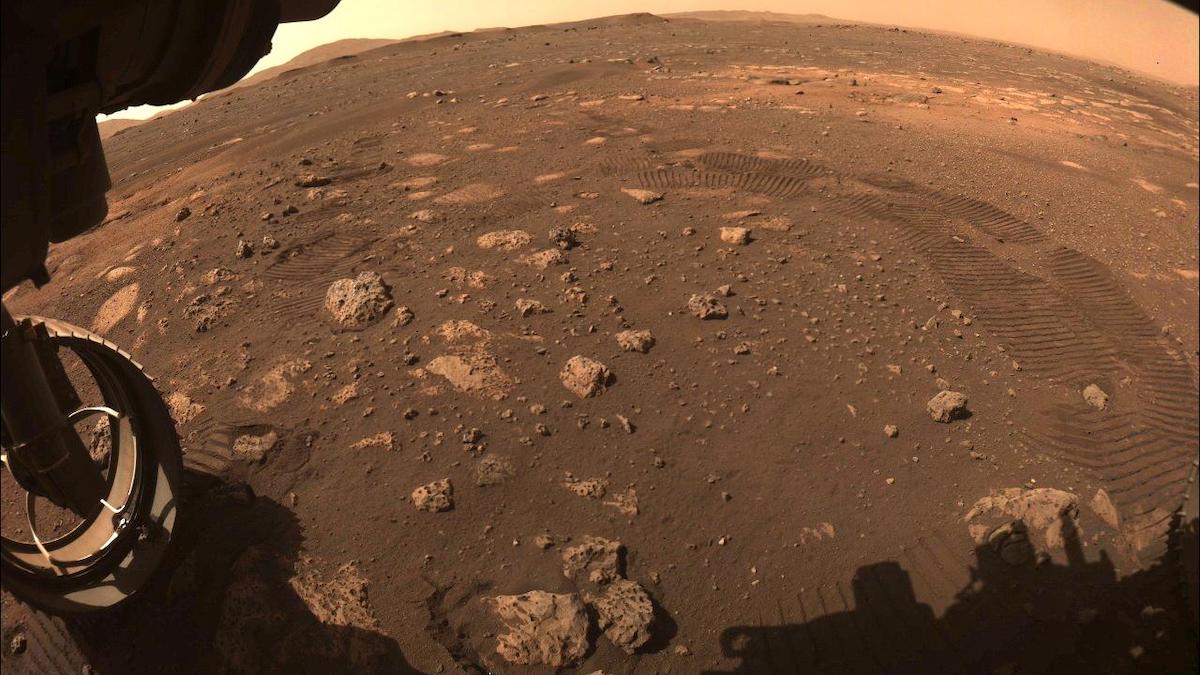
Perseverance has been exploring Mars’s Jezero Crater since 2021, giving scientists insight into the Red Planet’s geology and searching for potential signatures of life. Billions of years ago, Jezero Crater was frequently flooded with water, making it a potentially hospitable place for ancient microbial life.
The findings provide “an unambiguous confirmation and corroboration of previous reports of organics on Mars.”
The new study describes data from Perseverance’s Scanning Habitable Environments with Raman & Luminescence for Organics & Chemicals (SHERLOC) instrument, which identifies rocks’ chemical composition with a laser. The instrument’s measurements indicated that two mudstones in the Bright Angel outcrop in Jezero Crater—the Cheyava Falls rock and the Walhalla Glades rock—contained macromolecular organic carbon (MMC), a complex, large form of carbon-based molecules that can form via biotic or abiotic processes. One mudstone contained organic carbon associated with a silicate rock, and the other contained organic carbon associated with carbonate and sulfate minerals.
Previous analyses have indicated the presence of organic carbon on Mars: The Curiosity rover detected organic carbon in bulk measurements of ground-up rock from Mars’s Gale Crater, and MMC has been identified in Martian meteorites and at a single point in igneous rock in Jezero Crater. But the new study is the first to identify intact MMC at multiple sites on the Martian surface, and the first to do so in Martian mudstones.
The findings provide “an unambiguous confirmation and corroboration of previous reports of organics on Mars,” the new study states.
“This work shows that MMC is present in ancient Mars rocks,” Adrian Broz, a planetary scientist at Purdue University and coauthor of the new study, wrote in an email to Eos. Still, “it is unclear where or how these molecules originated.”
Biotic or Not?
On Earth, MMC is sometimes found within and around microbial fossils. But it also forms on Earth from abiotic processes, such as when hydrothermal systems subject rocks to extreme heat. Many meteorites that collide with Earth also contain MMC, meaning meteorites could also be an abiotic source of MMC on Mars, according to Broz.
The location of the detected MMC is relevant to the question of whether it indicates the presence of ancient life. In September 2025, scientists found potential evidence of ancient microbial life patterns resembling leopard spots, also at the Bright Angel outcrop. At the time, Nicola Fox, the science head of NASA, said the findings were “the closest we’ve actually come to discovering ancient life on Mars.”
The new research adds to the multiple observations of rock characteristics that could be attributed to the presence of ancient life at the Bright Angel formation. This spatially overlapping evidence lends credence to the idea that the newly detected MMC is a potential biosignature, Broz wrote.
The samples described in the new study were also found more than 3,500 kilometers (2,175 miles) away from the detections of organic carbon reported by the Curiosity rover, “which indicates that the habitability of Mars, and the availability of organics, may have been widespread across the planet billions of years ago,” the paper states.
Still, “it is possible that Mars had a way of abiotically manufacturing these types of features … so laboratory, modeling and field studies are now required,” Broz wrote. Returning a sample of the rocks in question to Earth is “ultimately required to fully address the question of the biogenicity of these features on Mars,” he added.
—Grace van Deelen (@gvd.bsky.social), Staff Writer
These updates are made possible through information from the scientific community. Do you have a story about science or scientists? Send us a tip at [email protected].