


In the most detailed and highest-resolution black hole simulation to date, an international team of researchers showed the Bardeen-Petterson effect for the first time.
astrophysics
Posted inEditors' Highlights
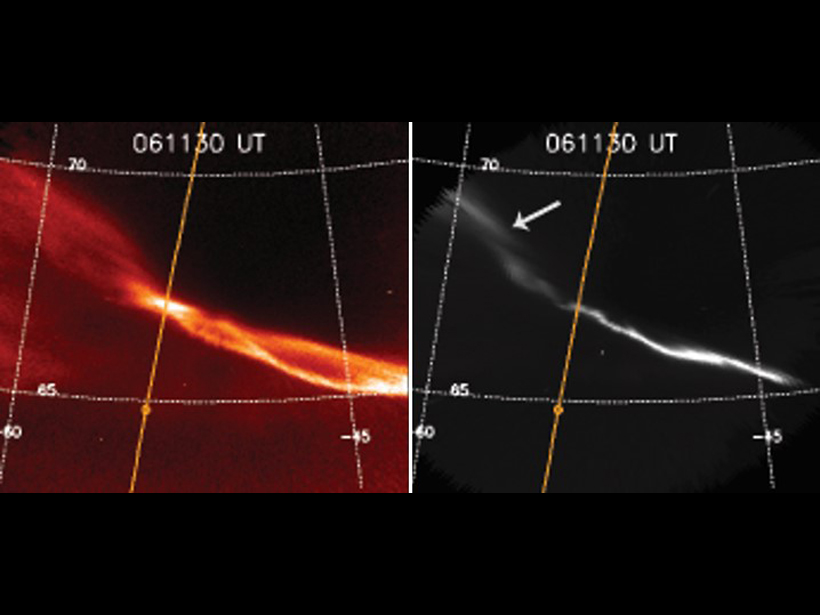
Red and Green Aurora Stop and Go for Different Reasons
Green-line arc is found to be embedded within large-scale upward field aligned currents while red-line-only arc is found to be associated with low-energy precipitation bursts.
Posted inResearch Spotlights
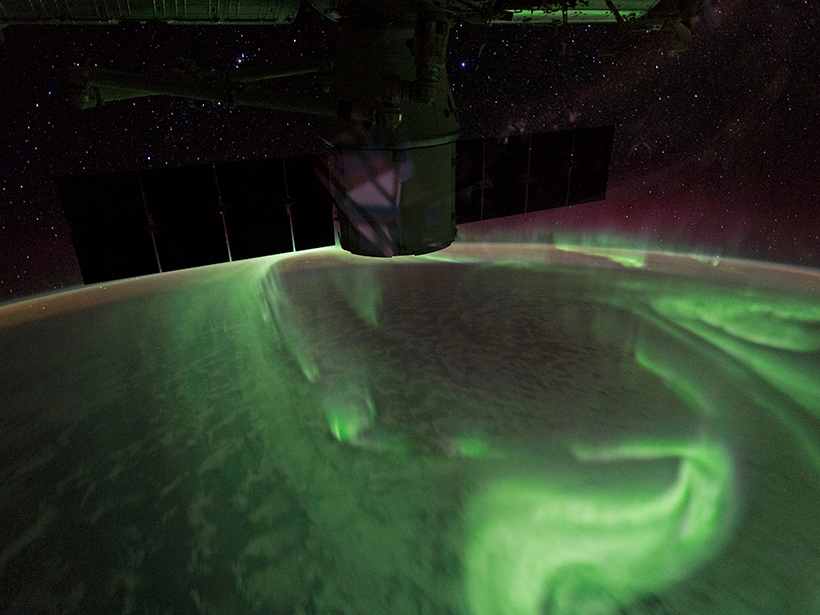
Bringing Clarity to What Drives Auroras
A new classification scheme helps researchers distinguish what accelerates the electrons that create auroras.
Posted inAGU News
Doherty Receives 2018 Space Physics and Aeronomy Richard Carrington Education and Public Outreach (SPARC) Award
Patricia Doherty will receive the 2018 Space Physics and Aeronomy Richard Carrington Education and Public Outreach (SPARC) Award at AGU’s Fall Meeting 2018, to be held 10–14 December in Washington, D. C. The award is given “for significant and outstanding impact on students’ and the public’s understanding of our science through their education and/or outreach activities.”

Posted inEditors' Highlights
Energetic Electrons Can Penetrate the Stratosphere
Precipitations of electrons with energies greater than 30 kiloelectron volts from the slot region penetrate at low altitude and can contribute to destroy ozone.

Posted inResearch Spotlights
Studying Soil from a New Perspective
Cosmic ray neutrons probe soil moisture in the Great Plains.

Posted inResearch Spotlights
Understanding the Effects of Anthropogenic Space Weather

A large plasma hole generated by the vertical launch of the Formosat-5 satellite created temporary navigating and positioning errors of up to 1 meter, according to a new study.

Posted inResearch Spotlights
New Explanation for “Meandering” Electrons Orbiting Earth
A new study proposes a simpler theory to explain a class of electrons zipping around Earth, propelled by magnetic explosions.

Posted inResearch Spotlights
Calculating Plasma Waves—With a Twist
What happens when two plasmas with different temperatures overlap? The answer depends on a quantum effect that twists the waves as they ripple through the sea of electrons.
Posted inEditors' Vox
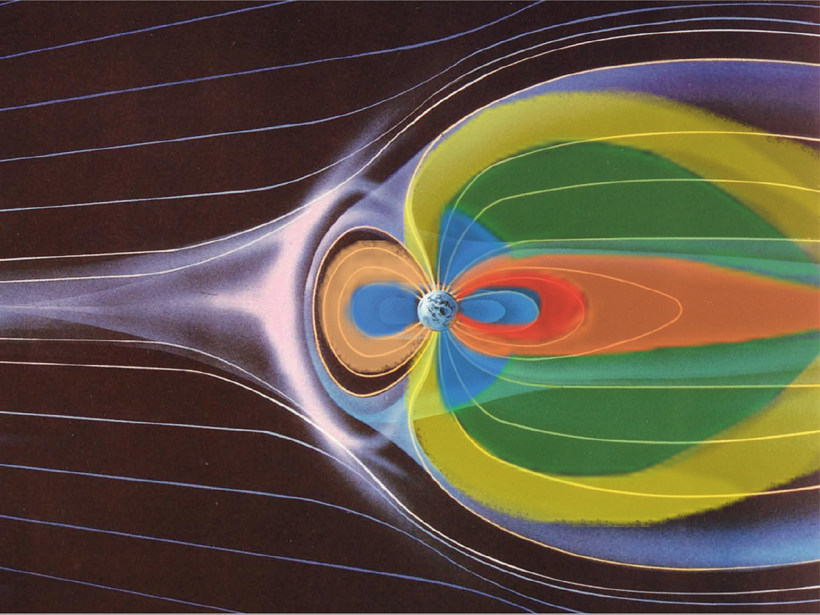
Filling Earth’s Space Environment from the Sun or the Earth?
The editor of a new book describes how a unique combination of the monograph and video show that a four-decade old paradigm in solar-terrestrial physics is changing.