


A new study employs a method originally developed to help map stars and galaxies to describe how ancient tombs are clustered. The research helps archaeologists studying remote or inaccessible sites.
Space & Planets

Posted inNews
Ejecta Discovered Near Site of Ancient Meteorite Impact

South Africa’s Vredefort impact structure is the largest on the planet, and researchers have now discovered the first proximal ejecta possibly deriving from the cataclysmic impact.

Posted inEditors' Highlights
Magnetic Record of Early Nebular Dynamics
Magnetized particles in a meteorite suggest strong magnetic fields in the early solar nebula.
Posted inEditors' Highlights
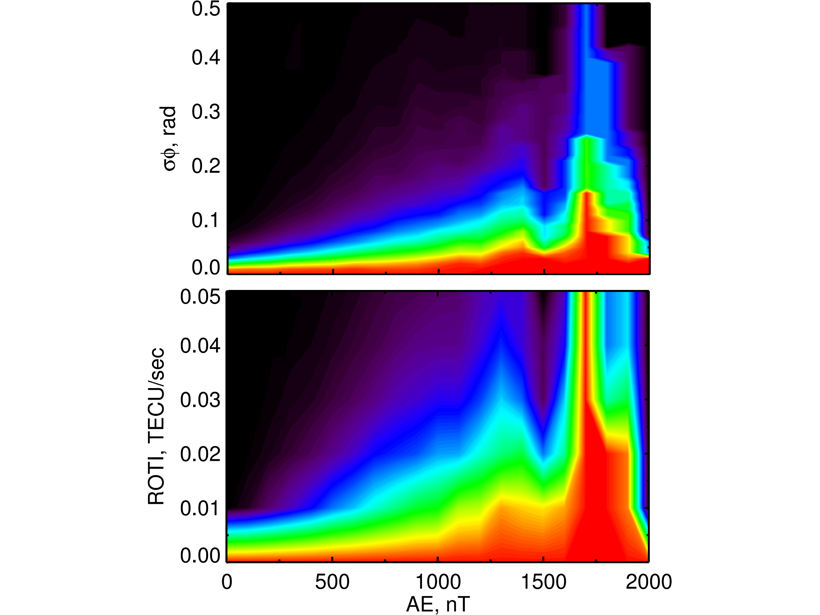
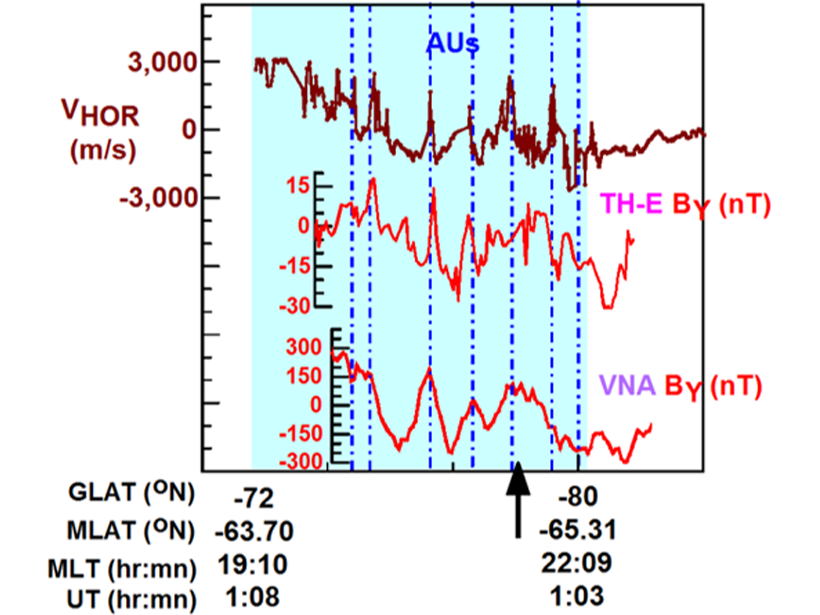
The Auroral E-region is a Source for Ionospheric Scintillation
Observations reveal a connection between auroral particle precipitation and scintillation, indicating that the ionospheric E-region is a key source region for phase scintillation at auroral latitudes.

Posted inNews
Glassy Nodules Pinpoint a Meteorite Impact
Researchers working in Chile’s Atacama Desert have collected thousands of “atacamaites” that suggest a meteorite struck the region roughly 8 million years ago.
Posted inEditors' Highlights
Satellite Data Reveal Magnetospause K-H Waves Impact Auroras
Analysis of multiple satellite data has revealed a striking connection between K-H waves on the magnetopause, surface waves in the hot zone near the plasmapause, and auroral undulations.

Posted inNews
Where Moons Are Made

The young, growing planet PDS 70 c has enough material swirling around it to make at least three Moon-sized moons.
Posted inFeatures
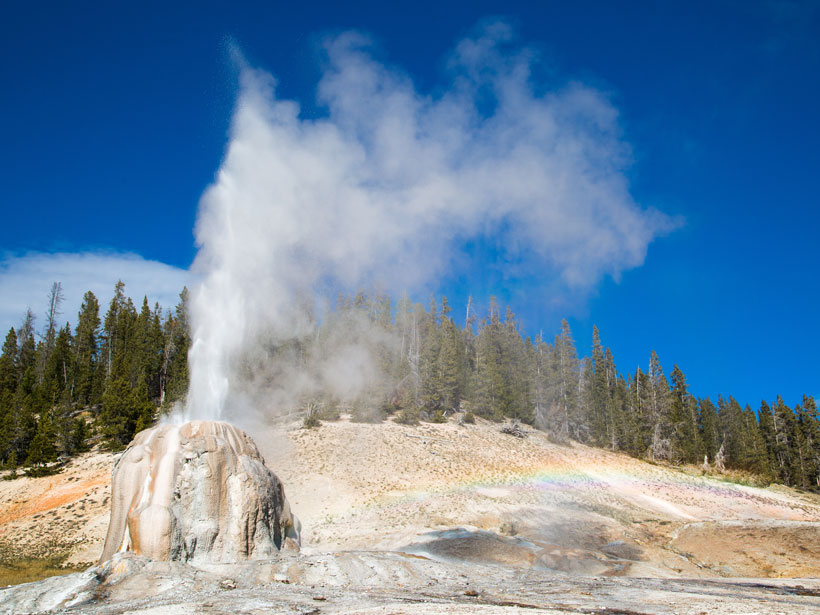
Why Study Geysers?
Aside from captivating our senses, geysers have much to tell us about subsurface fluids, climate change effects, and the occurrence and limits of life on Earth and elsewhere in the solar system.
Posted inNews
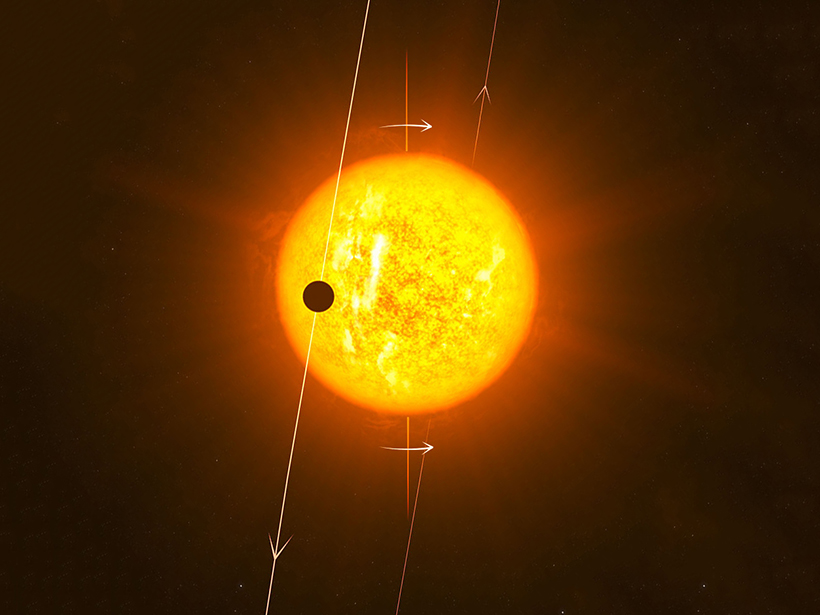
Peculiar Planets Prefer Perpendicular Paths
Some exoplanets orbit their stars from pole to pole instead of across the equator. Why do they do that?

Posted inGeoFIZZ
El universo de Dune inspira la nomenclatura de Titán

En todo el sistema solar, la ciencia choca con la ciencia ficción en formas literarias.