• About
  • Special Reports
  • Topics
    • Climate
    • Earth Science
    • Oceans
    • Space & Planets
    • Health & Ecosystems
    • Culture & Policy
    • Education & Careers
    • Opinions
  • Projects
    • Postcards From the Field
    • ENGAGE
    • Editors’ Highlights
    • Editors’ Vox
    • Eos en Español
    • Eos 简体中文版
    • Print Archive: 2015–2025
  • Policy Tracker
  • Blogs
    • Research & Developments
    • The Landslide Blog
  • Newsletter
  • Submit to Eos
  • AGU.org
  • Career Center
  • Join AGU
  • Give to AGU
  • About
  • Special Reports
  • Topics
    • Climate
    • Earth Science
    • Oceans
    • Space & Planets
    • Health & Ecosystems
    • Culture & Policy
    • Education & Careers
    • Opinions
  • Projects
    • Postcards From the Field
    • ENGAGE
    • Editors’ Highlights
    • Editors’ Vox
    • Eos en Español
    • Eos 简体中文版
    • Print Archive: 2015–2025
  • Policy Tracker
  • Blogs
    • Research & Developments
    • The Landslide Blog
  • Newsletter
  • Submit to Eos
Skip to content
  • AGU.org
  • Career Center
  • Join AGU
  • Give to AGU
Eos

Eos

Science News by AGU

Support Eos
Sign Up for Newsletter
  • About
  • Special Reports
  • Topics
    • Climate
    • Earth Science
    • Oceans
    • Space & Planets
    • Health & Ecosystems
    • Culture & Policy
    • Education & Careers
    • Opinions
  • Projects
    • Postcards From the Field
    • ENGAGE
    • Editors’ Highlights
    • Editors’ Vox
    • Eos en Español
    • Eos 简体中文版
    • Print Archive: 2015–2025
  • Policy Tracker
  • Blogs
    • Research & Developments
    • The Landslide Blog
  • Newsletter
  • Submit to Eos

Venus

Electric winds remove the components of water from Venus's upper atmosphere.
Posted inResearch Spotlights

Venus's Unexpected, Electrifying Water Loss

by Mark Zastrow 20 July 20164 May 2022

New research shows that an electric field surrounding Venus is stripping its atmosphere of water—and the same phenomenon may plague exoplanets scientists hope might be habitable.

Solar wind interacts with Venus's ionosphere to produce magnetotail.
Posted inResearch Spotlights

Solar Wind Disconnects Venus’s Magnetotail

by A. K. Higginson 27 June 201618 July 2023

Polarity reversals in the solar wind magnetic field disconnect the magnetic field trailing behind Venus, allowing ions from the atmosphere to escape.

Posted inResearch Spotlights

Evidence for Volcanoes on Venus

by David Shultz 16 October 201517 February 2023

Infrared light from the planet's surface shows hot spots that might be caused by lava.
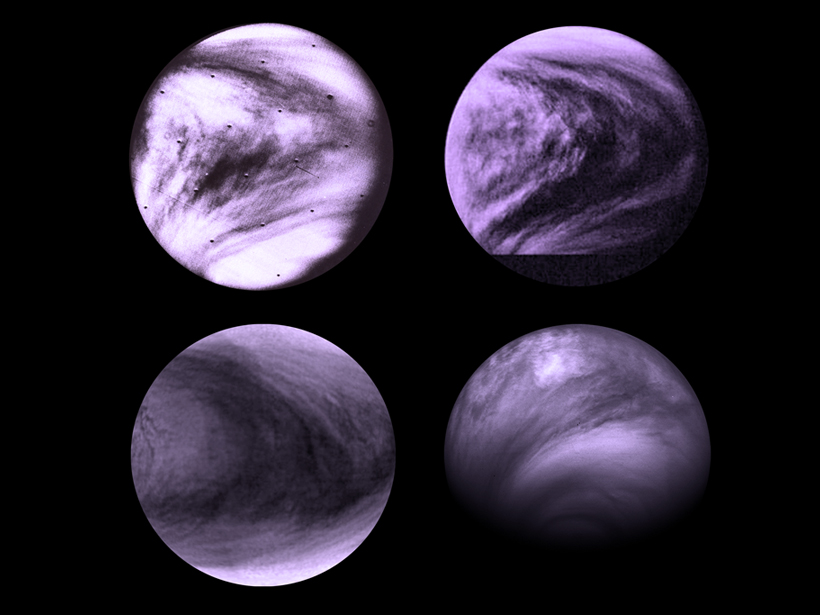
Posted inResearch Spotlights

New Atmospheric Wave May Shape Venus's Clouds

by J. Calderone 16 October 201523 January 2023

A novel model suggests that a new wave may be responsible for Venus's iconic Y pattern.

Posts pagination

Newer posts 1 2 3 4
Over a dark blue-green square appear the words Special Report: The State of the Science 1 Year On.

Features from AGU Publications

Research Spotlights

Sea Turtles, Shrinking Beaches, and Rising Seas

16 March 202616 March 2026
Editors' Highlights

Next Generation Fluid Flow Solver for Earth System Modeling

17 March 202612 March 2026
Editors' Vox

Salt: A Vital Compound for Science and Society

16 March 202616 March 2026
Eos logo at left; AGU logo at right

About Eos
ENGAGE
Awards
Contact

Advertise
Submit
Career Center
Sitemap

© 2026 American Geophysical Union. All rights reserved Powered by Newspack