
Editors’ Vox is a blog from AGU’s Publications Department.
In May 2023, a group of scientists gathered in Agros, Cyrpus, for an AGU Chapman Conference, “Hydrothermal Circulation and Seawater Chemistry: What’s the Chicken and What’s the Egg?” They discussed the role of hydrothermal fluxes in regulating ocean biogeochemistry and the Earth system. To share key finding from that conference—and other groundbreaking research on hydrothermal systems—the AGU book Hydrothermal Circulation and Seawater Chemistry: Links and Feedbacks came to life.
The latest volume in AGU’s Geophysical Monograph Series, this book explores on- and off-axis hydrothermal systems, boundary conditions such as climate and sedimentation history, and approaches for tracking oceanic processes. We asked the book’s Volume Editors about the latest methods and techniques, practical applications, and the future of the field of study.
In simple terms, what is hydrothermal circulation as it relates to seawater chemistry?
Hydrothermal circulation in this context is the flow of seawater through ocean crust.
Hydrothermal circulation in this context is the flow of seawater through ocean crust. It occurs at high-temperatures at mid-ocean ridges and at lower temperatures across much of the seafloor.
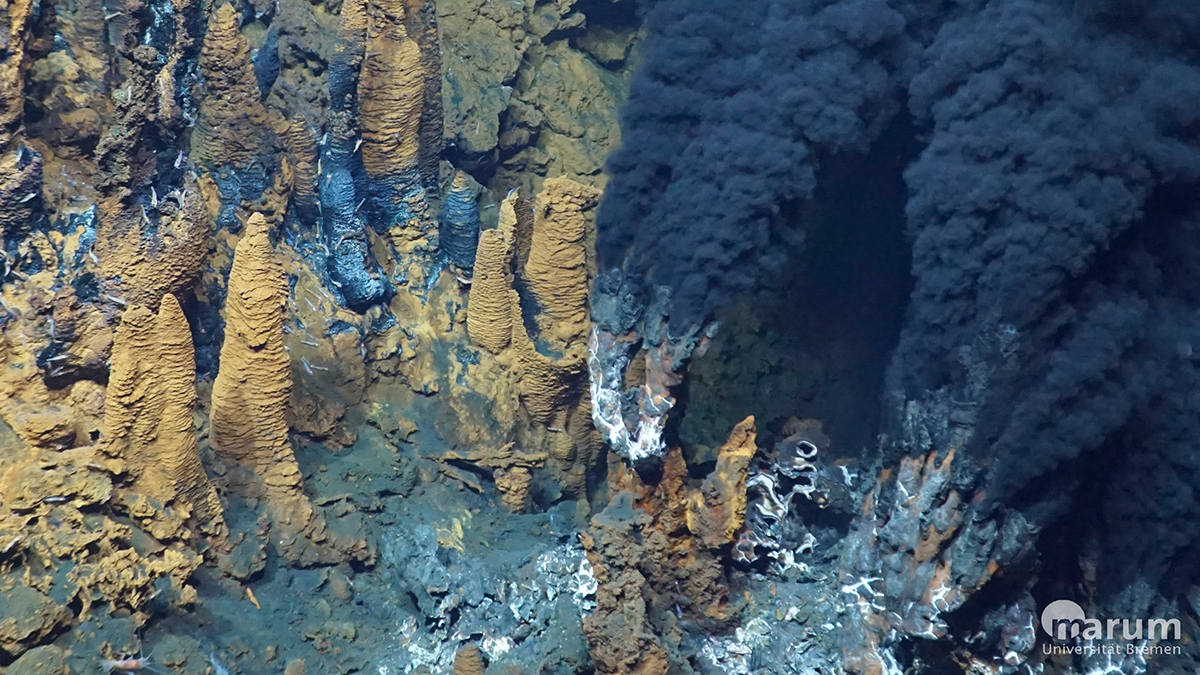
Along mid-ocean ridges, high-temperature (~400°C) reactions between seawater and crust turn the circulating seawater into hydrothermal fluids that become enriched in many elements such as potassium, calcium, and iron. Because these hot fluids are much less dense than cold seawater, the fluid flows rapidly upwards and vents at the seafloor. Cooling leads to precipitation of dissolved constituents forming chimney structures and particles carried by the fluid (the well-known “black smoke”). Other dissolved ions stay in solution and are added to the ocean, changing the composition of the seawater.
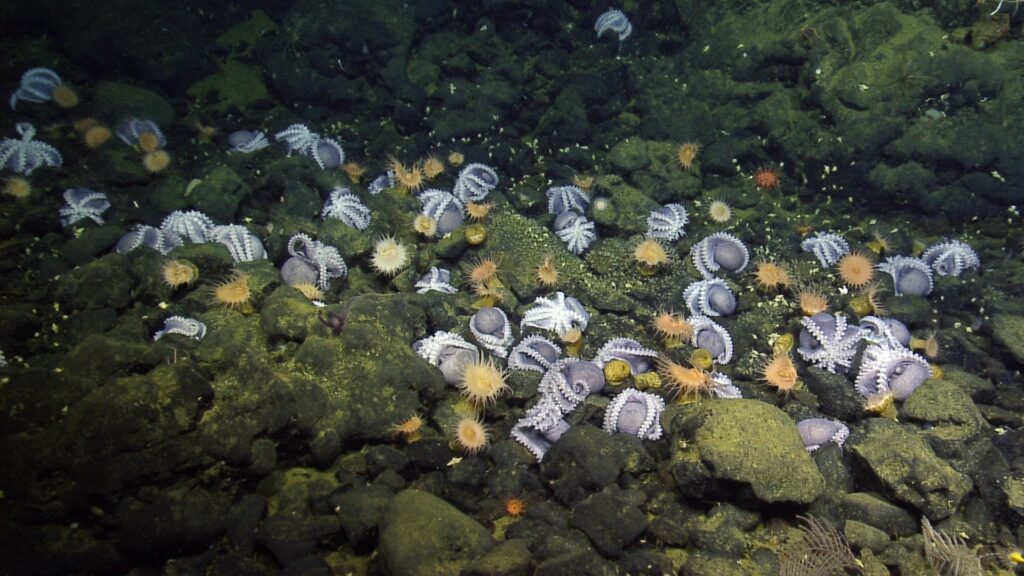
Hydrothermal circulation farther from mid-ocean ridges typically heats seawater by only 5–10°C and changes the chemical composition of the fluid much less than that of the hotter fluids. However, orders of magnitude more seawater circulates through low-temperature systems than high-temperature systems, making them equally important to seawater chemistry.
How do various boundary conditions impact hydrothermal processes in the ocean, and why is it important to study them?
The amount of fluid that flows through mid-ocean ridge hydrothermal systems depends on the geodynamic boundary conditions that control characteristics such as the average global rate of accretion of new oceanic crust and its thickness. These boundary conditions also control the types of rocks that make up the ocean crust, which impacts fluid–rock reactions and hence the composition of the fluid vented into the ocean. The composition and temperature of the deep seawater that circulates into the crust are also important boundary conditions controlling fluid–rock reactions and have both changed substantially over Earth’s history. For example, changes in the redox state of seawater over Earth’s history changed fluid–rock reactions and in-turn hydrothermal fluxes into the ocean.
What are the latest methods and techniques for studying hydrothermal circulation discussed in the book?
The book covers the latest methods and techniques for advancing various interdisciplinary fields focused on hydrothermal vents.
The book covers the latest methods and techniques for advancing various interdisciplinary fields focused on hydrothermal vents. For example, deploying novel instrumentation in the harsh conditions of high-pressure and high-temperature seafloor hydrothermal systems is improving studies of hydrothermal systems. Attaching instruments, such as Raman spectrometers and mass spectrometers, to seafloor cabled observatories will provide new insights into the dynamics of hydrothermal systems. Advancements in instrumentation will also significantly benefit the study of diffuse flow along mid-ocean ridges where fluids vent at tens of degrees Celsius rather than the much higher temperatures characteristic of “black smokers.” Diffuse venting circulates much more water, and probably more heat, than black smoker venting and yet has received only a fraction of the study. Scientists studying low-temperature seafloor hydrothermal systems distributed across the seafloor are starting to borrow methods used for studying continental weathering systems, which should lead to rapid progress being made in understanding these systems.
What practical applications do the studies presented in the book have for Earth system science?
Understanding the Earth system requires a quantitative understanding of the controls on global biogeochemical cycles. Currently, most models of global biogeochemical cycles either ignore hydrothermal systems or assume they do not change over time. However, there is now copious evidence that the fluxes of elements into and out of seawater due to hydrothermal systems are dependent on environmental conditions (e.g., climate, seawater chemistry) and hence do change over time. Furthermore, there can be feedbacks between the environment and the hydrothermal fluxes. This book will help people modeling the Earth system to better incorporate hydrothermal systems into biogeochemical models. In turn, the results of such models will become more robust.
Where do you see the study of hydrothermal systems heading in the next 10 years?
The book features many exciting directions that the study of hydrothermal systems will hopefully take in the next decade. For example, there is a pressing need for more intense study of seafloor weathering until we understand it as well as we understand continental weathering. Expanding the availability of novel instruments that can be deployed at hydrothermal vents at mid-ocean ridges will advance the understanding of hydrothermal systems (e.g., during volcanic eruptions that are currently poorly understood). Vast potential also exists to better incorporate hydrothermal processes into Earth system models. Finally, a growth area for future research will be the role of hydrothermal systems on exoplanets and in the search for other habitable bodies. For example, NASA’s ongoing Clipper Mission to Jupiter’s moon Europa will hopefully enrich our understanding of the role of hydrothermal activity in controlling the habitability of this body.
How is the book organized?
After an introductory chapter, the next six chapters address hydrothermal processes at mid-ocean ridges. They consider both black smoker and diffuse flow systems, as well as the impact of these systems on the water column above mid-ocean ridges. The methods used to study hydrothermal systems, both in the lab and field, are also covered. An example of the fingerprint of changes in axial hydrothermal processes through changing seawater chemistry is discussed next. This is followed by three chapters about low-temperature hydrothermal systems that discuss how much more we have to discover about these systems. The last four chapters address the role of oceanic hydrothermal systems on planetary scale processes, both on Earth and other rocky bodies. They discuss how global-scale models work, how hydrothermal processes can be incorporated in such models, and how hydrothermal systems might work on other rocky bodies.
Who is the intended audience of the book?
The audience for the book is intended to be broad—anyone interested in oceanic hydrothermal systems and/or ocean chemistry. People who are new to the field can use the book to get up-to-speed on ongoing interdisciplinary research in this area. This includes new graduate students or experienced researchers who have not previously considered the role of oceanic hydrothermal system in ocean chemistry. The book can also act as a starting point for researchers who develop global biogeochemical cycle models and who want to incorporate hydrothermal fluxes into these models. Finally, the book will appeal to people interested in planetary habitability and the role that hydrothermal systems may play in making other rocky bodies habitable, or the role hydrothermal systems may have played in nurturing early life on Earth.
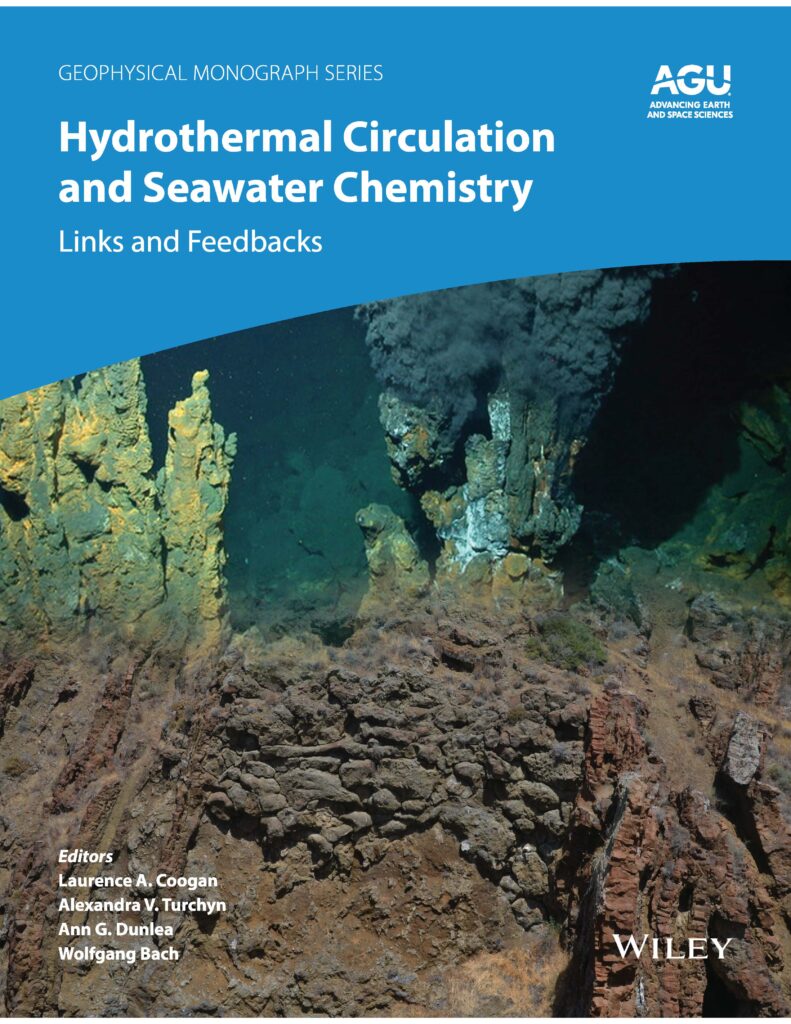
Hydrothermal Circulation and Seawater Chemistry: Links and Feedbacks, 2025. ISBN: 978-1-394-22915-4. List price: $225 (hardcover), $180 (e-book)
Chapter 1 is freely available. Visit the book’s page on Wiley.com and click on “Read an Excerpt” below the cover image.
—Laurence A. Coogan ([email protected];  0000-0001-7289-5120), University of Victoria, Canada; Alexandra V. Turchyn (0000-0002-9298-2173), University of Cambridge, United Kingdom; Ann G. Dunlea (0000-0003-1251-1441), Woods Hole Oceanographic Institution, United States; and Wolfgang Bach (0000-0002-3099-7142), University of Bremen, Germany
Editor’s Note: It is the policy of AGU Publications to invite the authors or editors of newly published books to write a summary for Eos Editors’ Vox.