
A new paper (Jia et al. 2026) has found that the 8 February 2025 Junlian rock avalanche was caused by progressive weakening of the rock mass through wetting and drying cycles.

On 8 February 2025, the major Junlian rock avalanche landslide occurred at Jinping Village in Sichuan Province, China. A paper (Jia et al. 2026) has now been published in the journal Landslides that provides more details about the possible causes of this event. This link should provide access to the paper.
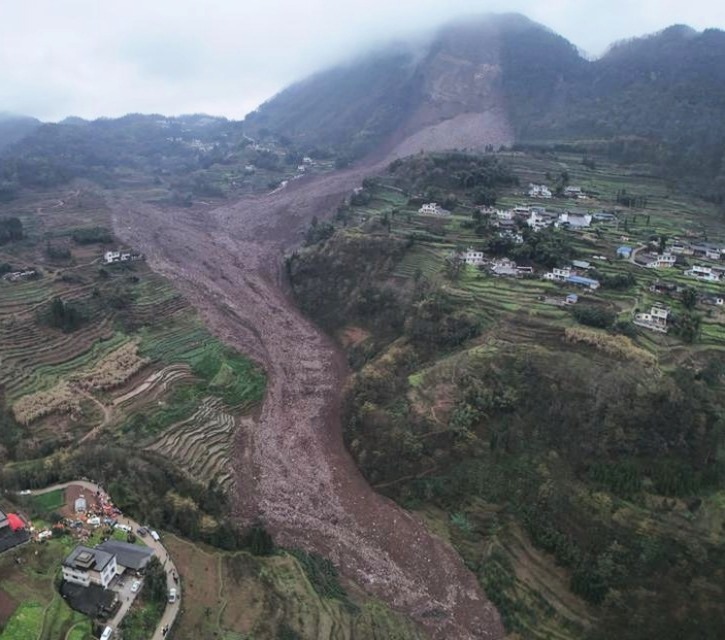
An earlier paper (Zhao et al. 2025), which I noted in June, has already described this landslide. This is a photograph of the aftermath of this event:
Unfortunately, the paper does not give a lat / long for this landslide, but I have previously noted that it is at [27.99885, 104.60801].
As a reminder, Zhao et al. (2025) determined that the initial failure was 370,000 m3, increasing to 600,000 m3 through entrainment. The landslide had a runout distance of 1,180 metres and a vertical elevation change of 440 m. In total, 29 people were killed.
The slightly odd thing about this failure is that the rainfall event that appears to have triggered it was unexceptional (c. 85 mm over the previous 30 days). I hypothesised that a progressive failure mechanism could have been in play.
Jia et al. (2026) have made some really interesting observations. First, this site was subject to previous landslides, most notably in February 2013. The paper notes that:
“all 173 people from 29 households under threat [from this earlier event] were included in the geohazard risk avoidance relocation subsidy program. Some farmers self-demolished their houses, but as some occasionally returned during the farming season, the Mu’ai Town Government, with support from the county government, organized mandatory demolition of unremoved houses in the area in 2018. ”
Further failures occurred in 2021 and 2022, whereupon all the households immediately below the unstable slope were relocated. However, homes located at a greater distance from the cliff were left in place – these were the people affected by the 2025 event.
Jia et al. (2026) suggest that initial movement of the landslide in the years before 2025 weakened the rock mass and opened pathways for the movement of water into the shear zone. Critically, their work suggests that successive wetting and drying cycles led to degradation of the the sandstones and mudstones forming the slope, moving the mass towards failure.
This weakening was sufficient to render the slope vulnerable to the effects of the rainfall in February 20925, triggering the Junlian rock avalanche.
We might take away to key messages from this work. The first is the need to understand the likely runout characteristics of a slope in determining the safety of the population. This is devilishly difficult. That there was an ongoing programme to relocate the most vulnerable people is (on the face of it) good, but it depends on this calculation.
Second is the need to understand the complexities of the processes occurring in a slope. In the case of the Junlian rock avalanche, it was the progressive weakening of the rock mass through wetting and drying cycles that meant that the slope could fail under the influence of unexceptional rainfall. As we drive climate change, similar processes will be occurring in many more slopes in China and elsewhere. That is going to pose a major challenge in terms of keeping people safe.
References
Jia, W., Wen, T., Chen, N. et al. 2026. Dry–wet cycle may trigger the catastrophic landslide in Junlian on February 8, 2025. Landslides. https://doi.org/10.1007/s10346-026-02692-2
Zhao, B., Zhang, Q., Wang, L. et al. 2025. Preliminary analysis of failure characteristics of the 2025 Junlian rock avalanche, China. Landslides. https://doi.org/10.1007/s10346-025-02556-1.