
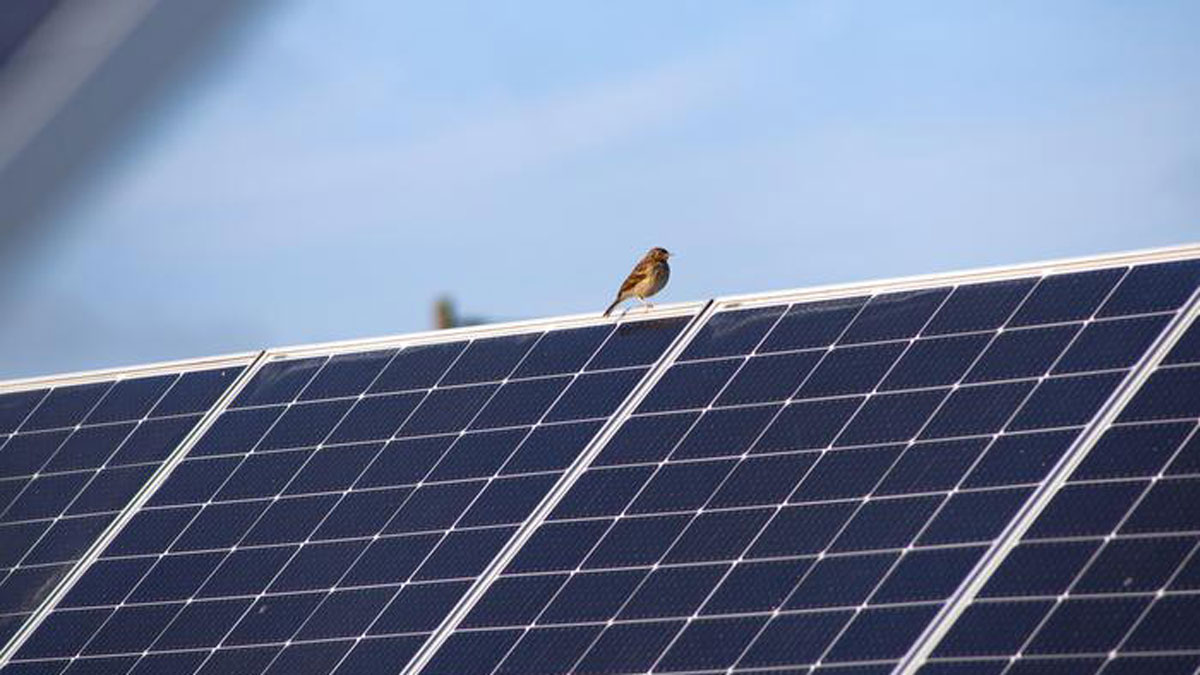

When Hanna Rae Martens visits the solar park she studies in northern Germany, she finds meadow pipits perched on the panels. They launch off to catch insects, then return, using the panels like tree branches.
This solar park, built on rewetted peatland, hosts a more diverse bird community than adjacent drained farmland, according to a new study in Ecological Solutions and Evidence. The findings suggest that combining peatland restoration with solar energy development could benefit birds.
Healthy peatlands hold large quantities of organic matter and, as a result, store more carbon than any other terrestrial ecosystem type.
In drained peatlands, on the other hand, that stored carbon is released to the atmosphere, presenting a major climate problem. In Germany, 95% of peatlands are degraded, and they account for 37% of all annual agricultural greenhouse gas emissions. Globally, drained peatlands emit 5% of all anthropogenic greenhouse gases. That is roughly twice what air travel produces.
Installing solar panels on rewetted peatland is one proposed [solution]: The land gets restored while landowners earn income from energy production.
Rewetting peatlands reduces emissions, but it also makes most crops impossible to grow, reducing the land’s economic prospects. Installing solar panels on rewetted peatland is one proposed way to resolve that: The land gets restored while landowners earn income from energy production.
Martens, a peatland ecologist at the University of Greifswald, led what she says is one of the first studies to examine what that setup means for birds. She and her colleagues tracked bird species at the solar park and at nearby drained grassland throughout the 2024 breeding season.
An Unusual Flock
The team used six low-cost AudioMoth recorders at the solar park and six at the drained grassland site. From March through October 2024, each recorder captured 40-second audio clips of the landscape every 4 minutes. The team generated a large dataset that was then run through BirdNet, an open-source neural network trained to identify bird species from their calls. To reduce false positives, the researchers applied species-specific confidence thresholds before counting any detection.
The solar park attracted a mix of species, including some typically found in wetlands, wooded edges, and urban areas. “The presence of wetland species like reed bunting and the endangered meadow pipit shows that the solar park is truly rewetted,” Martens said. “But we also recorded species like Eurasian tree sparrow and tree pipit, which are not typically found in peatlands. They all appear to use the structure of the solar panels.”
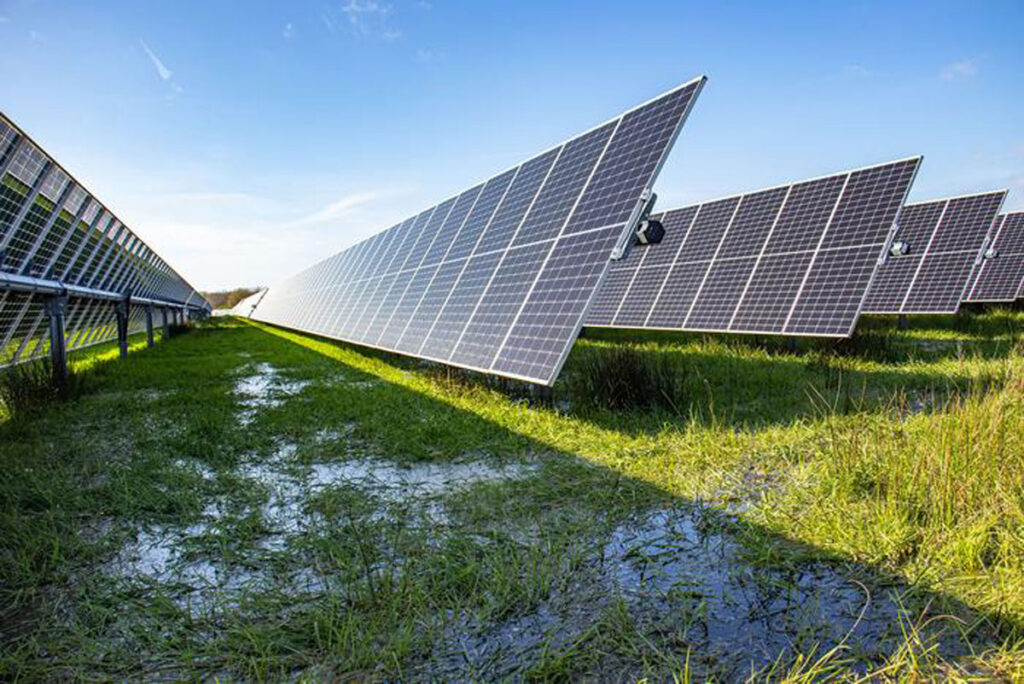
Though the overall number of species was similar across both sites, the solar park scored significantly higher on two standard diversity indices—the Shannon and Simpson indices. In other words, it hosted a more even and consistently present community of common species.
Promising, with Caveats
Outside scientists said the results were worth attention but cautioned against reading too much into them.
“I think this is a great idea to study,” said Michael Schummer, an associate professor of wetland wildlife at the SUNY College of Environmental Science and Forestry who was not involved in the research. But he pointed to a methodological concern: The audio recorders inside the solar park were spaced as close as 90 meters apart, below the 250-meter minimum standard for bird monitoring surveys. At that distance, multiple recording stations may capture sounds from the same bird territory, potentially inflating diversity estimates.
“Just as we want more biodiversity in the world, I think we need more diversity in our landscapes.”
Guido Bakema, a soil scientist at Wageningen University who was also not part of the study, raised a separate issue. The study, he said, compared the rewetted solar park to drained grassland but not to a rewetted peatland without solar panels, raising the question of whether it was the rewetting or the solar panels that accounted for the change in bird diversity. “It would be better if they had separated this,” he said.
The authors acknowledged these limitations directly, agreeing that a lack of replicates in this study means that the effects of rewetting and the addition of solar panels cannot be isolated. However, at the time of the study, no other operational rewetted peatland solar park existed nearby for comparison.
Martens is already working to address those gaps. She has expanded her research to five sites this year and plans to examine how design choices such as panel height, spacing, and row width affect which species show up.
“Just as we want more biodiversity in the world, I think we need more diversity in our landscapes,” she said.
—Larissa G. Capella (@CapellaLarissa), Science Writer
This news article is included in our ENGAGE resource for educators seeking science news for their classroom lessons. Browse all ENGAGE articles, and share with your fellow educators how you integrated the article into an activity in the comments section below.