Source: Journal of Geophysical Research: Biogeosciences
Forest soils store an estimated 40% of the world’s terrestrial carbon, but estimates suggest that around 15%–30% of that soil carbon is lost when a forest is harvested. Tracking such losses can be tricky: Wildfire, insects, disease, and past forest management can all affect forest soil carbon stores, and tree type, climate, and harvesting method can all affect how much carbon is lost.
The British Columbia Long-Term Soil Productivity (BC-LTSP) study is a long-term forest experiment that Wallace et al. used to examine how organic matter removal and soil compaction have affected soil carbon over the past 20 years, how soil carbon and the forest floor recover after heavy harvesting, and how latitude and climate affect soil carbon.
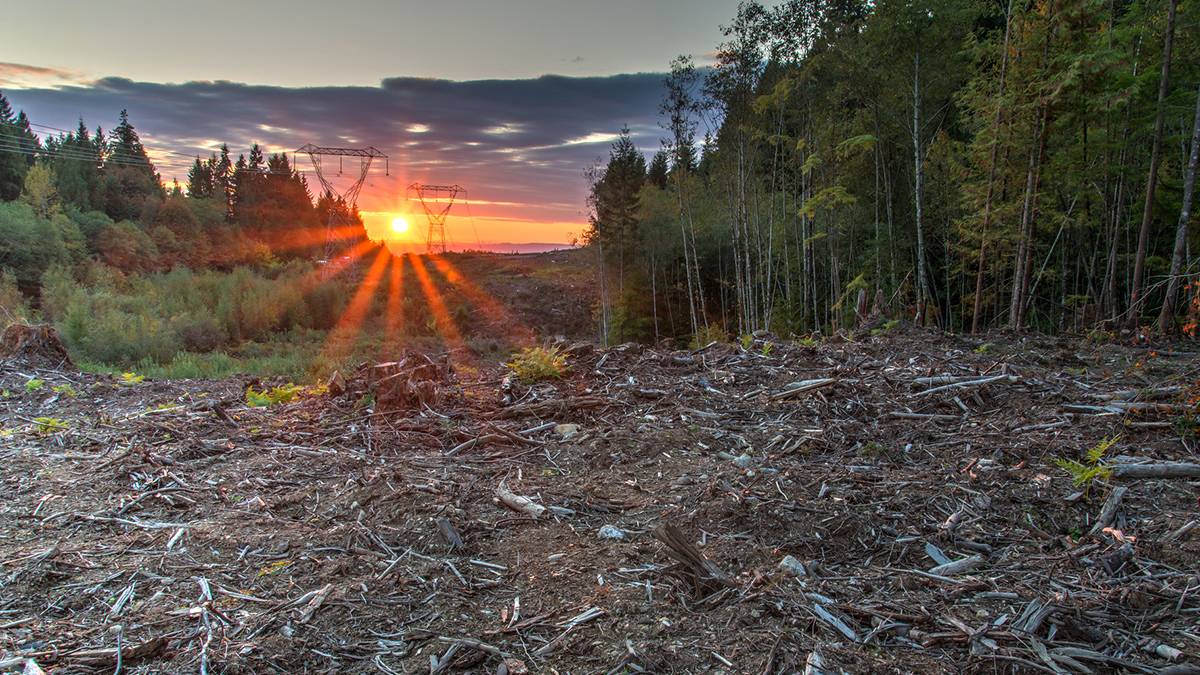
Researchers examined data from 12 BC-LTSP forest sites, located across four British Columbia biogeoclimatic zones that had reached 20 years postharvest. Each site was divided into nine plots to test different levels of soil compacting and organic matter removal. In some plots, only the tree trunks were removed during harvesting, a practice known as stem-only harvesting. In other sites, standard practice was whole-tree harvesting, in which the trees and the canopy residue that falls to the forest floor during logging are also removed from the site. In some plots, the entire forest floor—the layer of organic material atop the mineral soil—was removed. Researchers collected forest floor and mineral soil samples before harvesting and then again 5, 10, and 20 years later to measure the changes in soil carbon.
The researchers participating in the new study found that soil carbon was more stable when the forest floor stayed intact. After 20 years, forest floor carbon had declined by only 5%, while carbon in the mineral soil below the forest floor had increased by 14%. Stem-only harvesting helped preserve about 15% more forest floor carbon than whole-tree harvesting.
The more dramatic carbon loss occurred when both harvest residue and the forest floor were removed. Total soil carbon dropped 52% within 5 years and remained 33% below preharvest levels for 20 years. Recovery time varied among the sites where the forest floor was fully removed, with estimates of 22–86 years for soil carbon to return to preharvest levels. The authors suggest that maintaining organic residue and protecting the forest floor from heavy disturbance are key to preserving soil carbon during timber harvests and logging. (Journal of Geophysical Research: Biogeosciences, https://doi.org/10.1029/2026JG009694, 2026)
—Rebecca Owen (@beccapox.bsky.social), Science Writer