
Editors’ Highlights are summaries of recent papers by AGU’s journal editors.
Source: Journal of Geophysical Research: Earth Surface
When permafrost (perennially frozen ground) thaws and associated ground ice melts, the land surface can subside. However, long-term records that link changes in ground temperature with changes in the landscape over decades are rare.
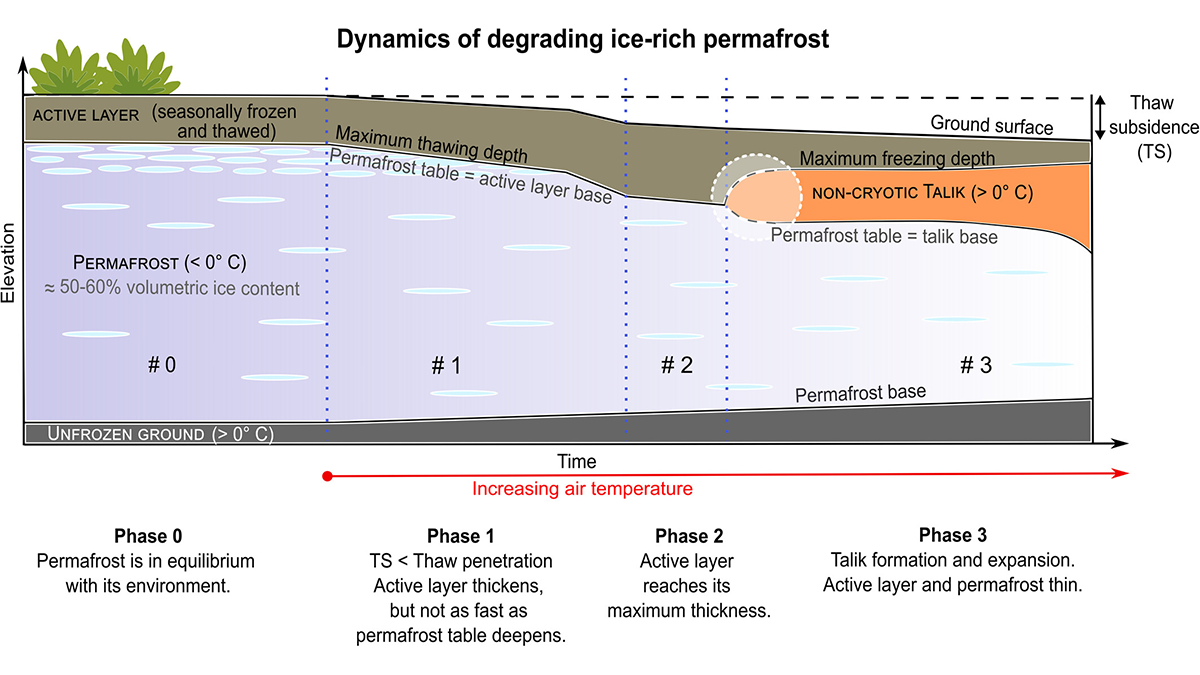
St-Cyr et al. [2026] present a 20-year record (2004–2024) of permafrost change and landscape subsidence near the Indigenous community of Umiujaq in Nunavik, Québec, Canada. Using repeated ground surveys, high-resolution laser measurements (LiDAR), and drone-based photography, the authors document cumulative ground subsidence of up to 3.8 meters. They combine these observations with ground temperature records to show that the active layer (the seasonally thawed layer above permafrost) thickened, permafrost became thinner, and unfrozen zones, called taliks, developed within the permafrost. The authors show that these changes did not occur at a constant rate but accelerated in response to substantial climate warming between 1992 and the early 2000s.
This long-term record demonstrates how warming can alter ground temperatures and ultimately cause large-scale geomorphological changes to the land surface, which has consequences for ecosystems, carbon cycling, and northern infrastructure. The study also provides a framework for long-term monitoring that could be applied in other permafrost regions to understand how diverse permafrost landscape types respond to a warming climate.
Citation: St-Cyr, M., Fortier, R., & Molson, J. W. (2026). Thaw subsidence of ice-rich permafrost near Umiujaq, Nunavik (Québec), Canada: 20 years of monitoring using ground-based leveling methods, LiDAR, and UAV photogrammetry. Journal of Geophysical Research: Earth Surface, 131, e2026JF009218. https://doi.org/10.1029/2026JF009218
—Louise Farquharson, Associate Editor, JGR: Earth Surface
