
Is there life after death?
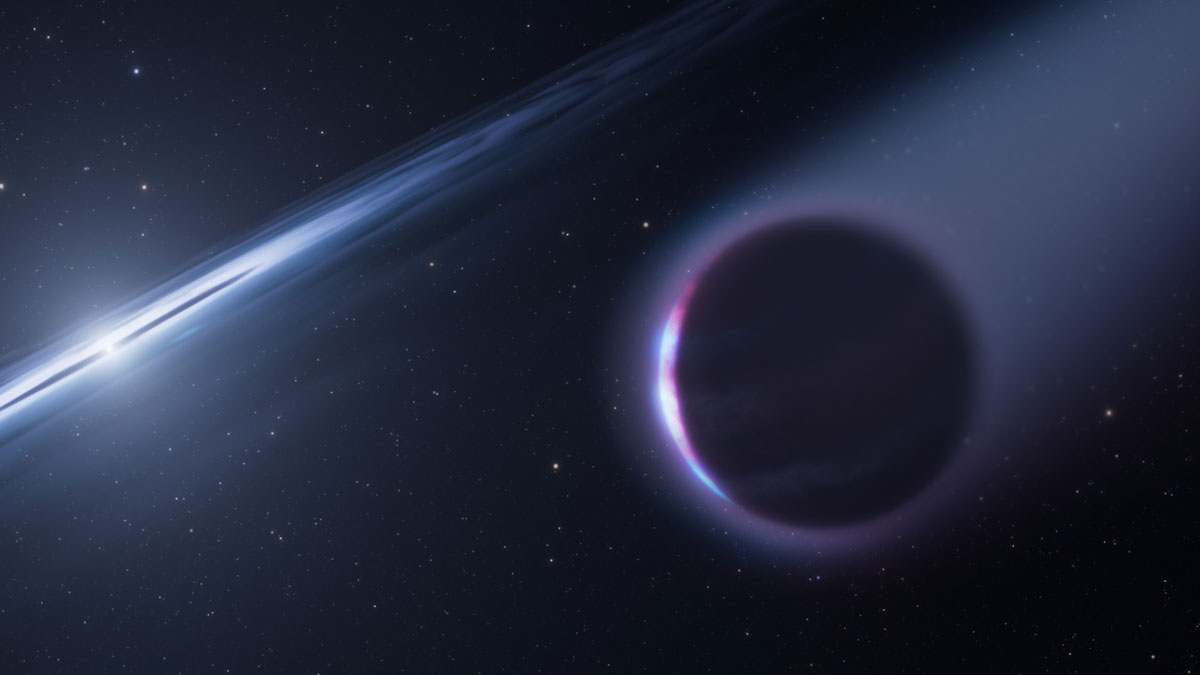
For star systems, the answer seems to be yes. Astronomers have identified the first strong hints of a newborn planet orbiting a white dwarf, which is a remnant of a star like our Sun after it has exhausted its nuclear fuel. In a cruel irony for the planet, the hints of its existence come from the white dwarf actively eating its progeny’s atmosphere. But for astronomers, it’s an exciting possibility.
On the basis of the strange chemical composition of the white dwarf atmosphere, the new exoplanet candidate seems to be a second-generation planet, formed out of the debris shed by the dying star rather than the debris shed by its birth.
“This white dwarf is unique because it has a lot of traces of copper, zinc, and niobium,” said Jamie Williams, an astronomer at the University of Warwick in the United Kingdom who was the lead author of the study, published in Nature Astronomy. “Niobium is especially interesting [because] that’s the first time it’s ever been discovered in a white dwarf.”
“I don’t know of any other source that comes close to being this strange.”
When astronomers see chemical elements heavier than hydrogen and helium in a white dwarf’s atmosphere, it’s likely “pollution” from a planet. The planet might have been destroyed when the star died—Earth’s possible fate when our own Sun goes kerplooie in 5 billion years or so—or might be a survivor from the original star system.
“I don’t know of any other source that comes close to being this strange,” said Juliette Becker, a planetary astronomer at the University of Wisconsin–Madison who was not involved with the study. “This [white dwarf] is very different from pollution profiles that have existed so far, which is very exciting.”
Cookie Monster Devouring His Children
Like all stellar corpses, white dwarfs are weird objects. This particular example, which carries the memorable name HS 0209+0832, is probably about half the mass of the Sun but the size of Earth, measurements that are fairly typical for a white dwarf. However, HS 0209 is relatively newly formed and very hot: about 35,000 kelvin (~63,000°F), compared to the Sun’s 5,800 kelvin surface temperature (10,000°F). A more fitting name might be “ultraviolet dwarf” since its spectrum peaks in the UV.
When astronomers observed HS 0209 in 1999 using the Hubble Space Telescope, they identified a relative excess of helium in its atmosphere. The amount came as a surprise because a white dwarf this hot should have little atmospheric helium. The new study drew together additional observations from a wealth of other telescopes, including later Hubble data, the Far Ultraviolet Spectroscopic Explorer (FUSE), and the Transiting Exoplanet Survey Satellite (TESS).
These additional data turned up further unexpected elements, including 3 times the niobium abundance seen in the Sun’s spectrum. When the researchers compared this spectrum to other polluted white dwarfs and solar system objects like comets and meteorites, they found no matches: HS 0209 is unique. However, because astronomers think atmospheric pollution comes from material stripped from orbiting planets, it seemed possible that was the case here. That’s where the TESS data, which measure fluctuations in the visible light output from stars, came in handy.
“We also see a variability in the brightness of the system, which we think is from a day-night phase curve of the planet around it,” Williams said. In other words, as the hypothetical planet orbits, the total light from the system varies on the basis of which side of the planet is facing Earth on a 4.4-day orbital period, a type of planet known as a “hot Jupiter.”
These data together indicate a planet whose chemistry corresponds to the very end stages of life for the progenitor star before it died and formed the white dwarf. In the scenario the researchers think is most probable, the gas the original star shed—containing zinc, copper, and niobium—provided the raw material for a second-generation planet.
“We have a white dwarf orbited by a disk of this kind of material [from the dead star],” Williams said. “This disk will fragment and then you’ll form a planet.”
But like Saturn devouring his children in Greco-Roman mythology, the white dwarf began boiling off the newborn planet’s atmosphere, absorbing part of the planetary atmosphere into its own and shedding most of the rest into space. (Perhaps Cookie Monster, with his messy eating habits, is a better metaphor.) This merging explains not only the excess of helium in HS 0209+0832’s atmosphere but also the presence of elements that are rare in the solar system. Williams expressed a hope of using the James Webb Space Telescope to attempt to directly detect the planet, which is hot enough to glow in the infrared.
“Because there are [pulsar] second-generation planets, I think there must be also second-generation planets around white dwarfs.”
Both Williams and Becker pointed out that HS 0209, pollution aside, is a very typical white dwarf, meaning it’s possible many other second-generation planets could be out there. Becker, who studies unusual scenarios for planetary formation, noted that second-generation planets were actually the first exoplanets discovered. However, those were orbiting pulsars: the remnants of stars many times more massive than our Sun.
“I also have a strong bias: Because there are [pulsar] second-generation planets, I think there must be also second-generation planets around white dwarfs,” she said.
—Matthew R. Francis (@BowlerHatScience.org), Science Writer