
Editors’ Vox is a blog from AGU’s Publications Department.
Very few climate model projections extend past 2100, which limits the development of long-term climate products and services that are essential to decision makers. A new article in Earth’s Future explores the methods and motivations of scientists studying climate change after 2100. Here, we asked the lead author about the importance of long-term climate projections, the challenges that researchers face, and thoughts on research avenues.
Why do most climate projections end at 2100?
2100 was the end date of projections in the 1990 first Intergovernmental Panel on Climate Change (IPCC) report, and it looks like it became a convention. To be fair, running Earth System Model simulations is expensive, and the longer the runs, the higher the costs. If your model can be showcased in the IPCC report with 21st century simulations, you might question the scientific benefits of running optional 200 year extensions. Finally, the main greenhouse gas emission pathways used after 2100 are not generated by emission models; they are poetically labeled stylized pathways and are built on the crude assumption that emissions will either remain constant, and/or return linearly to zero. I can understand why modelers would not want to spend valuable model time on simplistic scenarios that look like they’ve been drawn on a napkin. The next generation of simulations should extend to 2150.
Why is it important for projections to extend into the 22nd century?
I’m concerned that without long-term projections, we’re lacking the evidence that would help us manage future risks.
In a very practical sense, we need those projections to be able to offer climate services that support decisions with long-term implications. Urban development in coastal areas, biodiversity conservation plans, designs for nuclear facilities and other large infrastructures are all examples where today’s decisions will have repercussions for hundreds of years. I’m concerned that without long-term projections, we’re lacking the evidence that would help us manage future risks.
From a policy perspective, a few papers make the point that limiting projections to 2100 can leave the impression that climate change is a 21st century problem, when it’s definitely not. If I could live long enough to collect the money, I’d be willing to bet we’ll still be talking about rising sea levels 200 years from now. I believe/hope that expanding projections farther into the future can shape how we think about climate change and grant us a multi-generational perspective.
In your review article, what did you identify as the main motivations for studies of the far future?
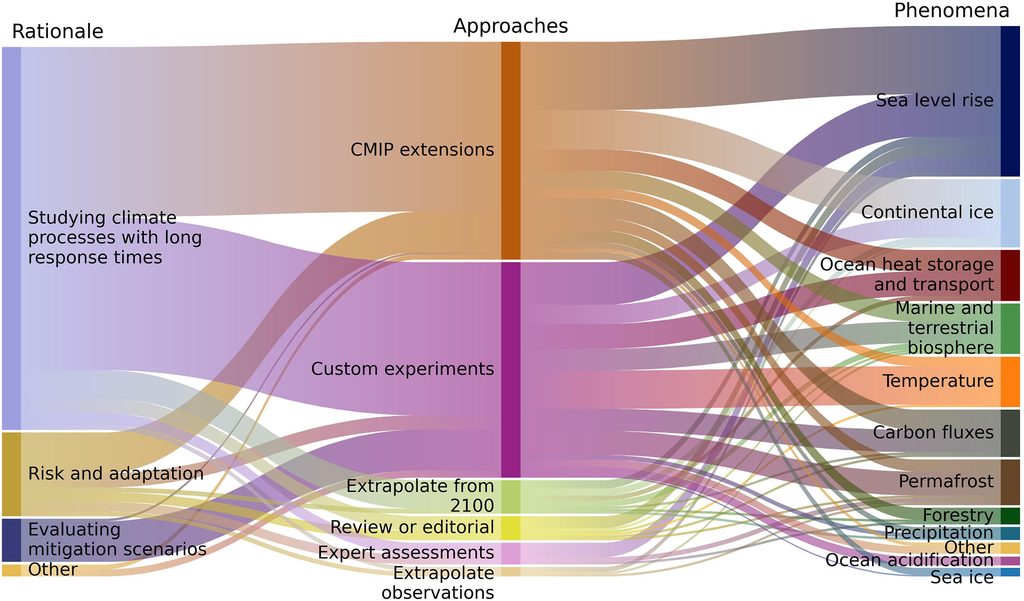
Informing future risks and climate change adaptation is certainly one of them, but a lot of papers are just happy to study climate processes for the sake of curiosity. If your field of research is the Antarctic ice sheet, you want to run long-term modeling experiments to see interesting stuff happening. The climate system has a lot of feedback mechanisms, but some of them only kick in after 2100. Another motivation is to answer questions about emission reduction strategies: what emissions manage to stabilize temperatures, how much carbon can be emitted to stay below 2°C, what is the cost of carbon when we account for damages far into the future?
What are some of the challenges of studying climate change beyond 2100?
If you’re someone like me who uses climate projections, there’s just not much data to work with, you can’t really use approaches developed for the 21st century context, and you need to think hard on how to turn the few available projections into usable information.
If you’re a modeler, there’s less confidence in the emission scenarios, there’s less confidence in climate models, and yet you need to convince your boss that you need more computer time and have faith that the results will be worth their own carbon emissions.
What are your recommendations for research efforts moving forward?
One thing I’ve learned from teaching my four teenage daughters how to drive is to keep my recommendations to myself, but I’ll take the bait. Now, climate services are relying heavily on the outcomes of research efforts, whose objectives and protocols change every few years as new scientific questions emerge. As a practitioner, I’d like to see us move towards a stable institutional framework for operational climate services. Just as met services deliver weather forecasts designed to meet the needs of air traffic controllers to wedding planners, I don’t see why we couldn’t have long-term climate projections driven by user needs and delivered on a regular schedule.
I’d like to see more attention given to probabilistic risk assessments for climate hazards.
In the meantime, I’d like to see more attention given to probabilistic risk assessments for climate hazards. Among over 400 papers about post-2100 climate change we’ve collected, only five mention the word “hazard”. I think it’s time we give decision-makers information not only about what could happen, but also how likely those outcomes are. Working with professionals across different sectors, I see probabilities as a crucial ingredient for climate science to trigger real world actions.
—David Huard ([email protected];  0000-0003-0311-5498), Ouranos Inc, Canada
