

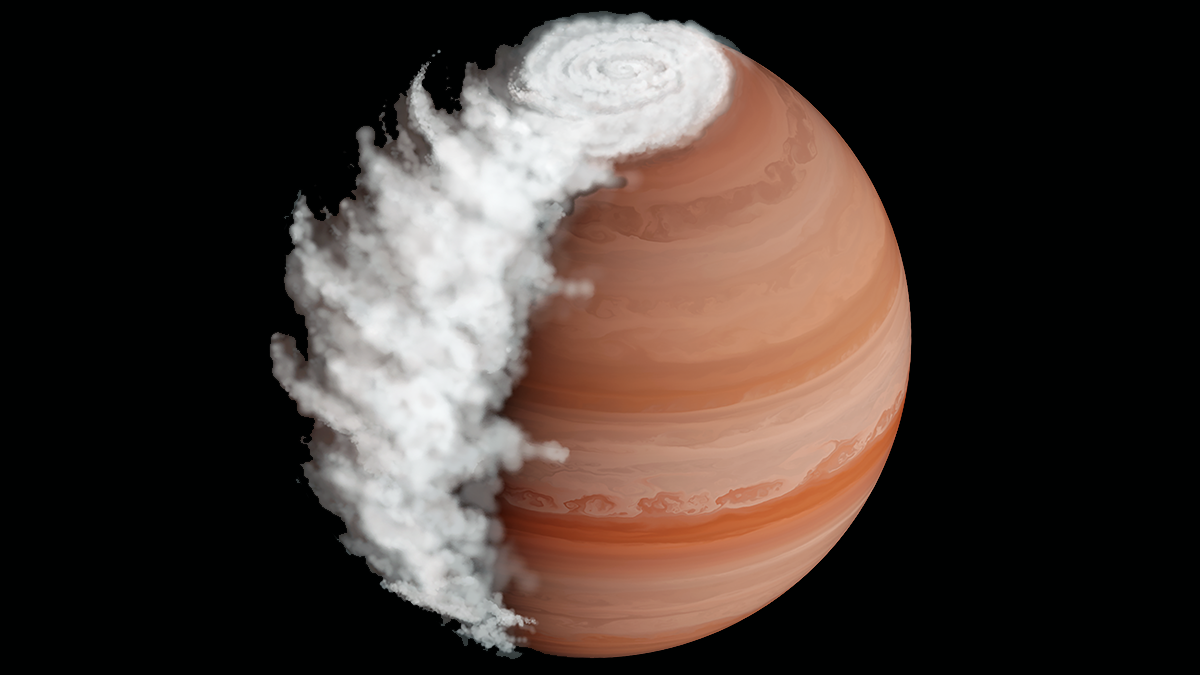
Clear skies are important for astronomers—not just here on Earth but also on the alien planets they are looking at.
For the past 20 years, scientists studying exoplanets have been literally blinded by fog. Many “hot Jupiters” (massive gas giants orbiting extremely close to their host stars) are constantly wrapped in clouds. This overcast condition acts like a fogged-up window, blocking telescopes from getting a clear reading of the planets’ true composition.
Astronomers using the James Webb Space Telescope (JWST) have now lifted the fog veil by using a novel observation technique published in Science. The technique was used to analyze data from WASP-94A b, an exoplanet nearly 700 light-years away discovered about a decade ago. The scientists were able to detect and account for atmospheric clouds on WASP-94A b by analyzing the planet’s sunrise and sunset zones separately as it crossed in front of its host star.
“It’s almost like we were able to part the clouds and figure out what’s going on three-dimensionally with this planet.”
“It’s almost like we were able to part the clouds and figure out what’s going on three-dimensionally with this planet,” said study coauthor David Sing, a planetary scientist at Johns Hopkins University.
WASP-94A b is so close to the star that it is tidally locked, meaning its rotation has stopped and the same side always faces the star. This creates extreme temperature variations across the planet. While the dayside reaches torrid temperatures well above 1,600 K, the night hemisphere is about 450 K colder. These milder conditions on the dark side allow clouds made of magnesium silicate, a common mineral found in Earth’s rocks, to condense.
This extreme thermal variation drives powerful winds that circulate air throughout the atmosphere, carrying cloud-filled colder air from the nightside over to the dayside. The clouds don’t last long, though. Like morning fog dissipating in the Sun’s warmth, the silicate clouds of WASP-94A b evaporate shortly after they hit the scorching dayside. Because the planet’s weather patterns are locked in place by its synchronized rotation, the morning edge of the planet, where the winds move from nightside to dayside (what we view as the leading edge of the transit from Earth), is permanently overcast, while the evenings (the trailing edge) remain always clear.
Timing Is Everything
The key to this observation was not so much where to look, but when. From our vantage point, WASP-94A b crosses right in front of its star, allowing the researchers to capture the precise moments when the giant planet begins its transit and when it finally moves beyond the edge of the star. As starlight filtered through WASP-94A b’s atmosphere, astronomers separately measured its leading and trailing edges (also known as terminators, or limbs) at the times when the planet began and concluded its transit. By analyzing how the spectral signatures changed between these two phases, they were able to reveal the differences between the morning and evening hemispheres.
These measurements require extreme precision. “As the planet is going in front of the star, you have to measure it in that very short time where only part of the planet is blocking the star,” Sing said. “In only about 10 minutes, you have to get the spectra of a planet, which is really hard because planets are faint and the signals are small. We really needed JWST, the largest telescope in space, to be able to make that measurement that quickly.”
What unfolded was a totally unprecedented view of an exoplanet. “What we found was really surprising,” Sing said. “All of the clouds were basically piled up on the morning terminator, while the evening terminator, which is hotter, was clear.”
The team also realized that the clouds were floating much higher up than anyone anticipated—way above the stratosphere—and were made of surprisingly large particles. This suggests the atmosphere undergoes far more violent, turbulent mixing than previously predicted.
“It’s pretty clear they are magnesium silicate clouds,” Sing said. While scientists expected that this material would form clouds on these planets, “we haven’t really been able to show that before.”
“The study is a great example of how we can measure and understand the multidimensional and complex nature of exoplanet atmospheres,” said Hannah Wakeford, an astrophysicist at the University of Bristol in the United Kingdom who was not involved with the study. “Clouds are the most important part of a planetary atmosphere, and they play a major role in the amount of energy coming into and leaving the planet.”
A Different Composition
Breaking through the cloud barrier allowed researchers to see the true chemical makeup of this world. Previous observations of exoplanet atmospheres using the Hubble Space Telescope had to rely on an “average spectrum,” blending the composition of both sides of a planet on a single profile, mostly because Hubble can’t get a planet’s spectra as quickly and precisely as JWST does. As a result, researchers were getting wrong readings of essential components, such as the amounts of oxygen, carbon, and other heavy elements.
“That kind of rewrites much of what we’ve been learning with Hubble over the last few decades.”
These average spectrum readings meant that models were predicting that WASP-94A b had a heavy metal abundance up to 100 times greater than our Sun. By separating the limbs, the new observations have revealed that this number is actually closer to 10. “That kind of rewrites much of what we’ve been learning with Hubble over the last few decades,” Sing said.
Sing and his colleagues think the same findings could apply to countless other hot Jupiters. In fact, there’s nothing special about WASP-94A b, except that it has the right geometry. “Not all hot Jupiters will be good candidates to reveal this limb asymmetry,” Sing said. “For instance, if a planet just grazes across the bottom of the star during transit, you won’t be able to cleanly separate the two sides out.”
Getting a better handle on what hot Jupiters are made of is a significant step for planetary science and could also help refine atmospheric circulation models on Earth and beyond, Sing said.
Apart from WASP-94A b, the team applied the same method to eight other hot gas giants, discovering hints of similar cloud cycles in two of them: WASP-39 b and WASP-17 b. The team plans to continue studying similar planets with JWST, including a gas planet in the habitable zone of its host star.
—Javier Barbuzano (@javibar.bsky.social), Science Writer