
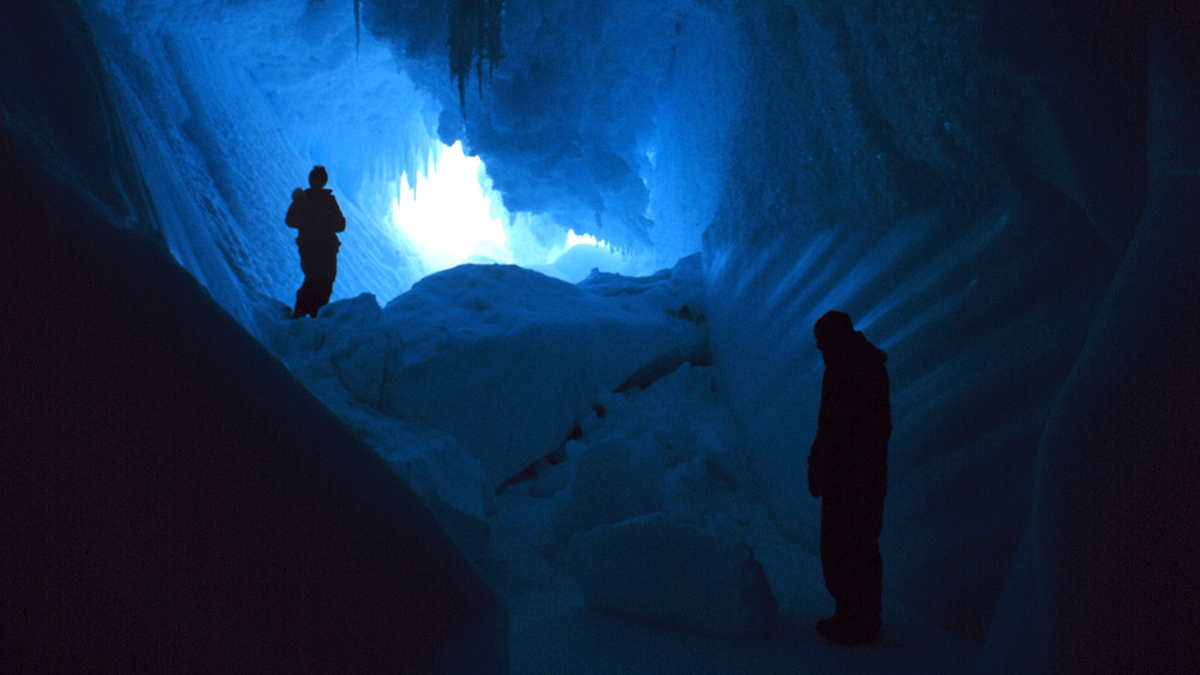

As Earth’s population continues to grow and strain environmental resources, researchers are increasingly examining how humans might one day build settlements beyond Earth. Not many construction materials can withstand extreme temperatures and low-pressure environments like those that exist on Mars, however. New research explores an unconventional candidate: ice.
“This study…is expanding and questioning, How do we support life on other worlds?” said Rafid Quayum, a postbaccalaureate student at Harvard University and a researcher on the project. “Can we come up with a solution that’s environmentally friendly and also inspired by Earth’s systems?”
Ice, Quayum’s team says, offers a rare combination of benefits that can mitigate many of the environmental challenges astronauts would face: It absorbs radiation, transmits visible light, and can create a passive greenhouse effect inside enclosed habitats. That assumes, of course, that astronauts can harvest it.
Icy Habitats
Humans have been building temporary and permanent structures out of ice and snow for centuries. From the igloos and quinzhee of some Inuit peoples in Greenland and the Canadian Arctic to Kamakura in Japan, people have long recognized that ice can retain heat, keep out the elements, and be sourced in many cold environments.
But while ice retains its insulating qualities in environments beyond Earth, it may not be readily available, explained Armin Kleinboehl, a planetary scientist at the Jet Propulsion Laboratory in Pasadena, Calif., who was not involved in the study. Sourcing ice locally, especially on Mars, would be challenging. While Mars’s poles contain abundant ice, their harsh seasonal cycles make them unsuitable for long-term habitats, he said.
Unlike shelters built from regolith, ice domes would allow natural light to filter in, an advantage for both plant growth and human psychological well-being.
“If you were to build a build a habitat in those regions, you would want people to get out before the polar winter sets in,” Kleinboehl said. Instead, mission planners often target the northern midlatitudes, where shallow subsurface ice may be easier to access, he added.
Still, ice has certain advantages as a building material. Unlike shelters built from regolith, the fine layer of planetary topsoil made of dust, soil, and broken rock, ice domes would allow natural light to filter in, an advantage for both plant growth and human psychological well-being, Quayum said.
What’s more, even if surface ice isn’t easily accessible in the regions on Mars where humans might want to build, the resources are abundant on icy worlds like Ceres and Callisto, the researchers noted. Sourcing the ice from other planetary bodies could reduce the energy and cost of transporting materials from Earth.
Keeping Warm in Cold Environments
Quayum’s team modeled hypothetical ice domes that could be built on Mars’s surface, explored techniques to create them, and simulated what the conditions would be like inside. They placed their simulated domes at the midlatitudes of Mars, where ice is less accessible than at the poles but sunlight is more abundant. In these regions, daily temperatures swing from −56°C to −37°C, which is not enough to melt the ice, according to the model.
Removing dust and regolith allows the resulting ice shell to transmit sunlight while acting as radiation shielding.
In addition to temperature, Mars’s atmospheric pressure, which is less than 1% of Earth’s, also presented a challenge. Because liquid water cannot exist stably at such low pressures—it boils and freezes almost simultaneously—the team proposed using vacuum distillation to purify locally sourced ice. With this technique, heated ice vaporizes rather than melts. The vapor can then be captured, condensed into a liquid under high pressure, purified, and refrozen into clear, contaminant-free ice. Removing dust and regolith during this process allows the resulting ice shell to transmit sunlight while acting as radiation shielding, Quayum explained.
In the modeled ice domes, hydrophobic seals reinforced the dome by preventing any interior melted water from seeping into the shell, where it could weaken the ice. An aerogel insulating layer further slowed heat transfer to keep the outer layer below its melting point. Inside the habitat, sunlight warmed the air.
“There will be convection, like on Earth, to mix heat around, which should result in a fairly uniform temperature throughout [the dome],” said Robin Wordsworth, a planetary scientist at Harvard University and a researcher on the project.
The heat from that air then moved outward through the ice by conduction, a process that prevented the shell from losing strength. Temperature models and 3D structural simulations suggest the dome could remain stable at average Martian temperatures of roughly −58°C.
The team will present these results on 16 December at AGU’s Annual Meeting 2025 in New Orleans.
Testing Beyond Theory
The team said that a lot of research is still needed to determine whether ice domes could be a viable habitat for future Martian astronauts. Like Earth, Mars has seasonal variations that could affect the long-term durability of the domes, an effect they hope to investigate further.
To try to move Mars ice habitats beyond theory, the researchers aim to conduct field tests in extreme environments on Earth that mimic Martian conditions, such as the subzero temperatures of Antarctica and low-pressure environments like the Himalayas. If those are successful, structural habitability could eventually be tested on Mars itself.
“It would be something really exciting for scientists to be able to travel to other planetary environments, conduct field work, and be able to stay in habitats…using ice,” said Quayum.
—Olivia Maule (@ocmaule), Science Writer