
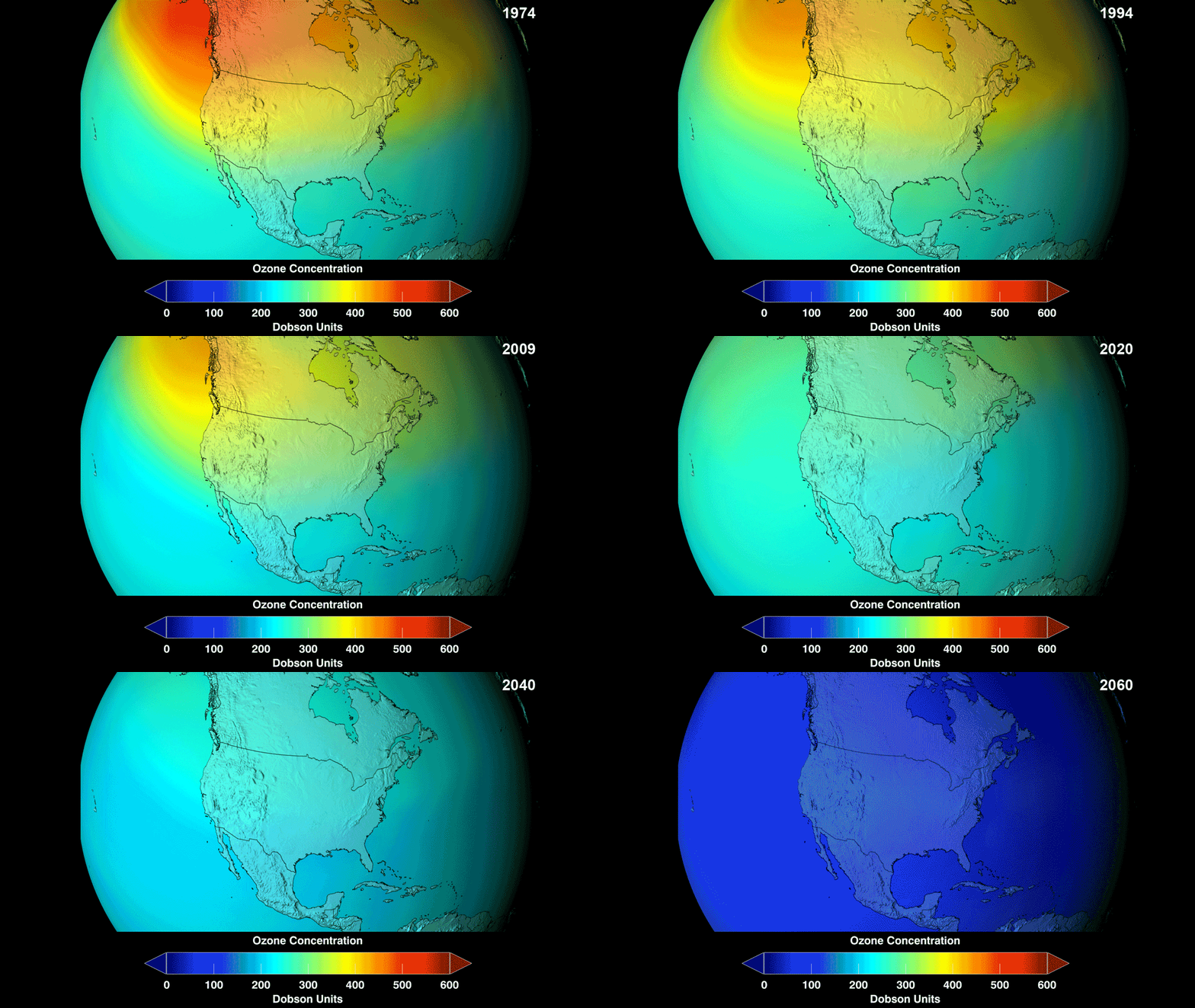
A hole in the Montreal Protocol could delay the recovery of Earth’s ozone layer by about 7 years. New research found that the use of ozone-depleting substances used as feedstocks—chemicals used in the making of other chemicals—has not waned over time. In fact, their use has increased since the treaty’s adoption in 1987.
“The Montreal Protocol is such a success story that these ozone-harming sources are becoming relevant. A few decades ago, they were drowned out.”
“The Montreal Protocol is such a success story that these ozone-harming sources are becoming relevant. A few decades ago, they were drowned out,” said Luke Western, who researches greenhouse gases and ozone-depleting substances at the Massachusetts Institute of Technology. Western is a coauthor of a new study on the findings published in Nature Communications.
Almost 40 years ago, the Montreal Protocol banned the production and consumption of almost 100 long-lived gases that harm Earth’s ozone layer, such as chlorofluorocarbons (CFCs) and hydrochlorofluorocarbons (HCFCs), then largely used as coolants in refrigerators and air conditioners. These uses were the primary problem that needed to be solved and were the Montreal Protocol’s main target, Western explained.
However, ozone-depleting substances used in the production of other chemicals—including CFCs themselves—had so little impact at the time that they were not included in the ban. Only about 0.5% of feedstock chemicals, such as carbon tetrachloride (used in the making of some CFCs and a by-product of the manufacture of plastics like polyvinyl chloride, or PVC), were emitted into the atmosphere. With the production and use of the most prevalent ozone-harming gases banned, scientists thought the use of feedstocks such as carbon tetrachloride would die out over time.
However, not only did the die-out not happen, but the use of ozone-depleting substances as feedstock actually increased by 163% between 2000 and 2024. Western and his team found that associated emissions increased as well: Now, about 3.6% of these ozone-depleting feedstock chemicals are leaking into the atmosphere. The increase comes partly from their use in producing the non-ozone-depleting gases that replaced HCFCs and CFCs after the Montreal Protocol went into force.
“It’s almost the same as charging your electric car with fossil fuel–based energy.”
“This is quite ironic,” Western said. “It’s almost the same as charging your electric car with fossil fuel–based energy.”
If maintained at current levels, these emissions could delay full recovery of Earth’s ozone layer by anywhere from 6 to 11 years. Currently, recovery to 1980 levels is expected by 2040 for most of the world, by 2045 over the Arctic, and by 2066 over Antarctica, according to the World Meteorological Organization.
Filling a Gap
To estimate feedstock emissions, the researchers used datasets from the Advanced Global Atmospheric Gases Experiment (AGAGE) and NOAA containing information on about 50 chemicals from 1978 to 2023. The team used these data to model feedstock production and consumption between 2025 and 2034 and then between 2035 and 2100 for business-as-usual and low-emission scenarios.

When measured from now until the end of this century, feedstock emissions in the models tended to stabilize, but the real problem could be in the short and medium terms, the study suggested. Under a business-as-usual scenario, the production of some chemicals, such as methyl chloroform (used in solvents and found in household cleaners), is projected to decrease by 6% per year until 2050. But others, such as halon 1301 (used in the making of insecticides and pharmaceuticals), are set to increase (in halon 1301’s case, by 4% a year until 2050). With the estimates at hand, the team modeled feedstock emissions and their potential effect on the ozone layer.
“This is a very important study because it addresses several questions that remained open not just in the Montreal Protocol, but in research on the ozone layer recovery in general,” said Marco Aurélio Franco, an atmospheric sciences researcher at the University of São Paulo in Brazil.
Franco, who did not take part in the study, said research like this is fundamental to improving estimates for atmospheric chemistry and physics models. After all, some feedstock chemicals, including carbon tetrachloride—whose production is set to increase by 4% a year through 2034—are also greenhouse gases.
Carbon tetrachloride, Franco pointed out, acts differently depending on where it is in the atmosphere. In the troposphere, Earth’s lowest atmospheric layer, the substance traps heat by reflecting infrared radiation back to Earth. At this level, carbon tetrachloride is still stable. But any amount of the substance that reaches the atmosphere’s next layer, the stratosphere, wreaks havoc on the ozone layer. “Ultraviolet radiation is able to break carbon tetrachloride, liberating chlorine,” Franco said. “Chlorine then breaks ozone molecules in a chain reaction. It’s the same mechanism as CFCs.”
The world, said Franco, needs to walk the last mile in refraining from producing and using ozone-depleting substances as feedstock, as we still need to understand their long-term effects. “These [feedstock emission] estimates could be appended to the Montreal Protocol, which proved to be a great success. We need to incorporate them into emission reports and atmospheric models. These emissions should not be neglected,” he said.
—Meghie Rodrigues (@meghier.bsky.social), Science Writer