
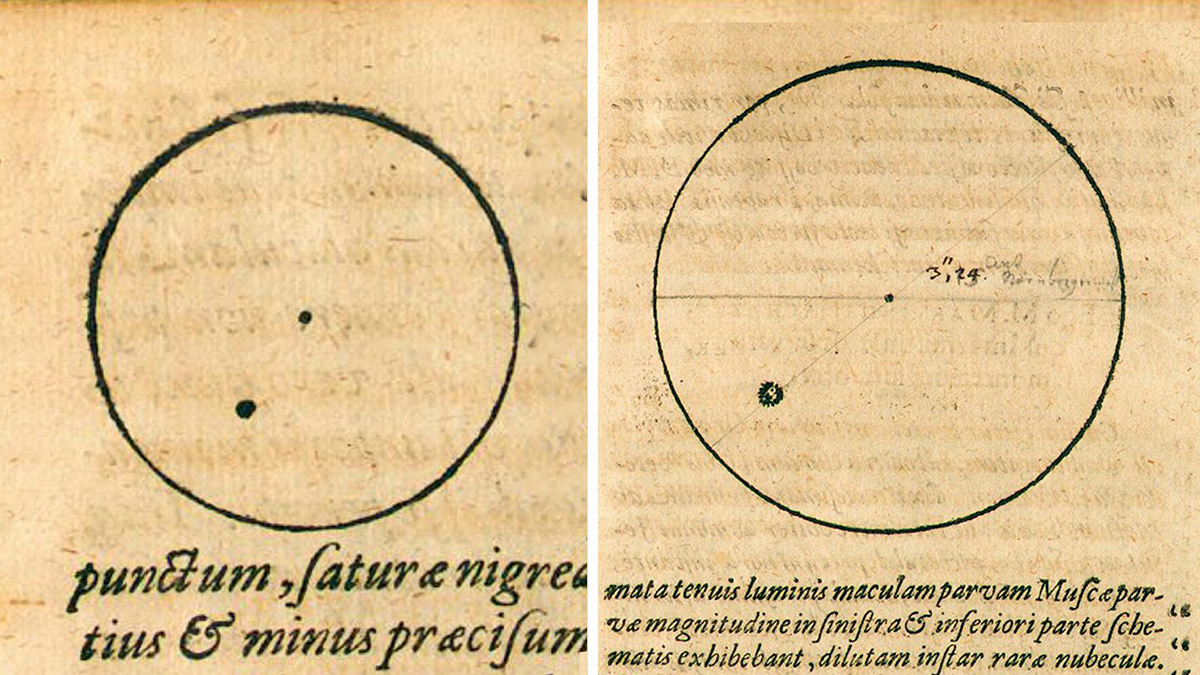
Johannes Kepler’s landmark 1607 sunspot observations may have been made at the end of the solar cycle, helping constrain the start of the Maunder Minimum.
Matthew R. Francis

Posted inFeatures
Saving the Planet with Radar Astronomy
Once the largest telescope in the world, Arecibo kept watch for dangerous asteroids using radar. With it gone, the world is preparing the next generation of radar observatories.

Posted inNews
Spiral Waves May Explain the Sun’s Baffling Rotation
New observations and models show a connection between high-latitude waves in the Sun’s interior and the different rates of spin between the solar equator and poles.

Posted inNews
Did a Cosmic Explosion Make the Ionosphere Dance?
Researchers have linked a 2022 gamma ray burst to a disturbance in the upper atmosphere, but proving the connection highlights the problems with this kind of measurement.

Posted inENGAGE, News
Five Martian Mysteries That Have Scientists Scratching Their Heads
Despite centuries of study and many spacecraft visits, the Red Planet still holds secrets. Here are just a few.

Posted inNews
Essential Ingredient for Life Found on Enceladus
Icy plumes from Saturn’s moon Enceladus contain phosphorus, part of the biochemistry of life—the first time the element has been found in a liquid environment beyond Earth.

Posted inNews
Magnetic Tangles Drive Solar Wind
Energetic collisions between magnetic fields produce gusty solar wind.
Posted inNews
(Probablemente) No podremos decir si Marte tiene vida
Los equipos de última generación no siempre pueden identificar la vida que habita en los lugares más parecidos a Marte en la Tierra, lo que hace que los científicos se pregunten cómo se se podría hacer mejor en el Planeta Rojo.

Posted inNews
We (Probably) Can’t Tell Whether Mars Has Life
State-of-the-art equipment can’t always identify life inhabiting the most Mars-like spot on Earth, leaving scientists wondering how to do better on the Red Planet.