• About
  • Special Reports
  • Topics
    • Climate
    • Earth Science
    • Oceans
    • Space & Planets
    • Health & Ecosystems
    • Culture & Policy
    • Education & Careers
    • Opinions
  • Projects
    • Postcards From the Field
    • ENGAGE
    • Editors’ Highlights
    • Editors’ Vox
    • Eos en Español
    • Eos 简体中文版
    • Print Archive: 2015–2025
  • Policy Tracker
  • Blogs
    • Research & Developments
    • The Landslide Blog
  • Newsletter
  • Submit to Eos
  • AGU.org
  • Career Center
  • Join AGU
  • Give to AGU
  • About
  • Special Reports
  • Topics
    • Climate
    • Earth Science
    • Oceans
    • Space & Planets
    • Health & Ecosystems
    • Culture & Policy
    • Education & Careers
    • Opinions
  • Projects
    • Postcards From the Field
    • ENGAGE
    • Editors’ Highlights
    • Editors’ Vox
    • Eos en Español
    • Eos 简体中文版
    • Print Archive: 2015–2025
  • Policy Tracker
  • Blogs
    • Research & Developments
    • The Landslide Blog
  • Newsletter
  • Submit to Eos
Skip to content
  • AGU.org
  • Career Center
  • Join AGU
  • Give to AGU
Eos

Eos

Science News by AGU

Support Eos
Sign Up for Newsletter
  • About
  • Special Reports
  • Topics
    • Climate
    • Earth Science
    • Oceans
    • Space & Planets
    • Health & Ecosystems
    • Culture & Policy
    • Education & Careers
    • Opinions
  • Projects
    • Postcards From the Field
    • ENGAGE
    • Editors’ Highlights
    • Editors’ Vox
    • Eos en Español
    • Eos 简体中文版
    • Print Archive: 2015–2025
  • Policy Tracker
  • Blogs
    • Research & Developments
    • The Landslide Blog
  • Newsletter
  • Submit to Eos

Xingyuan Chen

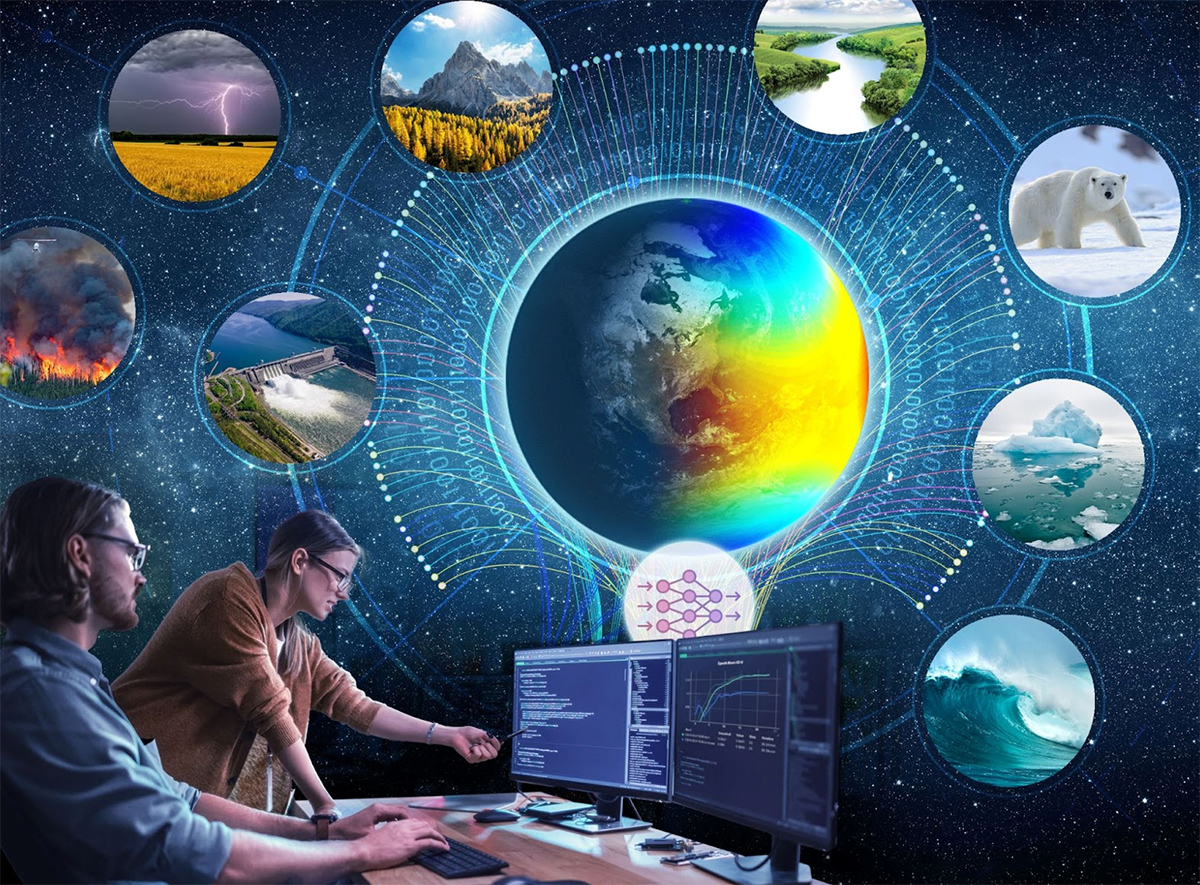
Artificial intelligence–generated depiction of two people looking at computer monitors on a desk, small images of nature scenes in circles representing different Earth science applications, and a depiction of Earth surrounded by zeros and ones representing digital data, all in front of a star-filled night sky background.
Posted inScience Updates

A Two-Step Approach to Training Earth Scientists in AI

by Lexie Goldberger, Peishi Jiang, Tirthankar “TC” Chakraborty, Andrew Geiss and Xingyuan Chen 29 April 202523 December 2025

Researchers learned machine learning methods during a boot camp, then applied their new knowledge to real-world research problems during a hackathon.

Illustration of a computer screen with mountains and a river.
Posted inEditors' Vox

Advancing AI and Machine Learning Beyond Predictive Capabilities

by Dipankar Dwivedi, Xingyuan Chen, Chaopeng Shen and Harihar Rajaram 1 November 202331 October 2023

A new cross-journal special collection invites contributions that unlock the next frontier in hydrology and Earth sciences through artificial intelligence and machine learning.

Over a dark blue-green square appear the words Special Report: The State of the Science 1 Year On.

Features from AGU Publications

Research Spotlights

Our Ocean’s “Natural Antacids” Act Faster Than We Thought

30 January 202630 January 2026
Editors' Highlights

Visualizing and Hearing the Brittle–Plastic Transition

3 February 20263 February 2026
Editors' Vox

Tsunamis from the Sky

3 February 20263 February 2026
Eos logo at left; AGU logo at right

About Eos
ENGAGE
Awards
Contact

Advertise
Submit
Career Center
Sitemap

© 2026 American Geophysical Union. All rights reserved Powered by Newspack