• About
  • Special Reports
  • Topics
    • Climate
    • Earth Science
    • Oceans
    • Space & Planets
    • Health & Ecosystems
    • Culture & Policy
    • Education & Careers
    • Opinions
  • Projects
    • Postcards From the Field
    • ENGAGE
    • Editors’ Highlights
    • Editors’ Vox
    • Eos en Español
    • Eos 简体中文版
    • Print Archive: 2015–2025
  • Policy Tracker
  • Blogs
    • Research & Developments
    • The Landslide Blog
  • Newsletter
  • Submit to Eos
  • AGU.org
  • Career Center
  • Join AGU
  • Give to AGU
  • About
  • Special Reports
  • Topics
    • Climate
    • Earth Science
    • Oceans
    • Space & Planets
    • Health & Ecosystems
    • Culture & Policy
    • Education & Careers
    • Opinions
  • Projects
    • Postcards From the Field
    • ENGAGE
    • Editors’ Highlights
    • Editors’ Vox
    • Eos en Español
    • Eos 简体中文版
    • Print Archive: 2015–2025
  • Policy Tracker
  • Blogs
    • Research & Developments
    • The Landslide Blog
  • Newsletter
  • Submit to Eos
Skip to content
  • AGU.org
  • Career Center
  • Join AGU
  • Give to AGU
Eos

Eos

Science News by AGU

Support Eos
Sign Up for Newsletter
  • About
  • Special Reports
  • Topics
    • Climate
    • Earth Science
    • Oceans
    • Space & Planets
    • Health & Ecosystems
    • Culture & Policy
    • Education & Careers
    • Opinions
  • Projects
    • Postcards From the Field
    • ENGAGE
    • Editors’ Highlights
    • Editors’ Vox
    • Eos en Español
    • Eos 简体中文版
    • Print Archive: 2015–2025
  • Policy Tracker
  • Blogs
    • Research & Developments
    • The Landslide Blog
  • Newsletter
  • Submit to Eos

Editors’ Vox

Posted inEditors' Vox

On Integrating Sedimentology and Hydrogeology in Streambeds

by D. Partington, C. T. Simmons, R. Therrien and P. Brunner 27 April 20183 March 2023

A new modeling blueprint seeks to unify sedimentology, hydrology, and hydrogeology in the modeling of streambeds.

Posted inEditors' Vox

Deep Learning: A Next-Generation Big-Data Approach for Hydrology

by C. Shen 25 April 20189 March 2023

What can Artificial Intelligence offer hydrologic research? Could deep learning one day become part of hydrology itself?

Native Prairie in East Central North Dakota
Posted inEditors' Vox

Diagnosing the Warm Bias in the Central United States

by A. Steiner 23 April 201815 February 2023

A set of four papers published in JGR: Atmospheres present results from a project investigating why models predict warmer surface temperatures than are observed in the central United States.

Posted inEditors' Vox

Societal Impacts Collection Continues to Grow

by Jenny Lunn and Paige Wooden 18 April 20187 January 2022

There have been further additions to the highly successful “Earth and Space Science is Essential for Society” collection of commentaries.

Marine mollusk shells record the magnitude of the radiocarbon marine reservoir effect in their habitat.
Posted inEditors' Vox

Radiocarbon in the Oceans

by E. Q. Alves 17 April 201827 January 2022

Offsets in radiocarbon concentration within the ocean or between the ocean and the atmosphere are particularly useful proxies for a variety of studies.

Posted inEditors' Vox

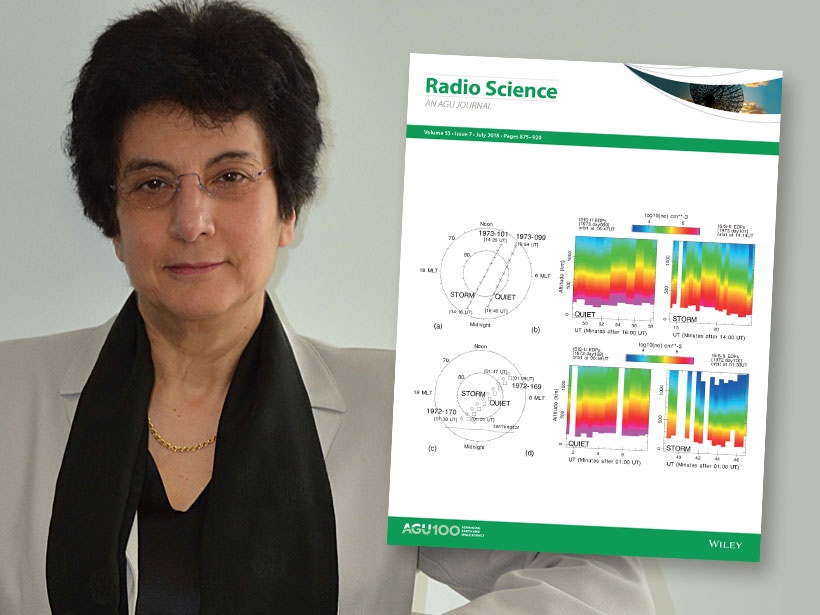
Electric Currents in Outer Space Run the Show

by Andreas Keiling, O. Marghitu and M. Wheatland 11 April 201816 November 2021

A new book explores our understanding of electric currents, which are fundamental to the structure and dynamics of space plasmas.

Posted inEditors' Vox

Coupled from the Start

by P. A. Dirmeyer 2 April 201818 February 2022

Atmosphere and land model development has historically been segregated but coupled processes crucial to prediction and extremes can be properly represented only with a holistic approach.

Volcanic caldera Mount Tambora Indonesia
Posted inEditors' Vox

Are We Prepared for the Next Mega Eruption?

by Fabio Florindo 30 March 20182 May 2022

The frequency of eruptions with a Volcanic Explosivity Index of 7 is only one or two per thousand years but we cannot afford to be complacent.

NASA's TWINS (Two Wide-angle Imaging Neutral-atom Spectrometers) Mission
Posted inEditors' Vox

The Big Picture in Geospace

by J. Goldstein 28 March 20184 May 2022

A NASA stereo-imaging mission called TWINS continues to push the boundaries of what we know about the region of space close to Earth.

Posted inEditors' Vox

Diversity of El Niño Variability Makes Prediction Challenging

by S.-W. Yeh 26 March 20188 March 2022

The atmospheric response to El Niño, both in the Pacific region and around the world, changes with each event and is uncertain in future under the influence greenhouse gas forcing.

Posts pagination

Newer posts 1 … 31 32 33 34 35 … 49 Older posts
Over a dark blue-green square appear the words Special Report: The State of the Science 1 Year On.

Features from AGU Publications

Research Spotlights

Making a Map to Make a Difference

11 February 202611 February 2026
Editors' Highlights

Monitoring Ocean Color From Deep Space: A TEMPO Study

11 February 202610 February 2026
Editors' Vox

A Double-Edged Sword: The Global Oxychlorine Cycle on Mars

10 February 202610 February 2026
Eos logo at left; AGU logo at right

About Eos
ENGAGE
Awards
Contact

Advertise
Submit
Career Center
Sitemap

© 2026 American Geophysical Union. All rights reserved Powered by Newspack