
Editors’ Highlights are summaries of recent papers by AGU’s journal editors.
Source: Earth and Space Science
The color of the oceans is an important diagnostic parameter as it reflects the health of oceans, monitors CO2 variability, and tracks ecosystem changes due to environmental stressors. Remote observations of the ocean color (OC) are routinely performed, but rapid changes in this parameter are difficult to capture. Geostationary platforms are uniquely suited for this purpose, because they monitor the same area and can therefore detect changes in real time. However, measurements of OC from geostationary satellites are not routinely performed.
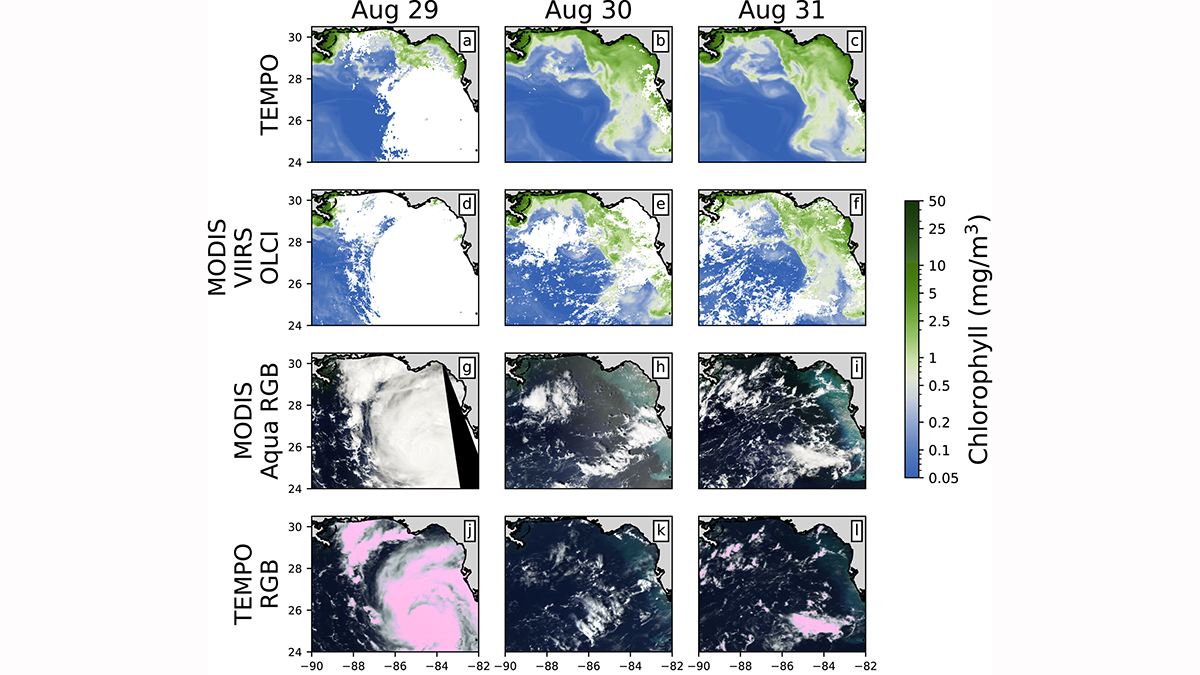
The Tropospheric Emissions: Monitoring of Pollution (TEMPO) geostationary instrument monitors air quality and pollution over North America. Using a new approach, Fasnacht et al. [2025] apply a combination of statistical and machine learning techniques to TEMPO hyperspectral hourly measurements, and obtain OC values across the USA coastal regions and the Great Lakes.
Thus, the authors demonstrate the feasibility of capturing hourly variability of environmental parameters from deep space. This reinforces the scientific value of future dedicated geostationary ocean color missions, such as the Geosynchronous Littoral Imaging and Monitoring Radiometer (GLIMR), and the Geostationary Extended Observations (GeoXO) Ocean Color Instrument (OCX).
Citation: Fasnacht, Z., Joiner, J., Bandel, M., Ibrahim, A., Heidinger, A., Himes, M. D., et al. (2025). Exploiting machine learning to develop ocean color retrievals from the tropospheric emissions: Monitoring of pollution instrument. Earth and Space Science, 12, e2025EA004341. https://doi.org/10.1029/2025EA004341
—Graziella Caprarelli, Editor-in-Chief, Earth and Space Science