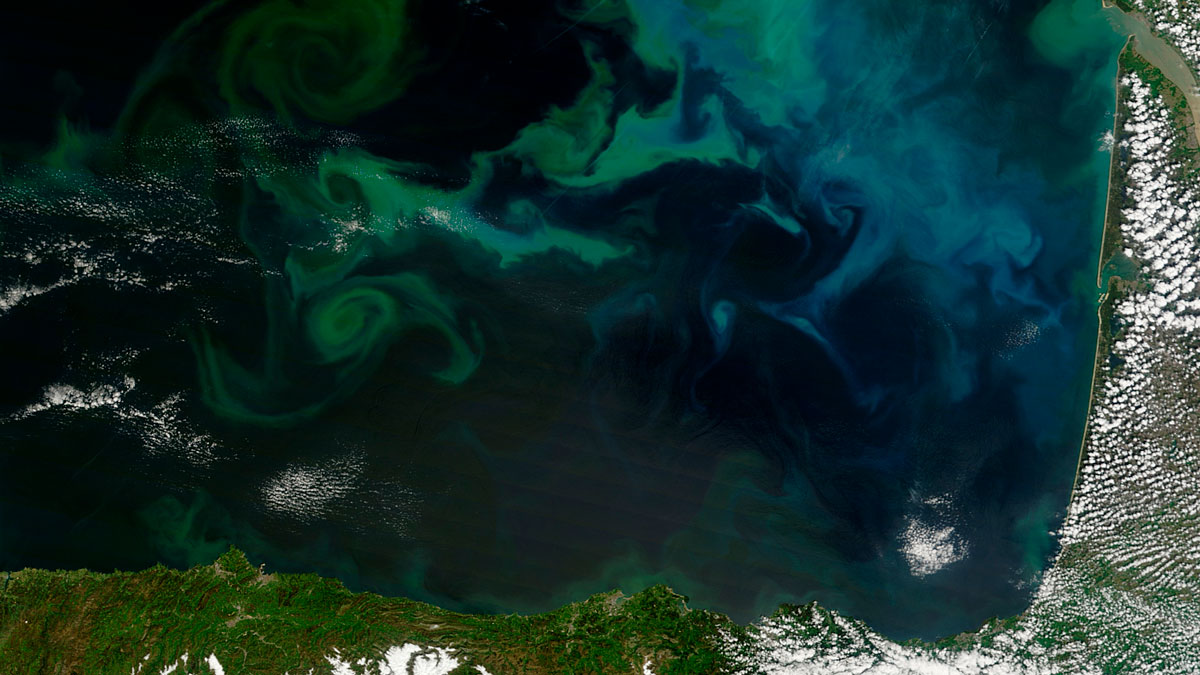
Source: AGU Advances
From coral reefs and kelp forests to the open ocean and deep-sea zones, nutrients that support phytoplankton growth and marine productivity form the foundation of oceanic ecosystems. When levels of key nutrients—such as nitrate and phosphate—get too high or too low, these ecosystems may face major disruption. However, at a global scale, long-term trends in marine nitrate and phosphate levels have been unclear.
Martiny now reports the first globally comprehensive, observation-based evidence that ocean nutrients are undergoing widespread and interconnected changes throughout the water column.
The study incorporates more than 14 million nitrate and phosphate measurements captured around the world between 1925 and 2025. To uncover long-term trends in the data and to determine whether the detected trends were statistically distinct from randomized data, researchers used an autoencoder. This type of unsupervised neural network is often used for handling large amounts of noisy data.
The analysis revealed that depending on location, nitrate and phosphate levels have changed in different ways depending on their biome, depth, and distance from coastlines. Nitrate and phosphate levels are rising in many coastal areas near population centers, such as in the North Atlantic, most likely because of anthropogenic inputs such as pollution and runoff. In contrast, far from shore, toward the surface in the open ocean, phosphate levels are decreasing significantly, with some areas, such as equatorial waters, also experiencing slight nitrate declines. These nutrient declines could lead to lower marine productivity.
Meanwhile, nitrate levels are increasing in many parts of the deep ocean, suggesting a possible imbalance involving uptake of nitrogen by marine organisms and reduced mixing between deep and shallow seawater.
Rather than analyzing each depth in isolation, the researchers examined how the full vertical structure of nutrient profiles has evolved through time, finding that changes near the surface and at depth form coherent, vertically connected patterns across the water column. These patterns provide clues about biogeochemical mechanisms, such as how biological fixation of nitrogen is influencing nutrient distribution.
Further analysis also suggests that current ocean simulations underestimate how quickly nitrate and phosphate levels are changing in the real world. These findings could thus aid improvement of Earth system models, and they underscore a need for continued monitoring of nutrients throughout the oceans, the author suggests. Meanwhile, if current anthropogenically driven climate change trends continue, the large-scale trends captured in this study may intensify, threatening marine ecosystems worldwide. (AGU Advances, https://doi.org/10.1029/2025AV002080, 2026)
—Sarah Stanley, Science Writer