
Editors’ Highlights are summaries of recent papers by AGU’s journal editors.
Source: Water Resources Research
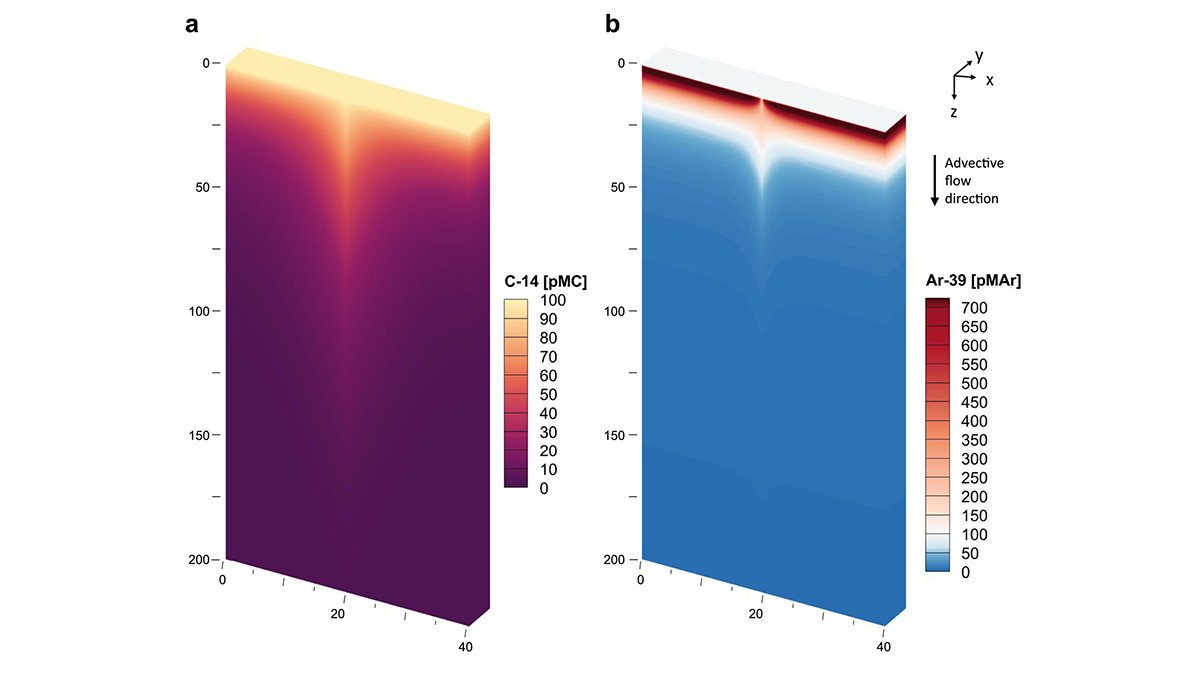
A crucial source of freshwater, groundwater is vulnerable to contamination and overuse. Knowing how long groundwater has been under ground is critical for sustainable management of this resource. The Carbon-14 (14C) and Argon-39 (39Ar) isotopes are environmental tracers especially suited for dating groundwater aged between 50 and 30,000 years. However, ages obtained from previous analyses of these two tracers disagreed with each other.
Musy et al. [2025] use a quantitative framework to understand the effect of groundwater flow within the Earth’s subsurface on the age calculated from 14C and 39Ar measured in aquifers in Denmark. Reactions that affect 14C, the production of 39Ar in the subsurface, and the existence of slow and fast paths for groundwater flow, such as in fractured aquifers, explain the differences observed between age estimates. Accounting for these processes leads to more accurate estimate of groundwater residence times and supports better water resource management.
Citation: Musy, S. L., Hinsby, K., Wachs, D., Sültenfuss, J., Troldborg, L., Aeschbach, W., et al. (2025). Bridging the 39Ar–14C groundwater dating gap: A dual-permeability transport perspective based on numerical modeling and field data. Water Resources Research, 61, e2025WR040370. https://doi.org/10.1029/2025WR040370
—Sergi Molins, Associate Editor, Water Resources Research