
Editors’ Highlights are summaries of recent papers by AGU’s journal editors.
Source: AGU Advances
The mid-latitude atmospheric circulation features an interplay between high-frequency variability, such as propagating synoptic systems and low-frequency variability, including slowly-varying weather regimes. Understanding the interaction between these timescales is essential for linking short-term weather dynamics with the long-term mean climate. Central to this interaction is the process of Rossby Wave Breaking (RWB), namely, the final, irreversible stage of large-scale, upper-atmosphere wave lifecycles, where meandering jet-stream flows (Rossby waves) overturn and break.
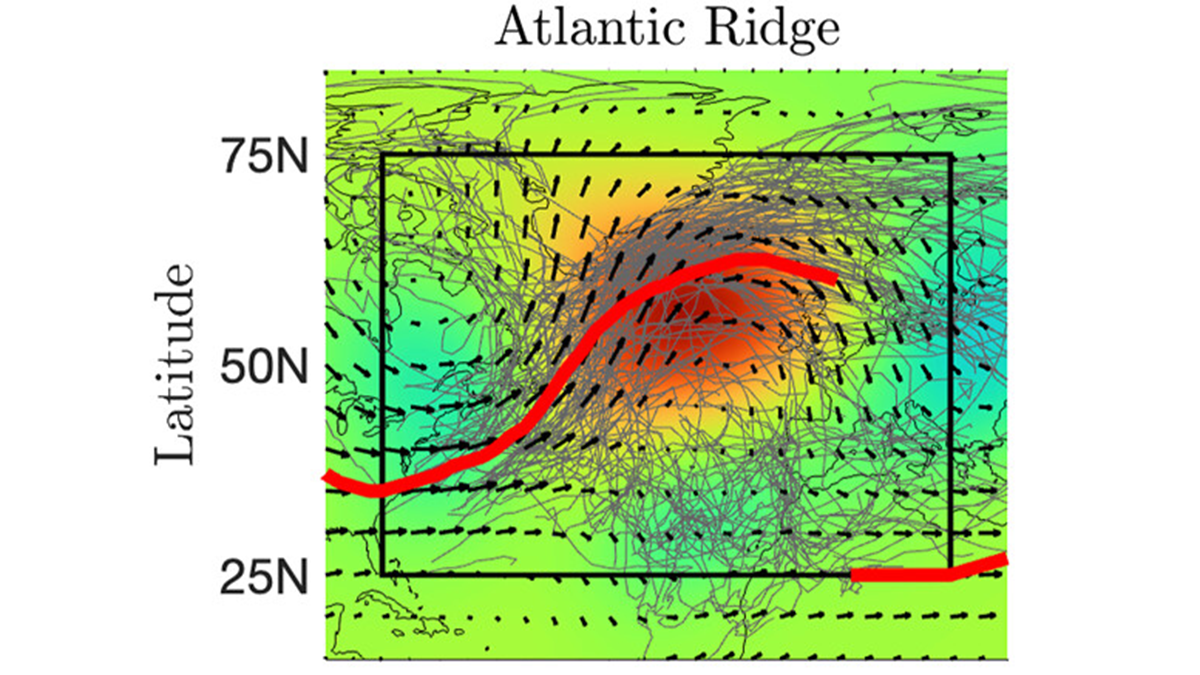
In Tamarin-Brodsky et al. [2026], 35 years of reanalysis data support the investigation of connections between fast and slow parts of the atmospheric circulations. A simplified wave breaking equation is derived, offering a dynamical explanation for the distribution of RWB events and how they are connected to weather regimes.
Citation: Tamarin-Brodsky, T., Harnik, N., & Falkena, S. K. J. (2026). On storm tracks, weather regimes, and a wave breaking recipe. AGU Advances, 7, e2025AV002049. https://doi.org/10.1029/2025AV002049
—Alberto Montanari, Editor-in-Chief, AGU Advances