
Editors’ Highlights are summaries of recent papers by AGU’s journal editors.
Source: AGU Advances
The critical zone (CZ) refers to the layer of Earth extending from the bedrock up to the vegetation canopy, including interconnected systems such as river and floodplain corridors, the active soil and root zone, and the near-surface environment where plants interact with the atmosphere. The conservation of the CZ requires a detailed understanding of how it evolves under anthropogenic impacts, such as intensive agriculture.
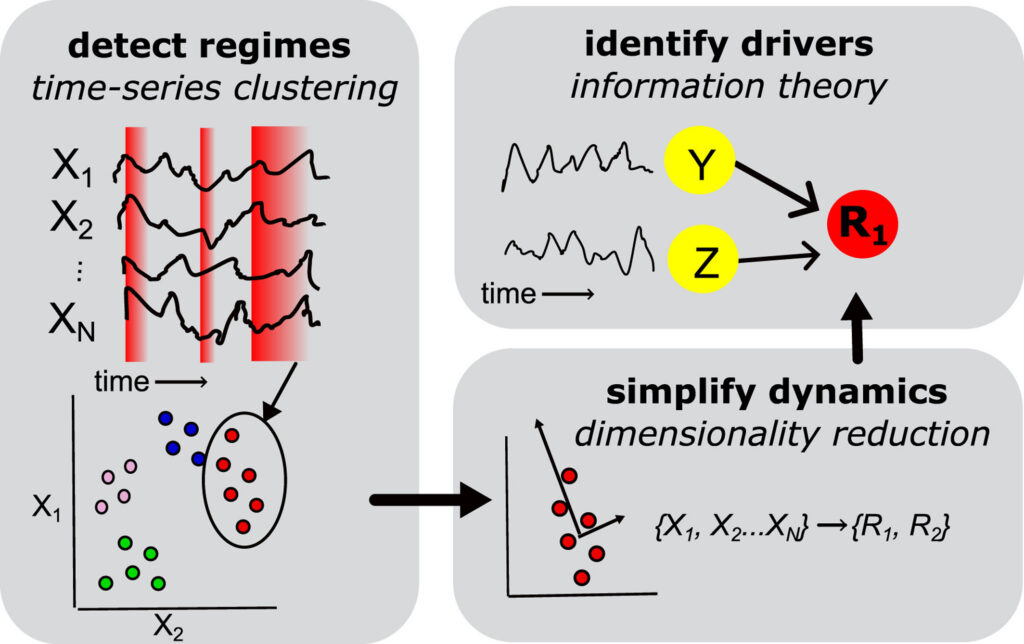
Goodwell et al. [2026] use a data driven approach to relate shifts in the critical zone to indicators of human impact. Their findings deliver innovative knowledge on transitions, drivers, and predictability in many contexts, and support better prediction and management of the critical zone under environmental change.
In particular, the authors find evidence of abrupt shifts in the variability of key features like stream and soil chemistry, land-atmosphere interaction and so forth, which can be attributed to intensive management, for instance due to mechanized planting and harvesting. These human-impacted and naturally appearing regimes in the dynamics of critical zone have implications for understanding processes and making predictions of the status of the critical zone under environmental change.
Citation: Goodwell, A. E., Saccardi, B., Dere, A., Druhan, J., Wang, J., Welp, L. R., et al. (2026). Detecting regimes of critical zone processes, drivers and predictability with a data-driven framework. AGU Advances, 7, e2025AV002098. https://doi.org/10.1029/2025AV002098
—Alberto Montanari, Editor-in-Chief, AGU Advances
