
Editors’ Highlights are summaries of recent papers by AGU’s journal editors.
Source: Journal of Geophysical Research: Solid Earth
The Geomagnetic Polarity Time Scale (GPTS), the sequence of normal and reverse polarity chrons with absolute ages assigned to them, is a foremost means to date geological and biological processes and assess their rates of chance. Evidently for correct conclusions, the GPTS must be as precise and accurate as possible. Recent GPTS versions rely heavily on astrochronologically derived chron durations with radioisotopic ages and ocean floor magnetic anomalies having a secondary role only.
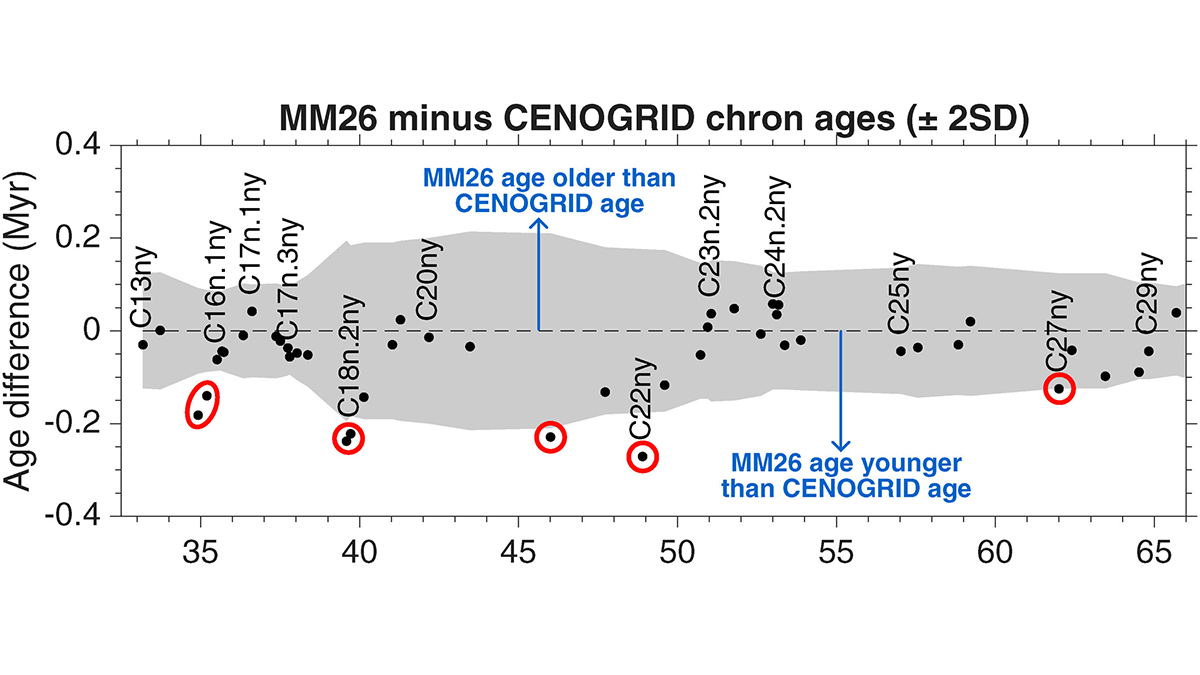
Here, starting from a Bayesian formulation, Malinverno and Meyers [2026] construct a refined time scale for the age range between 33 and 83 million years ago by integrating these three approaches while keeping them on the same level, under the premise of minimizing rate changes in sea floor spreading. Time scale uncertainties are now quantified by a Monte Carlo approach—an important asset. The study is a template for time scale construction and indicates ways to further refine this time scale. Also, it inherently illustrates that high-resolution time scales with astrochronologically derived durations can be faithful for periods for which no marine magnetic anomalies do exist (i.e. most of the geological record), given the relatively modest differences between the new time scale and CENOGRID.
Citation: Malinverno, A., & Meyers, S. R. (2026). A Late Cretaceous-Eocene Geomagnetic Polarity Time Scale (MM26) that combines marine magnetic anomaly records, radioisotopic dates, and astrochronology. Journal of Geophysical Research: Solid Earth, 131, e2025JB033130. https://doi.org/10.1029/2025JB033130
—Mark Dekkers, Editor, JGR: Solid Earth